What Are Some Hidden Gems In Palermo?
The quiet corners, local friggitorie and little-known dishes that most visitors to Palermo never find, plus the gems just outside the city.
What Are Some Hidden Gems In Palermo?
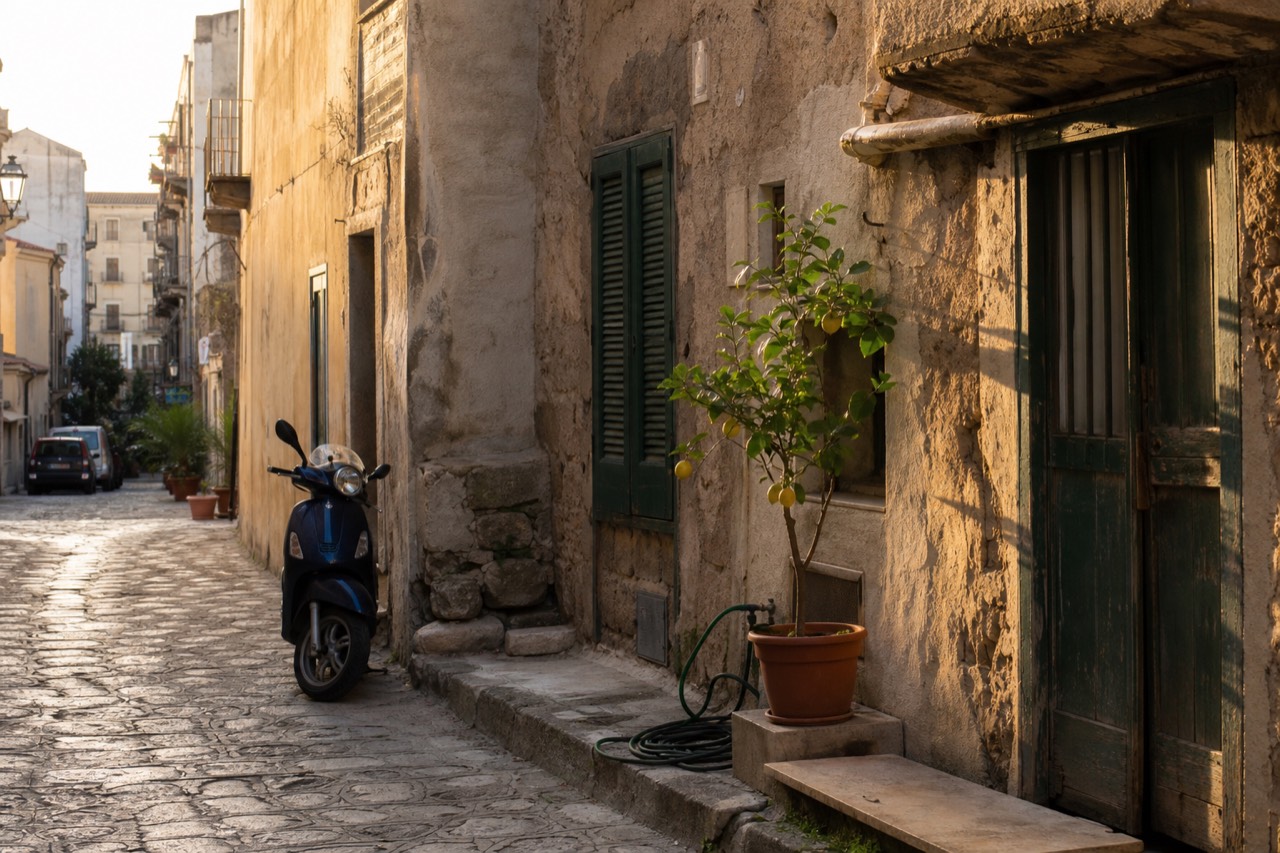
The honest ones are the places Palermo's own residents still queue at: the friggitorie and trattorias away from the market stalls, the Steri palace where Guttuso's three-by-three-metre market painting hangs, the Ciaculli mandarin groves on the city edge, and a handful of 2026 openings the guidebooks have not reached yet. None of these require a ticket broker or a car. Almost all of them sit inside the historic centre's limited-traffic zone, which means they are reached on foot, the way the city itself is built to be read.
The word "hidden" does a lot of dishonest work in travel writing. A lot of what gets sold as a secret in Palermo is simply the Ballarò market with better photography. This page takes a narrower view: a hidden gem here is a place that locals still use for themselves, a dish that appears on Sicily's official traditional-product list but rarely on a visitor's plate, or a corner of the city whose fame has not yet caught up with what is actually in it. That standard cuts the list down considerably, and it is a better list for it.
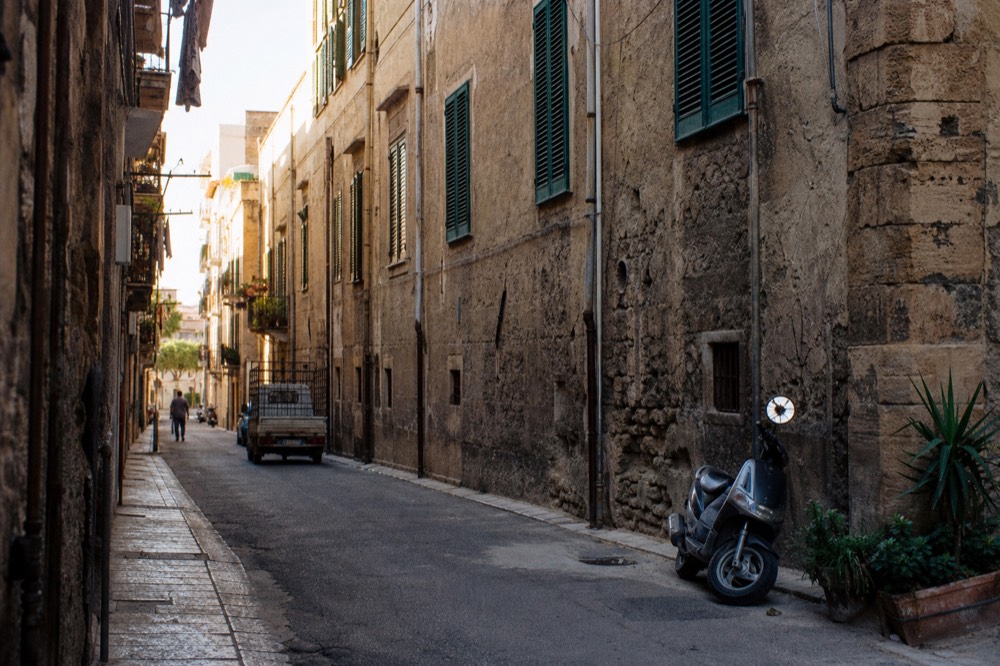
Some of what follows is genuinely obscure. Some of it is well known to Palermitans and simply unmarked in English. One or two spots have been written about in passing for a century, like the Steri's painting, and are still missed by most people who walk past the building every day of their trip.
If you want a shortcut to the hidden side rather than a self-guided hunt, a small-group walk with a local guide is the most efficient version of it, and the evening departures reach corners the daytime crowds never see.
Where Do Locals Actually Eat Away From The Markets?
Away from the market stalls, Palermo's everyday eating happens at a handful of friggitorie and trattorias that rarely appear in English-language guides: nni Franco u Vastiddaru for panelle, I Cuochini near the Capo, Bar Vabres for arancine, and family-run trattorias like Osteria Nonna Dora in the historic centre. None of these trade on a view or a story. They trade on the food, and the queue outside the counter is usually the only marketing they have ever needed.
The reason this counts as a hidden-gem category at all is a genuine shift in the markets themselves. Recent visitor reports describe disappointment at Ballarò, with one traveller describing pre-made arancini reheated in a microwave at more than one stall. The replies from locals in that same thread are the most useful hidden-gem list in Palermo, and it is worth repeating where they send people: Passami u Coppu, Donna Franca, Sfrigola, nni Franco u Vastiddaru, Basile, I Cuochini and Bar Vabres. A separate thread of Palermo residents answering a "where do you really eat, no traps" question names Trattoria Al Vecchio Club Rosanero, Trattoria Pisci e Trema da Pino, Trattoria Bersagliere and Osteria Nonna Dora. The pattern is consistent. Locals have largely moved their eating off the market streets and onto the surrounding blocks.
| Spot | What to order | Why it stays quiet |
|---|---|---|
| nni Franco u Vastiddaru | Panelle and crocchè in a sesame bun | Old-school friggitoria, no English signage, local trade |
| I Cuochini | Fried snacks near the Capo | Tiny counter, steps off the market route most tours take |
| Bar Vabres | Arancine and pastries | Recommended by name in local replies to disappointed visitors |
| Basile, Focacceria del Massimo | Cheap standing lunch | Working focacceria near the theatre, not on the market circuit |
| Osteria Nonna Dora | Typical Sicilian sit-down plates | Praised in resident threads for price and portion |
| Trattoria Al Vecchio Club Rosanero | Daily specials | A locals' answer to "where do you really eat" |
| I Segreti del Chiostro | Cannoli filled to order | Runs from the Santa Caterina convent, easy to walk past |
| Bissot Bistro | Baccalà | Named in recent traveller reports as a highlight |
Prices on this circuit remain honest by big-city standards. Local press reported in 2026 that an arancina or a panelle panino in the centro storico runs 3 to 4.50 euros, roughly double the 2021 level but still the cheapest full snack in the city, and that pizza with a drink averages 14.56 euros. The same reporting notes those rises were the sharpest in Italy over five years, which residents feel and visitors mostly do not.
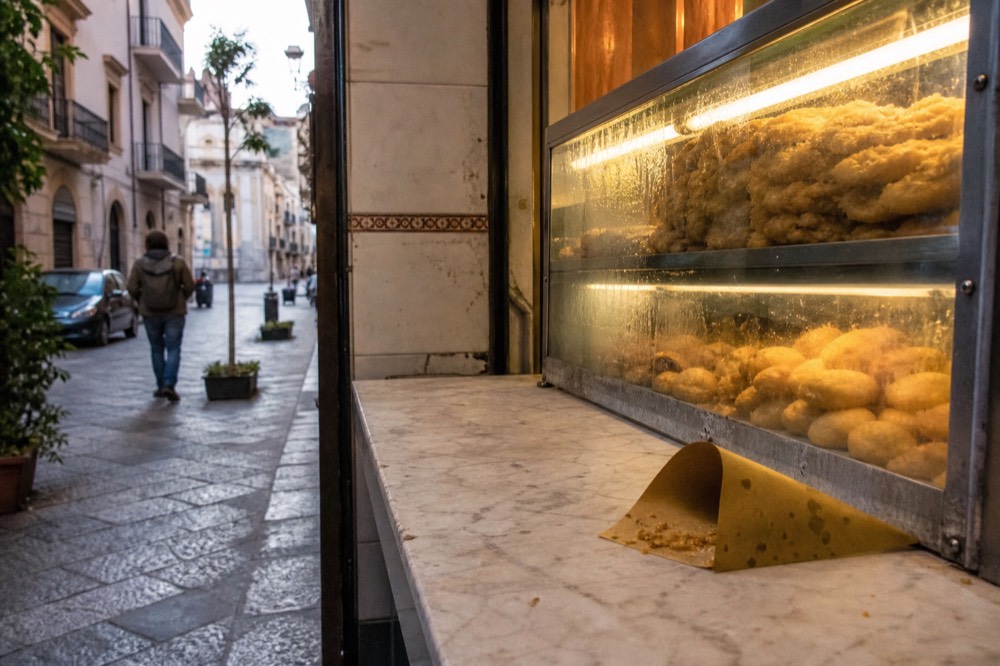
There is a fuller treatment of this whole question in the guide to where locals actually eat in Palermo, which goes street by street. The short version is this: if a place has a host outside and a menu in four languages, it is somebody's business model. If it has a queue and a number dispenser, it is somebody's lunch.
What Does Palermo Look Like After Dark?
After dark the centre changes character: the Vucciria turns into a nightlife square, the city's movida rules now limit takeaway alcohol sales between 01:00 and 07:00, and a three-hour night street food walk with a local guide is the easiest way to see the evening city safely and well fed. Night is when Palermo stops performing for visitors and starts performing for itself, and the two overlap less than you would expect.
The Vucciria is the clearest example. Its daytime food market has contracted, a shift documented in local reporting and in academic work on the quarter, while its evenings have intensified into bars and late tables. The city has responded with rules rather than resistance: an ordinance signed in July 2026 restricts takeaway alcohol sales in the movida zones between 01:00 and 07:00 and requires neighbourhood food shops in parts of via Maqueda to close by 22:00. A pedestrian-area ordinance covering piazza Caracciolo and the surrounding lanes runs to 31 December 2026. What that means for a visitor is simple. The Vucciria at night is walkable, loud and best entered with a plan.
The night-food angle is where a guide genuinely earns its cost, because the evening city is harder to read than the morning one. The Small-Group Night Street Food Tour of Palermo, run by Streaty Food Tours, is rated 4.9 across 580 reviews, runs three hours from $69.8 per person, and caps departures at 12 spots. One thing to know before booking: it is non-refundable, as are the operator's other products, so it belongs late in your planning rather than early.
If you would rather build the evening yourself, the same money buys a lot of standing food. Recent traveller reports single out SPINA bar for a limoncello spritz, Dal Barone for cheese, hams and natural wine at a fair price, and Fonderia, a new taverna with a grill and a listening bar that opened near piazza Fonderia in early 2026, as the kind of place that is still mostly locals. Resident threads advise treating the area around the station and some lanes off the markets with ordinary big-city caution after dark, and picking streets closer to Teatro Massimo or Politeama for a late walk home.
Which Dishes Do Most Visitors Never Try?
Beyond arancine and cannoli, Sicily's official traditional-product list carries items most visitors never meet: the iris, a round piece of sweet fried dough filled with ricotta cream whose registered territory is Palermo itself, stigghiola, and snails, listed as vaccareddi. Panelle, meanwhile, is the one canon item whose official production territory is the city of Palermo, a detail recorded on the regional technical sheet, which even fixes the batter's spread at half a centimetre before cutting and frying.
The iris is the best-kept secret of the lot, because it sits in every rosticceria case in the city and almost nobody visiting knows its name. The official description is a round piece of Palermitan rosticceria made of sweet fried dough filled with ricotta cream, with the filling inserted through a cut in the base. It costs pocket change and it is a Palermo item in the strict sense: the registered production territory is the city itself, not the island.
Stigghiola is the one to approach with open eyes. The regional sheet describes the traditional version as lamb intestine laid along pork caul fat with onion, and it is grilled rather than fried. The sheet itself notes that the product is very probably a legacy of past Jewish culinary culture, phrased as a hypothesis by the official source, and that it may not be consumed more than 72 hours after production. Snails, listed as vaccareddi, are the other quietly traditional bite, appearing on the official list under fish and mollusc preparations.
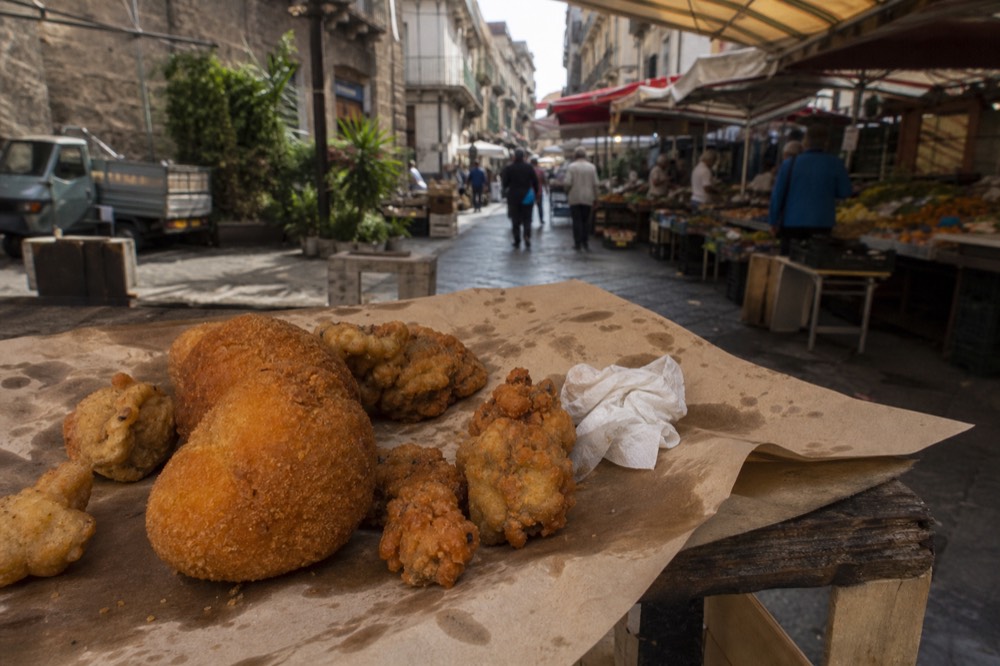
Two calendar dates turn these dishes into events. On 13 December, Santa Lucia, Palermo marks what local press calls Arancina Day, with the city eating arancine al burro and alla carne in volume. And if you want the full canon explained while you eat it rather than decoded afterwards, the all-inclusive market walk covers the classic circuit with a guide who can tell an iris from an arancina at a glance; it is rated 4.9 across 2,308 reviews, runs three hours from $81.64 per person, and holds 12 spots per departure, with the same non-refundable policy noted earlier.
The Capo remains the best market for this scavenger hunt, and the city's own tourism portal documents its street-food roster, from sfincione to pane con le panelle, alongside the quarter's history as the old Seralcadio. The fuller background is in the Capo market guide, including why the butchers there historically hung meat outside the shops.
Which Quiet Corners Does The City Keep To Itself?
The quietest genuine gems are cultural: Guttuso's three-by-three-metre painting La Vucciria hangs inside the Steri, a short walk from the market it depicts, the Orto Botanico keeps a walled garden of citrus and palms, and Palazzo Butera opens Tuesday to Sunday on the seafront. None of these are unknown. All of them are under-visited relative to what they hold, which is the honest definition of the category.
The painting is the single best fact on this page. Renato Guttuso painted La Vucciria between 1 October and 6 November 1974, working from real market produce flown up from Palermo to his studio in the north, on a canvas three metres by three metres. He decided himself that it should hang at the University of Palermo's Steri complex, and it is there now, part of the university's Quadreria Mediterranea collection, according to the university's own museum records. Most Vucciria commentary never mentions that the market's most famous image is indoors, ten minutes away, free of the crowds.
| Corner | What it holds | Practical notes |
|---|---|---|
| The Steri, University of Palermo | Guttuso's La Vucciria, 3 x 3 m, painted in 1974 | Check university opening arrangements before going |
| Orto Botanico | Walled botanical garden, citrus and historic greenhouses | Seasonal hours published on the official site, closed 1 Jan and 25 Dec |
| Palazzo Butera | Seafront palazzo museum | Closed Mondays, winter schedule published on its site |
| RISO | Modern and contemporary art museum | Full ticket 12 euros including the exhibition supplement |
| Museo Archeologico Salinas | Regional archaeology | Full admission 8 euros |
| Cappella Palatina | Norman mosaics | Closed Tuesdays and Wednesdays for parliament sessions; restoration under way with entry assured from the main door |
The Orto Botanico deserves its own sentence: it is a working university research garden, a couple of blocks from the western edge of the centre, and its seasonal hours are published by the university itself on its official hours page. In the November to February schedule it opens mornings to late afternoon on weekdays. It is the calmest green space within walking distance of the markets, and it costs very little.
The Cappella Palatina comes with an honest caveat worth knowing before you queue: its mosaics have been under restoration since January 2025, with the right nave still under scaffolding, though the left nave and presbytery are complete and entry from the main door is assured. The chapel also closes on Tuesdays and Wednesdays when the Sicilian parliament sits in the adjoining palace. Plan around both facts and it remains one of the finest interiors in Italy.
When Should You Visit To Have Them To Yourself?
May, June and September are the statistical sweet spots: WMO normals give Palermo a 23.3 C average high in May with 4.1 rain days, 27.2 C in June with 1.9, and 27.5 C in September with 5.4, against July's near-rainless Festino crowds and December's 123.7 mm of rain. The climate record and the festival calendar point the same way, which is convenient, because the two rarely agree.
July is the complicated month. It is the driest, at 6.7 mm and 1.2 rain days on average, but the Festino di Santa Rosalia takes over the centre on 14 and 15 July, with the procession route running through Corso Vittorio Emanuele, the Quattro Canti and piazza Marina, the exact ground a market walk covers. The 2026 edition was the 402nd. If you are in the city those two nights, the Festino is not a hidden gem, it is the main event, and everything else empties out around it.
| When | What is happening | Why it matters for hidden gems |
|---|---|---|
| May | 23.3 C average high, 4.1 rain days | Warm, dry, before the summer peak |
| June | 27.2 C average high, 1.9 rain days | Long evenings, light until after 20:00 |
| 14-15 July | Festino processions through the centre | The centre is given over to the festival, not quiet exploring |
| September | 27.5 C average high, 5.4 rain days | Sea warm, crowds thinning after August |
| November | Sfincione Fest in Bagheria, 20-23 November 2026 | A food festival most visitors never schedule around |
| 13 December | Arancina Day, Santa Lucia | The city's own food holiday, cold-quiet streets |
Midwinter has a case that almost nobody makes. A mid-January day in Palermo has under ten hours of daylight, with the light gone before 17:15, which effectively makes a morning market the whole day's outdoor activity. But the Ciaculli mandarin harvest runs January to March, the Arancina Day crowds are Palermitan rather than tour-borne, and the WMO normals give January a 14.7 C average high. It is a walking city at 14.7 C in a way it is not at 30.5.
What Hidden Gems Sit Just Outside The City?
The best gems outside the centre are the Ciaculli mandarin groves, a Slow Food Presidium covering around 80 hectares on the city's edge and harvested January to March, Bagheria with its Michelin-starred I Pupi and November's Sfincione Fest, and Piana degli Albanesi, the hill town locals rate for cannoli. All three are reachable without a tour, though two of them reward a car or a determined bus schedule.
The Ciaculli late mandarin is the most quietly remarkable food story in the province. In the 1940s, in Ciaculli on the edge of Palermo, a spontaneous mutation of the Avana mandarin produced a late-season variety with very few seeds, sweet juicy pulp and thin skin, harvested from January to March. The Slow Food Presidium that protects it covers around 80 hectares of growers, and the foundation records that the Conca d'Oro plain around Palermo, until 60 years ago one big garden, has lost 80% of its cultivated land. Eating a Ciaculli mandarin in February is tasting the last of that plain.
Bagheria, a short trip east, holds two cards. One is I Pupi, the Michelin-starred restaurant of chef Tony Lo Coco, which relocated within the town in 2025 and remains starred. The other is Sfincione Fest, whose ninth edition runs 20 to 23 November 2026 along Corso Umberto I, with tastings and competitions. The comune's own announcement describes the white sfincione as Bagheria's symbol product, alongside the red version of Sicilian tradition. A slice costs between 1.50 and 3 euros at street level.
Piana degli Albanesi, up in the hills behind Monreale, is the cannoli answer that Palermo residents give when asked directly. Recent discussion threads are unambiguous about it: the best cannoli come from Piana degli Albanesi, and the shell should be filled to order. The town also hosts a cannolo festival each spring. This is the one gem on the list where the journey is part of the point.
How Do You String Them Into One Day?
A workable hidden-gem day starts at a morning market that is not Ballarò, moves through the Steri and the Orto Botanico while the midday heat peaks, eats standing at a friggitoria in the late afternoon, and finishes with a guided night walk, since the ZTL makes the historic centre a place you experience on foot anyway. The limited-traffic zone is the invisible hand behind the whole itinerary: it is active on weekdays during the day and at night at weekends, so a hire car is a liability in the centre and every gem on this page is a walking gem.
Morning is the markets' honest hours. Ballarò's official trading time runs Monday to Saturday from 07:30 to 20:00, with Sunday mornings only, but the produce is at its best early, and the Capo is the better browse for street food. Midday belongs indoors: the Steri for the Guttuso, the Salinas for 8 euros, or the Orto Botanico if the clouds are kind. Late afternoon is friggitoria time, when the fried food turns over fastest. Evening is either the Vucciria under your own steam or a guided night walk, and the guided version solves the one problem the Vucciria poses, which is knowing which doorway to walk through.
For anyone who wants the same territory covered with a local at the front, the Palermo Food Tours roster is organised around exactly these neighbourhoods, and the evening formats reach the quarters this page describes after the daytime crowds have gone home. The all-inclusive food and wine option, rated 5.0 across 125 reviews at 4 hours from $117.13 per person, is the deepest single evening on the list, again with the non-refundable caveat and 12 spots per departure.
The short answers: the friggitorie and trattorias locals queue at, Guttuso's La Vucciria inside the Steri, the Orto Botanico, the Ciaculli mandarin groves, and dishes like the iris and stigghiola from Sicily's official traditional-product list. Visit in May, June or September for the best mix of weather and quiet, and go in the evening to see the Vucciria as it actually works now rather than as postcards show it.
Common Questions About Hidden Gems In Palermo
What Are Some Hidden Gems In Palermo?
The friggitorie and trattorias locals actually queue at, such as nni Franco u Vastiddaru and I Cuochini; Guttuso's three-by-three-metre painting La Vucciria inside the Steri; the Orto Botanico; the Ciaculli mandarin groves at the city edge; and dishes like the iris and stigghiola that appear on Sicily's official traditional-product list but rarely on visitor itineraries.
What does Palermo look like after dark?
The Vucciria becomes a nightlife square rather than a food market, bars fill the lanes around piazza Caracciolo, and the city's movida rules limit takeaway alcohol sales between 01:00 and 07:00. A guided night street food walk is the easiest way to see it safely.
Which dishes do most visitors never try?
The iris, a sweet fried dough filled with ricotta cream whose registered territory is Palermo itself; stigghiola, grilled lamb intestine with caul fat; and snails, listed as vaccareddi on the regional traditional-product list.
When should I visit Palermo to avoid crowds?
May, June and September, per WMO climate normals: warm and comparatively dry without the July Festino crowds. Midwinter is the quietest of all, with January's 14.7 C average high and the Ciaculli mandarin harvest running January to March.
Is the Vucciria still worth visiting?
Yes, but for what it is now rather than what postcards show. Its daytime food market has contracted while its nightlife has grown, and the painting that made it famous hangs indoors at the Steri nearby. Go in the evening, or see the Guttuso first and recalibrate.