What Are The Most Popular Italian Sandwiches? A Palermo Guide
Discover Italy's most beloved sandwiches from panelle and pane ca meusa to piadina and tramezzini, plus where to taste them in Palermo.
Italy’s sandwich tradition is as varied as its regions. In Palermo, a sandwich is not a quick bite: it is a cultural marker, a street-food ritual that turns humble ingredients into something worth crossing the city for. From the chickpea fritters of the panelle panino to the slow-roasted pork of a central Italian porchetta roll, the most popular Italian sandwiches tell a story of geography, history and what each region had to work with.
What Are The Most Popular Italian Sandwiches?
The most popular Italian sandwiches include the crispy panelle e crocche panino from Palermo, the rich pane ca meusa (spleen sandwich) also from Palermo, the classic piadina from Emilia-Romagna, the delicate tramezzino found in bars across Italy, and the hearty porchetta panino from central Italy. Each reflects regional ingredients and centuries of tradition. Many are best experienced on a food tour through Palermo’s historic markets, where they are still made the old way.
To understand why these five sandwiches dominate the conversation, it helps to look at what makes an Italian sandwich different from its counterparts elsewhere. Bread is always central, but it is never an afterthought. The bread itself is regional: a sesame-dusted roll in Palermo, a thin unleavened flatbread in Romagna, or a crusty ciabatta in Tuscany. The filling is the star, but it rarely exceeds two or three ingredients. The result is something that tastes like the place it comes from.
Panelle e crocche panino: Palermo’s signature sandwich
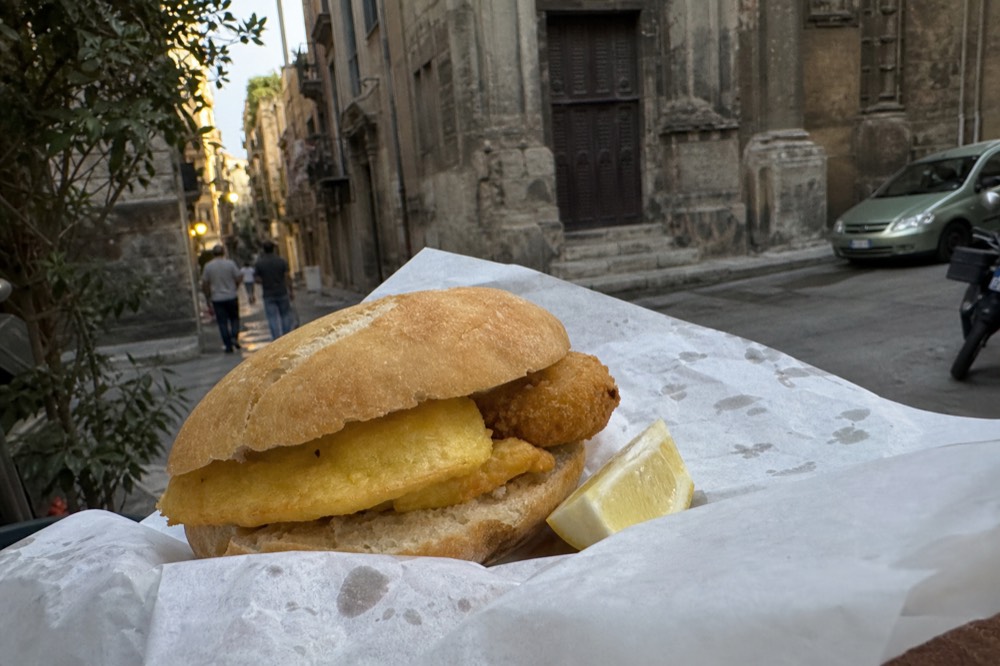
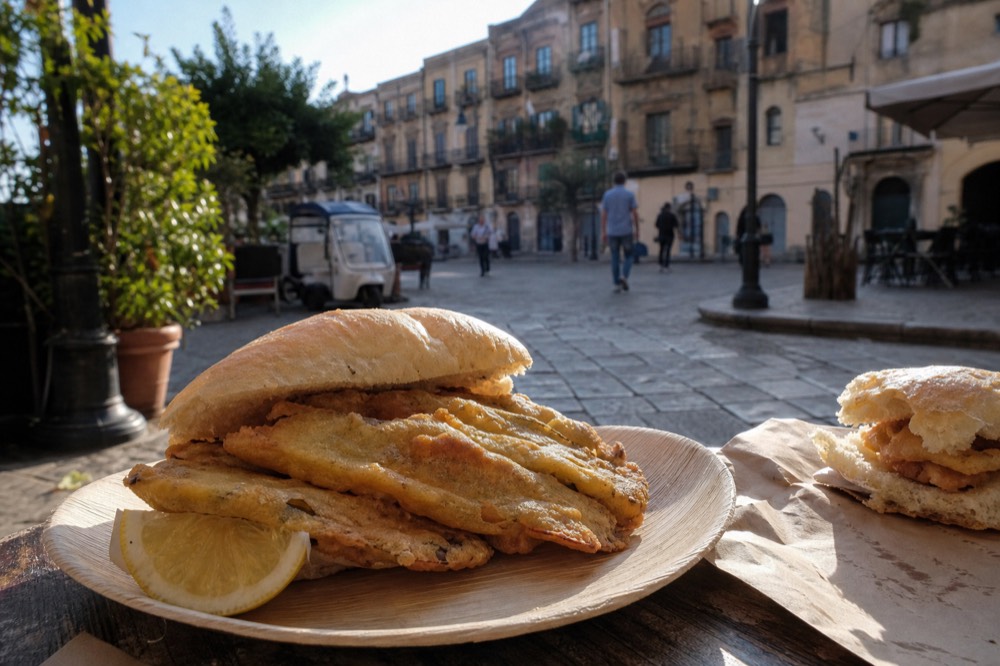
In Palermo, the most iconic sandwich is the panelle e crocche panino. Panelle are thin, rectangular fritters made from chickpea flour, water, salt and pepper, fried in olive oil until golden. Crocche are potato croquettes, mashed with parsley and sometimes mint, then deep-fried. Both are stuffed into a soft sesame roll, often with a squeeze of lemon and a dusting of black pepper.
The panella itself has official recognition. It is listed on Italy’s national register of traditional agri-food products (PAT), with a production territory that is specifically the city of Palermo and parts of its province. The official technical sheet even fixes the thickness at half a centimetre. That kind of precision is rare in street food, and it tells you how seriously Palermo takes its chickpea fritters.
You will find panelle e crocche at friggitorie throughout the city’s historic markets, especially at Ballarò, Capo and the Vucciria. The vendors fry them to order and assemble the sandwich in front of you. The combination of the hot, crisp fritters with the soft bread and the sharp lemon is one of the most satisfying things you can eat for a few euros.
Pane ca meusa: the spleen sandwich
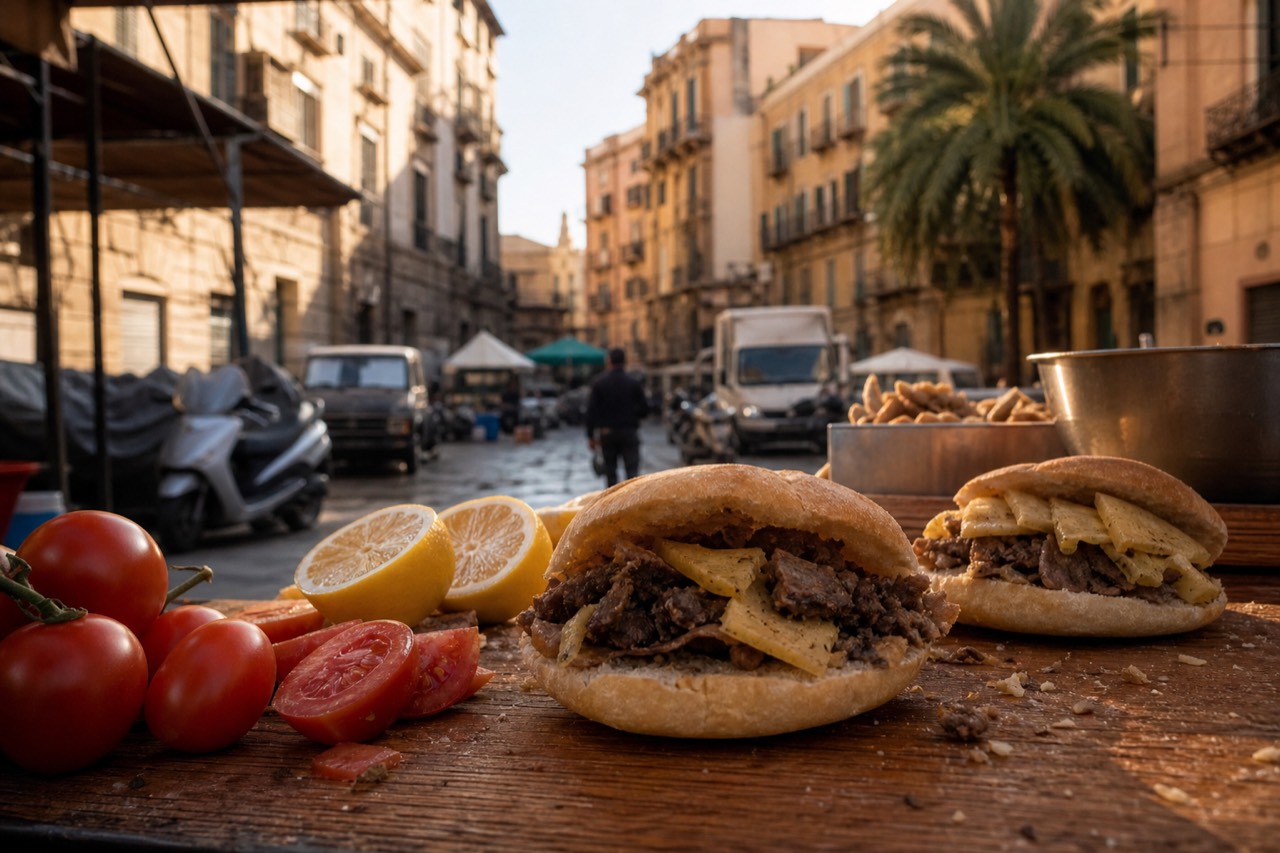
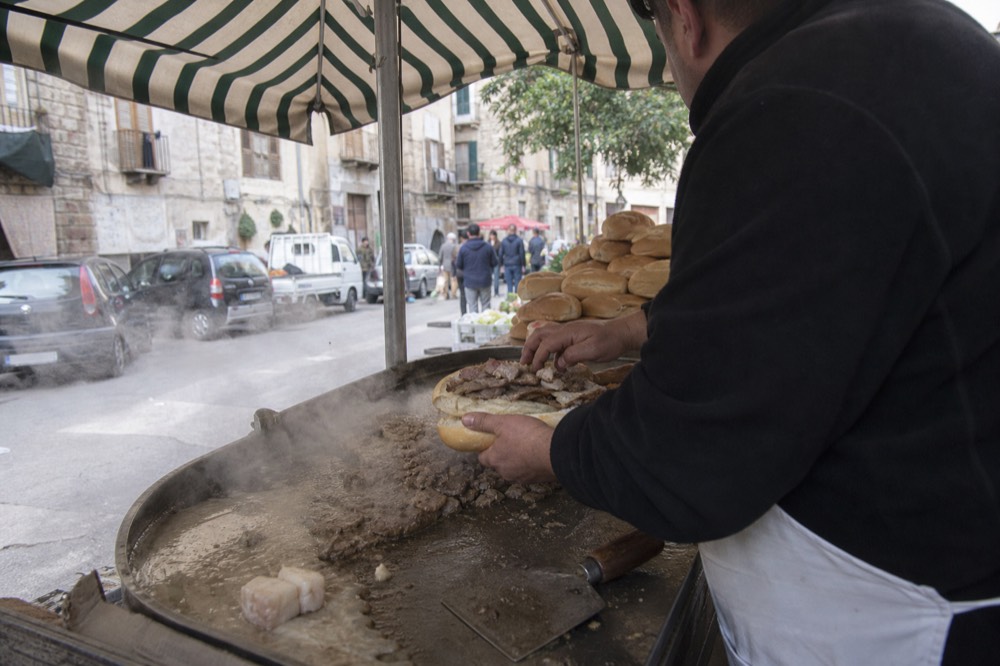
Pane ca meusa is Palermo’s other world-famous sandwich, and it is not for the faint-hearted. It consists of veal spleen and lung, boiled and then fried in lard, served on a soft sesame roll. The sandwich is a Palermo classic, served hot from the pan and folded into a round roll. The name means “bread with spleen” in Sicilian, and it has been sold from street carts for generations.
The exact composition of pane ca meusa is not codified in any official register, but the city’s own tourism portal lists it as a staple of the Capo market. Vendors are easy to spot: they work from large metal pots, slicing the offal with a cleaver and piling it onto the roll. The smell is pungent and unmistakable, and for many visitors it is the most memorable sandwich they try in Sicily.
Piadina: the flatbread sandwich from Emilia-Romagna
Outside Sicily, the piadina is one of Italy’s most recognised sandwiches. It comes from Romagna, the eastern part of Emilia-Romagna, and consists of a thin, unleavened flatbread cooked on a hot plate and folded around a filling. The classic version is filled with squacquerone cheese, rocket and prosciutto crudo, but you will also find it with grilled vegetables, sausage or Nutella for a sweet version.
Piadina is a street food that has become a national chain, but the best ones are still made in small kiosks where the dough is rolled and cooked to order. The contrast between the warm, slightly charred bread and the cool, creamy cheese is what makes it work.
Tramezzino: the bar sandwich
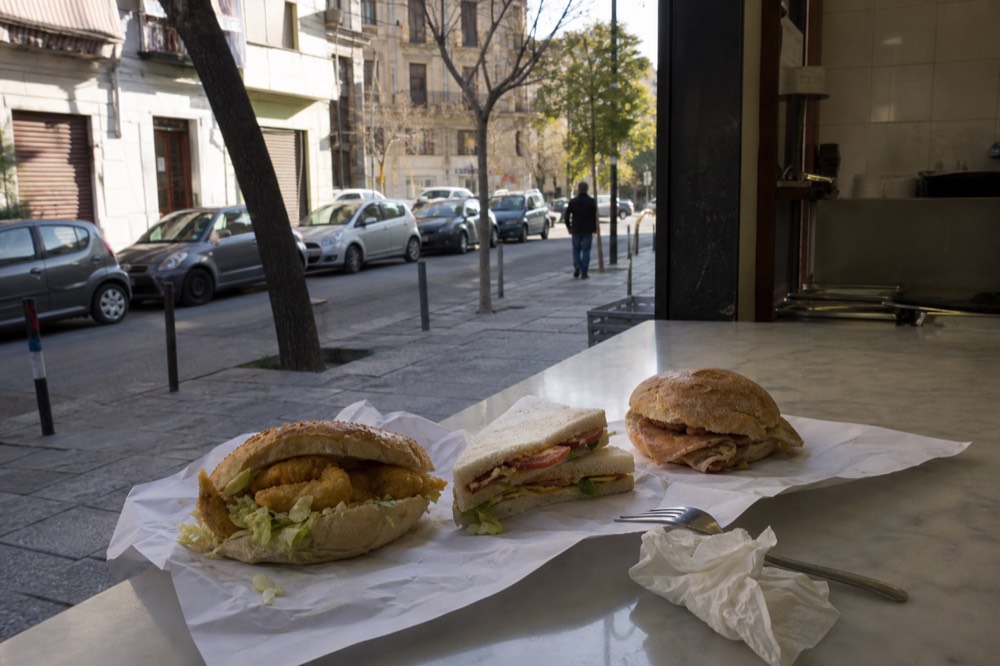
The tramezzino is a soft, crustless white-bread sandwich cut into a triangle, filled with anything from tuna and mayonnaise to artichoke cream or ham and cheese. It was invented in Turin in the 1920s and is now found in bars and cafes all over Italy. It is the sandwich you eat standing at the counter with a coffee, and it is a staple of the Italian breakfast or mid-morning snack.
Tramezzini are often overlooked in favour of more substantial sandwiches, but they are a genuine part of Italy’s sandwich culture. The bread is light and slightly sweet, and the fillings are usually creamy and delicate.
Porchetta panino: central Italy’s roast pork roll
Porchetta is a whole pig, boned, seasoned with rosemary, garlic, fennel and salt, rolled and slow-roasted until the skin is crackling and the meat is juicy. It is sliced and piled onto a crusty roll, sometimes with a spoonful of the cooking juices. It is most associated with Lazio and Umbria, but you will find porchetta vans at markets and festivals all over central Italy.
A good porchetta panino needs nothing else. The meat is the star, and the crisp, salty skin provides the crunch.
| Sandwich | Region | Key ingredients | Typical setting |
|---|---|---|---|
| Panelle e crocche panino | Palermo, Sicily | Chickpea fritters, potato croquettes, sesame roll, lemon | Friggitoria, market stall |
| Pane ca meusa | Palermo, Sicily | Veal spleen and lung, lard, sesame roll, lemon, caciocavallo | Street cart, market |
| Piadina | Emilia-Romagna | Thin flatbread, squacquerone cheese, prosciutto crudo, rocket | Kiosk, fast-casual |
| Tramezzino | Turin (national) | Crustless white bread, tuna, mayonnaise, artichoke cream | Bar, café |
| Porchetta panino | Lazio, Umbria | Roast pork with crackling, rosemary, garlic, crusty roll | Food van, market |
How A Food Tour Turns A Sandwich Into A Story
A guided food tour through Palermo’s markets adds context that transforms a simple sandwich into a cultural experience. Guides explain the history of the ingredients, the techniques behind the frying, and the family stories of the vendors, turning a quick snack into a narrative of the city itself. This is why many visitors book a tour early in their trip.
Eating a panelle e crocche panino from a market stall is one thing. Eating it while a guide explains that the chickpea flour batter is poured onto a dampened board and cut cold into rectangles, that the thickness is fixed by a regional regulation, and that the sesame roll is baked by the same family that has supplied the market for three generations, is something else entirely.
A food tour through Palermo’s markets gives you the context that makes these sandwiches make sense. You see the ingredients at the neighbouring stalls, you hear the abbanniata (the shouted sales cry of the hawkers), and you understand why a sandwich that costs a few euros can be a protected regional product.
For those who want to dive deeper, a Palermo Food Tours experience typically includes stops at several friggitorie and market stalls, so you can compare panelle from different vendors and see how the same recipe varies from one street to the next.
What Other Italian Sandwiches Are Worth Seeking Out?
Beyond the five most popular sandwiches, Italy offers a wealth of regional variations that rarely appear in tourist guides. From Florence’s lampredotto tripe sandwich to Campania’s fried mozzarella in carrozza, these lesser-known options reward adventurous eaters. Each reflects local ingredients and traditions, often with a history as rich as the more famous versions.
- Lampredotto panino (Florence): tripe sandwich served with salsa verde and spicy sauce, a Florentine institution.
- Mozzarella in carrozza (Campania): a fried mozzarella sandwich, essentially a grilled cheese taken to the extreme.
- Pane, burro e acciughe (Piedmont): bread, butter and anchovies, a simple but revelatory combination.
- Muffuletta (Sicilian-American): a New Orleans creation by Sicilian immigrants, layered with cold cuts, cheese and olive salad on a round sesame loaf. It is not Italian in the strict sense, but it is a direct descendant of Palermo’s sesame bread tradition.
Each of these sandwiches has a story, and many of them can be traced back to the same principles that define Palermo’s street food: use what is local, waste nothing, and let the bread do the work.
Where Do Palermo’s Most Famous Sandwiches Come From?
Palermo’s iconic sandwiches are inseparable from its four historic markets: Ballarò, Capo, Vucciria, and Borgo Vecchio. These are the city's four historic working markets, and the street-food trade still happens here, with vendors passing recipes down through generations. Understanding the markets is key to understanding why panelle and pane ca meusa taste the way they do.
The history of Palermo’s street sandwiches is inseparable from the city’s markets. The four historic markets, Ballarò, Capo, Vucciria and Borgo Vecchio, are where Palermo's food trade still happens. The Comune di Palermo's tourism portal calls Ballarò the city's oldest and largest market. The city’s own tourism portal calls it the city’s oldest and largest market, and it is where many of the best panelle and pane ca meusa vendors still operate.
The Capo market, in the ancient Seralcadio quarter, was historically a meat market. The Comune di Palermo attributes the custom of hanging quarters of meat outside the shops to the city’s former Jewish presence, for draining the blood. That tradition is still visible today, and it is part of the context for why pane ca meusa became a Capo speciality.
The Vucciria, once the grandest food market of old Palermo, has largely transformed into a nightlife district, though a few daytime food stalls remain. Its name comes from the French boucherie, butcher’s shop, because it was originally a meat market. Today, the Vucciria is a regulated pedestrian area, established by a municipal ordinance in June 2025 and extended through the end of 2026.
Borgo Vecchio, the youngest of the four, was founded in 1556 after the construction of the new port. It was settled by fishermen and sailors, and it remains a morning market with a distinct neighbourhood feel. For more on the markets and their street food, see our guide to Palermo street food.
Which Sandwich Should You Try First In Palermo?
If you have only one sandwich to try in Palermo, make it a panelle e crocche panino. It is the most accessible and widely available of the city’s street foods, and it captures the essence of Palermo’s frying tradition. For the adventurous, pane ca meusa offers a more intense, offal-forward experience that is uniquely Palermitan.
If you only have one meal in Palermo, make it a panelle e crocche panino. It is the sandwich that best represents the city: simple, fried, and built on ingredients that have been part of the local diet for centuries. It is also the easiest to find, with friggitorie in every market and along the main streets of the historic centre.
If you are feeling adventurous, try pane ca meusa. It is a sandwich that divides opinion, but it is also the most Palermitan thing you can eat. The vendors are friendly and will often offer you a taste before you commit.
The Original Palermo Street Food & Market Tour includes both of these sandwiches, along with arancini, cannoli and other market staples, on a three-hour walk through the city’s oldest food districts. It is the most-reviewed Palermo food tour on the live listing, with a 4.9 rating across 2308 reviews, and it is limited to 12 guests per departure.
How Do Italian Sandwiches Compare To Sandwiches From Other Countries?
Italian sandwiches are defined by restraint: a few high-quality ingredients, bread that is never an afterthought, and a focus on balance rather than excess. This contrasts sharply with the layered, multi-component sandwiches common in the United States or the United Kingdom, where a dozen ingredients might compete for attention. In Italy, the sandwich is a showcase for one or two perfect elements.
Italian sandwiches are defined by restraint. A panelle e crocche panino has three or four components. A porchetta panino has two. A tramezzino might have three. The bread is never an afterthought, and the filling is never piled so high that you cannot taste each ingredient.
This is the opposite of the maximalist sandwich culture found in parts of the United States or the UK, where a Reuben or a club sandwich can have a dozen components. In Italy, the sandwich is a vehicle for one or two perfect things, and the skill is in making those things perfectly.
That philosophy extends to the way sandwiches are eaten. A panelle panino is eaten standing at the counter of a friggitoria, wrapped in paper, with the oil still hot. It is not a sit-down meal. It is a quick, intense experience, and it is meant to be followed by another one a few streets away.
What Role Do Sandwiches Play In Sicilian Food Culture?
In Sicily, sandwiches are not just lunch; they are a morning ritual, an afternoon snack, and a late-night meal. The friggitorie open early to serve panelle and crocche to market traders, and the same stalls feed the evening crowds in the Vucciria. This rhythm is tied to the markets, and the best sandwiches are often sold out by midday.
In Sicily, the sandwich is not a lunchtime convenience. It is a morning ritual, an afternoon snack, and a late-night meal all in one. The friggitoria opens early, because panelle and crocche are breakfast food for many Palermitans. The pane ca meusa cart appears around mid-morning and stays until the bread runs out. The porchetta van arrives at the market on Saturday and is gone by Sunday afternoon.
This rhythm is tied to the markets. The markets open early, and the sandwich vendors are there to feed the traders and the shoppers. By midday, the best sandwiches are often sold out. If you want to eat like a local, you need to be at the market by 10am.
The evening brings a different kind of sandwich culture. In the Vucciria, the night-time crowd eats panelle and crocche between drinks. The same friggitorie that served breakfast now serve a post-midnight crowd. It is a reminder that in Palermo, the sandwich is always available if you know where to look.
The Small-Group Night Street Food Tour of Palermo is an all-inclusive evening walk that visits the Vucciria and other night-time food spots, with a focus on the same sandwiches and street snacks that locals eat after dark. It is rated 4.9 across 580 reviews and is also limited to 12 guests.
Are There Any Sandwiches That Are Uniquely Sicilian?
Panelle e crocche panino and pane ca meusa are the two sandwiches that are almost impossible to find outside Sicily. Even within Italy, they are rarely made beyond Palermo, relying on specific techniques and local supply chains. Other Sicilian sandwiches like sfincione, a thick focaccia, also have deep roots but are less known internationally.
Yes. Panelle e crocche panino and pane ca meusa are the two that are almost impossible to find outside Sicily. Even within Italy, they are rarely made outside Palermo. The chickpea fritters require a specific batter and frying technique, and the spleen sandwich requires a supply chain and a customer base that only exists in the city.
There are other Sicilian sandwiches that are less famous but equally rooted. The sfincione is a thick, spongy focaccia-style bread sold by the slice at Palermo's market stalls, often sold by the slice and sometimes folded like a sandwich. In Bagheria, just outside Palermo, the white sfincione is made without tomato and is the town’s symbolic product, celebrated at an annual festival in November.
The arancina, while not a sandwich, is often eaten alongside panelle and crocche as part of the same street-food circuit. The name itself is a linguistic battleground: Palermo says arancina (feminine), Catania says arancino (masculine), and the Accademia della Crusca has ruled that both are correct. The dish itself is a fried rice ball with a meat ragù or other filling, and it is a staple of every Palermo food tour.
| Sicilian sandwich | Main ingredient | Typical cost (2026) | Where to find it |
|---|---|---|---|
| Panelle e crocche panino | Chickpea fritters, potato croquettes | €2.50–€3.50 | Ballarò, Capo, Vucciria friggitorie |
| Pane ca meusa | Veal spleen and lung | €3–€4.50 | Capo market carts, Via Maqueda |
| Sfincione (folded) | Focaccia with tomato, onion, caciocavallo, anchovies | €1.50–€3 per slice | Bakeries, market stalls |
| Arancina (accompaniment) | Fried rice ball with ragù | €2.50–€4 | Friggitorie, bars |
How To Plan A Sandwich-Focused Trip To Palermo
The best approach is to spend a morning walking through at least two historic markets, starting at Ballarò around 8am when the friggitorie are frying their first batch of panelle. A guided food tour can handle the logistics, ensuring you visit the best stalls at the right times without missing out due to early sell-outs or seasonal closures.
The best way to sample Palermo’s sandwiches is to spend a morning walking through at least two of the historic markets. Start at Ballarò around 8am, when the stalls are fully set up and the friggitorie are frying their first batch of panelle. Walk through the market, try a panelle e crocche panino from one vendor, then head to the Capo market and try a pane ca meusa from a different one.
If you are visiting in summer, be aware that July is the driest month in Palermo, with an average of just 6.7 mm of rain and 1.2 rain days, and the Festino di Santa Rosalia on 14 and 15 July closes large parts of the historic centre for processions. The markets are still open, but the atmosphere is different and some vendors may close early.
For a more structured experience, a guided food tour removes the guesswork. The tours listed on this site visit multiple markets in a single morning or evening, with a guide who can explain the history and the technique behind each sandwich. They also handle the logistics, so you do not have to worry about opening hours or finding the right stall.
Common Questions About Italian Sandwiches
What Are The Most Popular Italian Sandwiches?
The most popular Italian sandwiches are the panelle e crocche panino and pane ca meusa from Palermo, the piadina from Emilia-Romagna, the tramezzino found in bars across Italy, and the porchetta panino from central Italy. Each represents a distinct regional tradition and is best eaten in its place of origin.
Is panelle a sandwich or a fritter?
Panelle are chickpea fritters, but in Palermo they are almost always served inside a sesame roll, making a panelle e crocche panino. The fritters are the filling, and the sandwich is the most common way to eat them on the street.
What is the difference between pane ca meusa and a regular meat sandwich?
Pane ca meusa is made from veal spleen and lung, boiled and fried in lard, and served on a sesame roll with lemon and sometimes cheese. It has a rich, offal-forward flavour that is unlike any other Italian sandwich, and it is a Palermo speciality.
Can you find these sandwiches outside of Palermo?
Panelle e crocche and pane ca meusa are almost impossible to find outside Palermo. Other Italian sandwiches like piadina, tramezzino and porchetta are available in many Italian cities, but the best versions are always in their home regions.
What is the best time of day to eat a Palermo sandwich?
Panelle and crocche are a morning food, best eaten before midday when the fritters are freshest. Pane ca meusa is available from mid-morning until the bread runs out. In the evening, the same friggitorie serve a late-night crowd, especially in the Vucciria.
Are there vegetarian Italian sandwiches?
Yes. Panelle e crocche panino is vegetarian, as are many tramezzini and piadine with cheese and vegetables. Mozzarella in carrozza is also vegetarian. Sicily has a strong tradition of vegetable-based street food, including caponata and sfincione.