Palermo Street Food: A Local’s Guide To Eating From Sunrise To Midnight
Palermo’s street food runs on its own clock. The same stall that sells warm brioche and granita at eight in the morning might be frying panelle by noon and grilling stigghiola at midnight. This guide follows the city’s edible rhythm hour by hour, so you walk up to the counter knowing what to call, what to pay and where to find it.
Short answer
Palermo street food is a full-day, walkable meal made of fried snacks, stuffed breads and sweet ricotta pastries sold at markets, friggitorie and roadside counters. Mornings belong to granita and iris, midday to arancine and panelle, and evenings to sfincione and stigghiola. Most items cost between 1.50 € and 5 €, and the historic markets are the best places to eat.
What Exactly Is Palermo Street Food, And When Should You Eat It?
Palermo street food is not a single meal. It is a full-day, walkable feast that starts before office hours with a granita and a warm brioche, peaks around midday with arancine and panelle at the market, and keeps going past midnight with grilled stigghiola and a slice of sfincione in the Vucciria. Most items cost between 1.50 € and 5 €, and the best versions are still sold at the historic markets, not in restaurants.
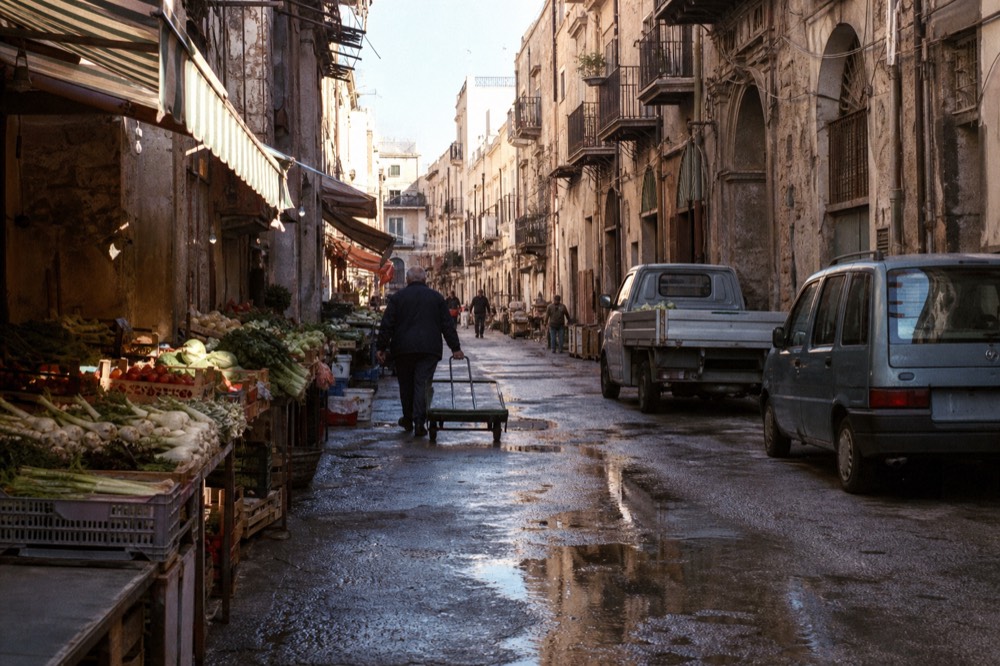
The rhythm matters. Walk through the Capo market at 8am and you will see workers spooning granita into a glass, dunking a soft brioche roll into it. By 10am the friggitorie are already dropping panelle into hot oil. At 1pm the arancine pyramids are full and the queue stretches past the door. And by 11pm, in the pedestrian-only stretch of the Vucciria, the grill smoke from a stigghiola cart is the only sign that the night is still young.
This guide follows that clock. Every dish here is listed by the hour you will actually find it at the counter, with the Sicilian name the vendor uses, not the translated menu version. Palermo’s street food is a language of its own, and learning a few words at the right time of day is the difference between a good meal and a great one.
Palermo Food Tours covers the markets and the stalls in detail on its walking tours, but if you are exploring on your own, this is your hour-by-hour map.
Early-Morning Street Food: What’s On The Counter From 7Am To 10Am
Palermo wakes up sweet. The first street food of the day is granita con brioche, a semi-frozen slush of almond, coffee or lemon spooned into a glass and eaten with a soft, round brioche roll. At the rosticcerie, the morning counter also holds iris, a fried dough ball filled with sweetened ricotta and dark chocolate chips, still warm from the oil. Both are breakfast, not dessert, and both are gone by 10am.
Granita is a Sicilian institution, and the Palermo version is denser and creamier than the icy granita of the east coast. The classic flavours are mandorla (almond), caffè (coffee) and limone (lemon), though you will also see gelsi (mulberry) and pistacchio. The brioche is always “col tuppo,” the round bun with a small topknot, and the local method is to tear off a piece and scoop the granita with it. A granita con brioche costs 3 € to 5 €, depending on the neighbourhood. In the centro storico, 4.50 € is common, and a 5 € price tag has drawn complaints in the local press as excessive for a traditional item.
Iris (pronounced EE-rees) is less famous but just as essential. The Palermo version is a round, sweet dough, deep-fried and filled with ricotta cream, dark chocolate and cinnamon. The dough is proved, baked, rested for twelve hours, then a hole is cut in the base and the filling is piped in. It is a morning-only item, sold at rosticcerie like I Cuochini and Bar Vabres, and it runs 2 € to 3 € apiece.
| Morning item | Sicilian name at the counter | Typical price | Where to find it |
|---|---|---|---|
| Almond granita with brioche | Granita di mandorla con brioche | 3–5 € | Caffè del Capo, Brioscia, any bar with a granita machine |
| Coffee granita | Granita di caffè | 2.50–4 € | Same bars; ask for “panna” if you want whipped cream on top |
| Iris (fried ricotta-filled dough) | Iris (singular, same word) | 2–3 € | I Cuochini, Bar Vabres, Antica Focacceria San Francesco |
| Brioche col tuppo (plain) | Brioche | 1–1.50 € | Every pasticceria and bar |
The morning window is short. By 10am the granita machines are being cleaned and the last iris are sold. If you want breakfast Palermo-style, set an alarm.
Midday Feasting: The Best Street Food From 11Am To 2Pm
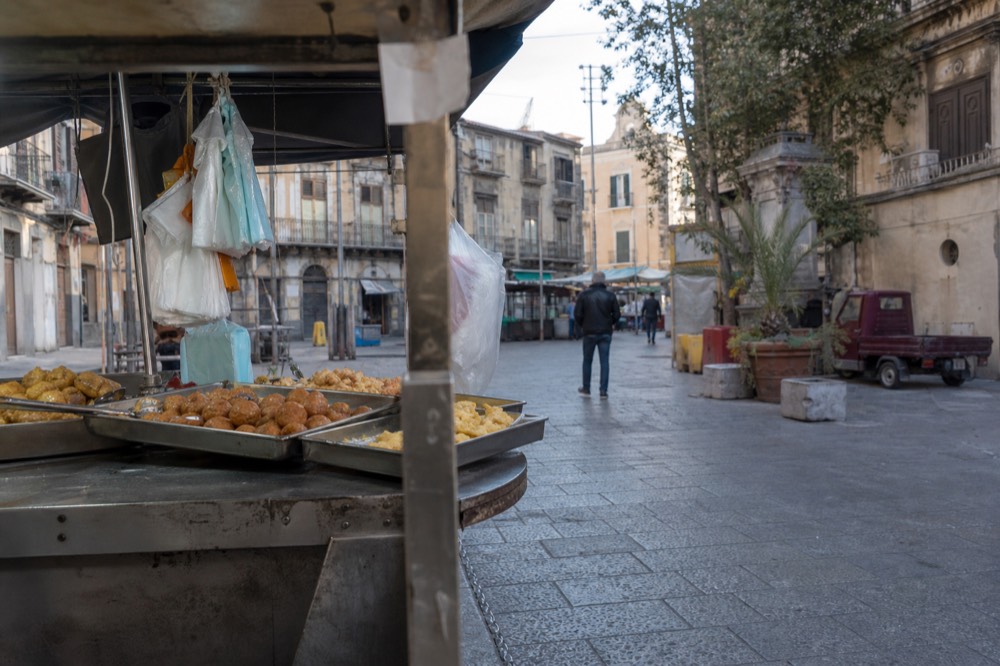
The midday shift is the fried-food hour. Arancine, panelle, crocchè and sfincione dominate every market counter and friggitoria from late morning until the afternoon lull. This is when Palermo street food is at its loudest, busiest and most generous, and a full lunch of two or three items rarely costs more than 8 €.
The undisputed king of the midday counter is the arancina. In Palermo the word is feminine, round and filled with a meat ragù, peas and cheese, though you will also find versions with ham and mozzarella or spinach. The Accademia della Crusca, Italy’s language authority, confirmed that the feminine form follows standard Italian grammar and is correct for the western half of Sicily, while the masculine arancino belongs to Catania. The first dictionary to record the word, Biundi’s 1857 Sicilian-Italian dictionary, defined it as a sweet rice dish, not a savoury one, and the Crusca notes that neither meat nor tomato appears in any 19th-century record. The arancina as we know it is a young dish, probably born in the second half of the 1800s, and the common claim that it descends from Arab cooking is, in the Crusca’s words, no longer certain.
A good arancina costs 2.50 € to 4 €. The best are fried to order, with a crisp, golden shell and a filling that stays moist. At a busy friggitoria like Nni Franco U Vastiddaru on Via Maqueda, the turnover is so fast that every arancina in the pile was fried in the last twenty minutes.
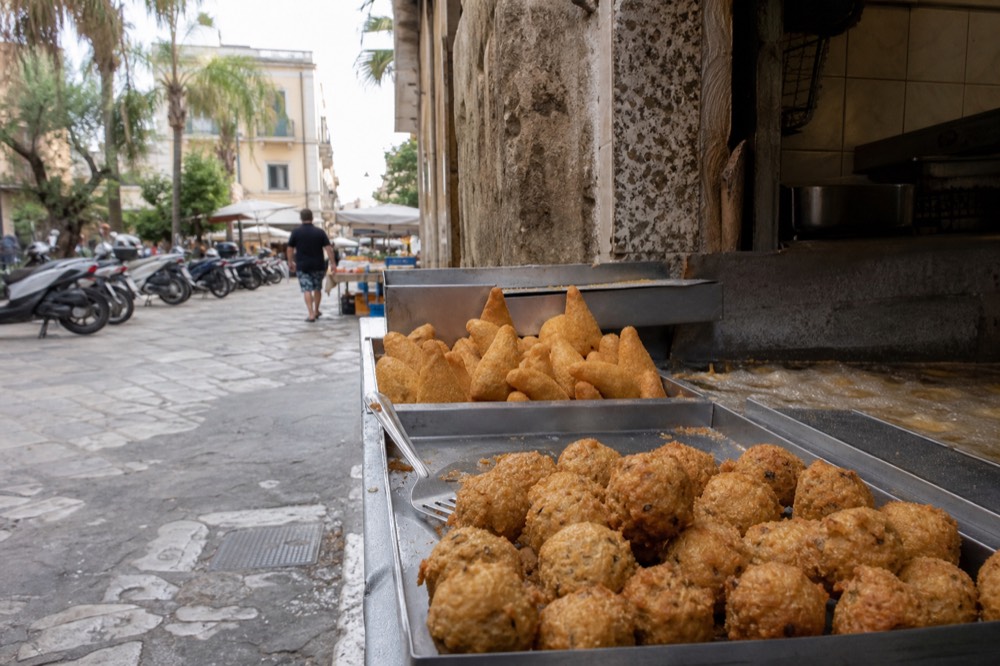
Panelle are the other midday staple. These are thin, rectangular fritters made from chickpea flour, water, salt and pepper, spread to exactly half a centimetre thick, cut cold and deep-fried in olive oil. They are a Palermo-specific product, officially recognised on Italy’s national PAT list of traditional foods with a production territory that names the city itself. A panino con panelle, the classic sandwich, costs 2.50 € to 3.50 €. Add crocchè, the potato croquettes, and you have the full Palermo street-food trinity.
Sfincione is the midday outlier, a thick, spongy focaccia topped with tomato, onion, caciocavallo and anchovies, sold by the slice from bakery counters and market stalls. In Palermo it is the red version; in nearby Bagheria, the white sfincione, without tomato, is the town’s symbol product and has its own festival every November. A slice runs 1.50 € to 3 €.
| Midday item | Sicilian name | Price | Best time to eat it |
|---|---|---|---|
| Arancina (meat ragù) | Arancina (arancine plural) | 2.50–4 € | 11am–2pm, while they are fresh |
| Panelle sandwich | Pane e panelle | 2.50–3.50 € | All day, but best hot from the fryer |
| Potato croquettes | Crocchè (crocchè di patate) | 1–2 € each | Same as panelle; order together |
| Sfincione slice | Sfincione (Palermo red) | 1.50–3 € | Midday, when the tray is fresh |
| Pane con la milza (spleen sandwich) | Pane ca meusa | 3–4.50 € | Late morning onward; an acquired taste |
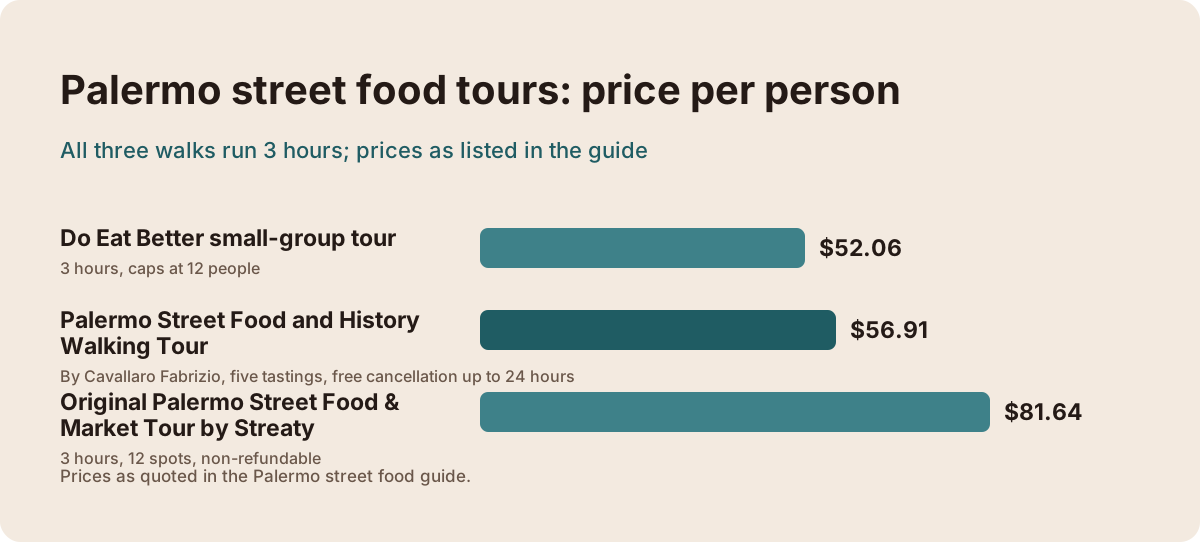
The midday market is the right moment for a guided walk. A local guide knows which stalls fry to order and which ones reheat. The three tours below cover the morning-to-lunch window with different styles and price points.
Afternoon Snacks And Market Treasures (3Pm To 6Pm)
The afternoon is the quietest stretch for Palermo street food, but it is also when the markets are at their most photogenic and a few specific items, like stigghiola and fresh cannoli, are at their peak. This is the hour for a slower, more deliberate eat, moving from stall to stall with a glass of something cold.
Stigghiola is the afternoon wildcard. It is a grilled skewer of lamb intestine wrapped around spring onion, pancetta and primo sale cheese, all bound in pork caul fat and cooked over charcoal. The official PAT technical sheet calls it one of the oldest foods of Sicilian country tradition and notes that it must be consumed within 72 hours of production even when vacuum-packed. A skewer costs 3 € to 5 € and is almost always sold from a street cart, not a shop. The smell of grilling stigghiola is the surest sign that you are in the right part of the Capo or Ballarò market in the late afternoon.
Cannoli are a Trapani product by PAT designation, not a Palermo one, but they are everywhere and they are best eaten in the afternoon when the ricotta filling is freshly piped. The shell, originally rolled around a piece of Arundo donax cane, is fried and cooled, then filled to order so it stays crisp. A good cannolo costs 2.50 € to 4 €. Avoid any stall where the shells are pre-filled and sitting in a display case; the ricotta will have softened the pastry.
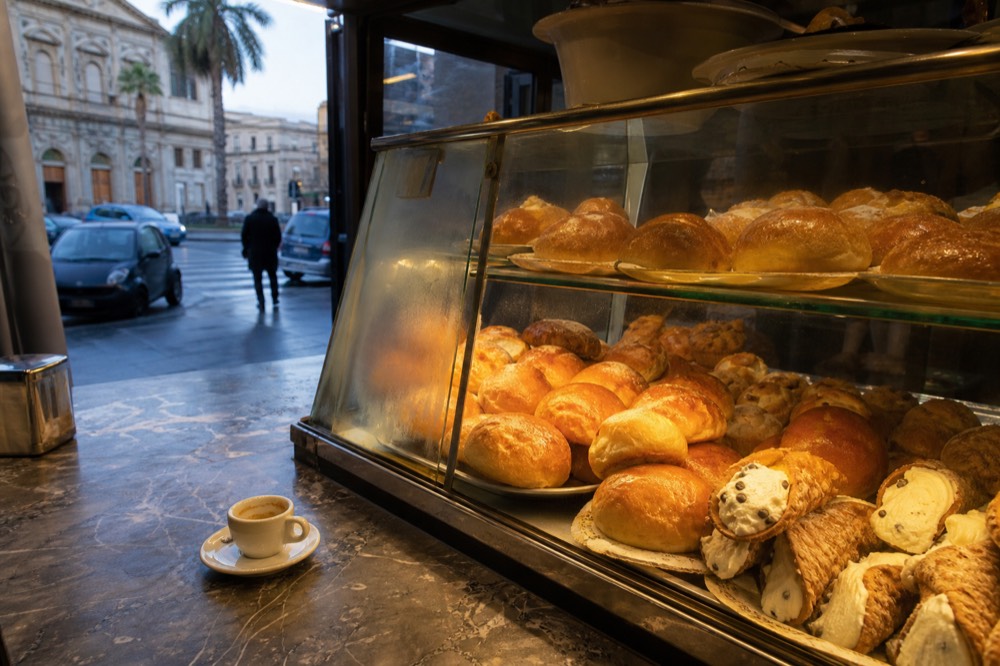
The afternoon is also the right time to walk the markets as markets, not just as food courts. Ballarò is open Monday to Saturday from 7:30 to 20:00, with Sunday mornings only, and the Comune di Palermo’s own tourism portal calls it the city’s oldest and largest market. The Capo, open every day morning and afternoon, is the one where quarters of meat still hang outside the butcher shops, a custom the Comune attributes to the city’s former Jewish presence for draining the blood. Borgo Vecchio, founded in 1556 after the new port was built, is a morning market that now draws a young crowd to its pubs and taverns in the evening.
The Original Palermo Street Food & Market Tour runs in the morning and early afternoon, hitting the markets when they are at their busiest. With only 12 spots per departure and a non-refundable booking policy, it tends to fill up. If you want a guided walk through Ballarò and the Capo with a local who knows the stallholders by name, this is the one.
Evening Street Food And The Vucciria After Dark (7Pm To 1Am)
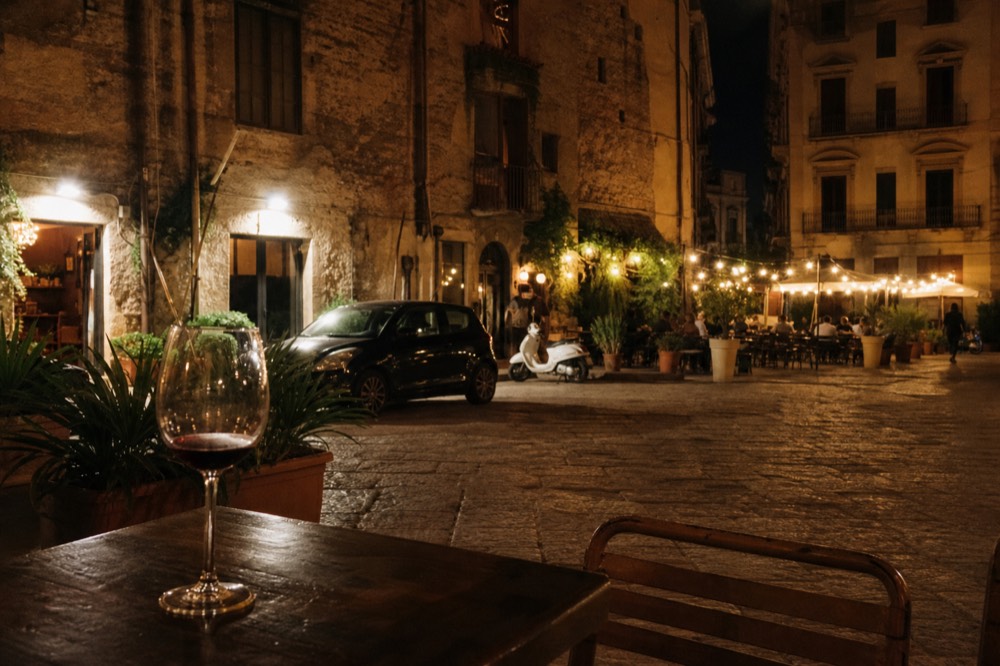
After sunset, Palermo street food shifts from fried snacks to grilled meat, baked focaccia and the chaotic energy of the Vucciria. The evening is when sfincione makes its second appearance, stigghiola carts multiply and the pedestrian-only piazza Caracciolo fills with drinkers, diners and the occasional impromptu street party.
The Vucciria is no longer the food market it once was. PalermoToday reported in March 2025 that the historic market “è ormai scomparsa” as a traditional trading space, with traders citing a loss of around 80% of their custom to the ZTL, parking shortages and the shift to tourist-focused street food. The Comune di Palermo’s own tourism page still describes it as a market open every day morning and afternoon, but the reality on the ground is different. By day the Vucciria is quiet; by night it is the city’s most intense drinking and eating strip, formalised as a pedestrian area by municipal ordinance, currently in force until 31 December 2026.
Evening eating here is less about a fixed menu and more about moving from one cart to the next. A slice of sfincione from a bakery counter, a skewer of stigghiola from a charcoal grill, a cannolo from a pasticceria that stays open late. The Vucciria’s most famous image, Renato Guttuso’s three-metre-square canvas painted in 37 days in 1974 with produce flown up from Palermo to his studio in the north, hangs ten minutes away at the Steri, the university’s monumental complex. The painter himself chose that it should stay in Palermo.
For a guided evening experience, the Small-Group Night Street Food Tour covers the Vucciria and the surrounding lanes with all food and drinks included. It is one of the few tours that runs after dark, and with only 12 spots, it sells out quickly in summer.
Which Palermo Markets Are Best For Street Food?
The four historic markets, Ballarò, Capo, Vucciria and Borgo Vecchio, each serve a different purpose for the street-food eater. Ballarò is the all-day heavyweight with the widest variety and the longest hours. The Capo is the best for meat-based street food and the morning granita ritual. The Vucciria is the after-dark destination. Borgo Vecchio is a morning-only local market with a growing nightlife scene.
The Comune di Palermo’s tourism portal groups all four as the city’s historic markets and notes that some were created during the Arab domination, though only Borgo Vecchio has a firm founding date of 1556. The shouted sales cry of the hawkers is called the “abbanniata” in Palermitan dialect, and listening to it is part of the experience.
| Market | Best for street food | Hours (official) | Street-food highlights |
|---|---|---|---|
| Ballarò | All-day eating, arancine, panelle, stigghiola | Mon–Sat 7:30–20:00, Sun morning only | The largest and oldest market; fried-food stalls along the main aisle |
| Capo | Meat dishes, granita, pane con la milza | Every day, morning and afternoon | Butcher shops with hanging meat; sfincione and panelle vendors |
| Vucciria | Evening drinking and late-night snacks | Every day (daytime quiet, night busy) | Sfincione, stigghiola, cannoli; pedestrian area after dark |
| Borgo Vecchio | Morning market, local vibe | Morning only | Fresh produce; growing pub and tavern scene at night |
Ballarò is the safest bet for a first-time visitor. It has the longest hours, the highest concentration of friggitorie and the clearest official schedule. The Capo is more atmospheric and less touristy, and it is the market where the Comune itself lists sfincione, pane con la milza and panelle as the signature street foods. The Vucciria is an evening-only proposition, and anyone who goes there at 10am expecting a bustling market will be disappointed.
For a deeper dive into each market, see our guides to Ballarò, the Capo and the Vucciria. If you want a guided walk that connects the markets with the food, the Ballarò Market & Street Food Tour by Eating Europe covers the morning market with a small group and a 24-hour cancellation policy.
How To Order Street Food Like A Local: Key Sicilian Phrases
You do not need to speak Sicilian to eat well in Palermo, but knowing five or six words will change the way a vendor looks at you. The most useful phrase is “una arancina, per favore,” with the correct feminine gender, and the second most useful is “com’è buono” after the first bite.
The gender of arancina matters in Palermo. Using the masculine arancino marks you as a visitor from the east coast or a tourist who learned the word from a Catania guidebook. The Accademia della Crusca has confirmed that both forms are correct, but the geography is strict: feminine and round in the west, masculine and often pointed in the east. In Palermo, saying arancina is the local choice.
| Italian / Sicilian phrase | What it means | When to use it |
|---|---|---|
| Una arancina, per favore | One arancina, please | At any friggitoria counter |
| Pane e panelle | Bread with chickpea fritters | Ordering the classic sandwich |
| Mi dà una granita di mandorla? | Can I have an almond granita? | Morning at the bar |
| Quant’è? | How much is it? | Before paying |
| Com’è buono! | How good this is! | After the first bite, genuine |
| Abbanniata | The hawker’s shout | Not to say, but to recognise |
The abbanniata is the loud, melodic cry that market vendors use to pull in customers. The Comune di Palermo’s tourism portal calls it “musica folkloristica” of the historic markets, and once you hear it, you will recognise it everywhere. It is not something you need to imitate. Just follow the sound.
How Much Does Palermo Street Food Cost?
A full day of Palermo street food, from morning granita to late-night stigghiola, costs between 15 € and 25 € per person. The single most expensive item is rarely more than 5 €, and many of the best things, like a slice of sfincione or a panino con panelle, are under 4 €.
Prices in the centro storico have risen sharply in the last five years. A local press report in May 2026 noted that the price of an arancina or a panino con panelle in the historic centre has roughly doubled since 2021, driven by tourism demand and the conversion of traditional food shops into street-food counters. A pizza and a drink now averages 14.56 € in Palermo, up about 60% in five years, the highest increase of any Italian city. Street food remains cheaper than a sit-down meal, but the days of a 1.50 € arancina are over in the tourist zone.
| Item | Price range | Notes |
|---|---|---|
| Granita con brioche | 3–5 € | Almond, coffee or lemon; price depends on neighbourhood |
| Iris | 2–3 € | Morning only; sold at rosticcerie |
| Arancina | 2.50–4 € | Meat ragù is the classic; ham and mozzarella also common |
| Pane e panelle | 2.50–3.50 € | Chickpea fritters in a roll; add crocchè for 1–2 € more |
| Sfincione slice | 1.50–3 € | Red (Palermo) or white (Bagheria) |
| Pane con la milza | 3–4.50 € | Spleen sandwich; an acquired taste |
| Stigghiola skewer | 3–5 € | Grilled lamb intestine; sold from carts |
| Cannolo | 2.50–4 € | Filled to order; avoid pre-filled shells |
| Bottled water or soft drink | 1–2 € | Tap water is safe and free at public fountains |
The coperto, a cover charge of 1.50 € to 3 € per person, applies only if you sit at a table in a trattoria or restaurant, not at a street-food stall or a market counter. The Italian consumer organisation Altroconsumo explains that the coperto must be clearly stated on the menu before you order, and if it is not, you can refuse to pay it. Lazio is the only Italian region that bans the coperto by law; in Sicily it is legal and common in sit-down places.
Are Guided Food Walks Worth It?
A food tour is the fastest way to learn the market layout, the stall hierarchy and the dish names in a single morning. For a first-time visitor who wants to eat well without spending the first day figuring out which friggitoria fries to order, a guided walk pays for itself in saved time and avoided microwaved arancine.
The main argument against a tour is the cost: a three-hour street-food walk runs from about 40 € to 90 € per person, which is two to four times what you would spend on the same food if you bought it yourself. The counter-argument is that a good guide takes you to stalls you would not find on your own, explains what you are eating in a way a sign never will, and steers you away from the tourist traps. A Reddit user who visited Ballarò in September 2025 reported buying arancine that turned out to be microwaved pre-made ones, and locals in the thread replied with a long list of better stalls, including Passami u Coppu, Donna Franca, Sfrigola and Nni Franco U Vastiddaru. A guide removes that trial and error.
The Palermo Street Food and History Walking Tour is a solid mid-range option at 57 € per person, with five tastings, a cannolo, a drink and a walk through the Capo market. It has a 4.9 rating across 1,672 reviews and a free 24-hour cancellation policy.
For a higher-end, all-inclusive experience, Secret Food Tours Palermo packs ten or more tastings into three and a half hours, including arancini, cannoli and wine, with a guide who mixes food and local history. The tour runs at 89 € per person and limits groups to 12.
If you are still deciding, the comparison below lines up three popular tours by price, duration and cancellation terms.
Palermo street food raises a handful of predictable questions: what to eat, when to go, how much it costs, and how to order. The answers below cover the most frequent ones, drawn from market hours, local pricing and the city’s own food traditions.
Common Questions About Palermo Street Food
What is the most famous street food in Palermo?
The arancina, a deep-fried rice ball filled with meat ragù, peas and cheese, is the city’s symbol dish. Panelle, chickpea fritters, and sfincione, a thick tomato-and-onion focaccia, are equally iconic and sold at every market.
What time of day is best for Palermo street food?
Midday, between 11am and 2pm, is when the friggitorie are busiest and the food is freshest. Mornings are for sweet items like granita and iris, and evenings are for grilled stigghiola and the Vucciria’s night scene.
Is Palermo street food safe to eat?
Yes. The stalls with the highest turnover are the safest. Look for queues, oil that looks clean and arancine that are fried in front of you. Tap water in Palermo is drinkable and meets EU quality standards.
Do I need cash for street food in Palermo?
Most market stalls and friggitorie are cash-only. Carry small notes and coins. Some bars and rosticcerie accept cards, but do not rely on it.
What is the difference between arancina and arancino?
Both words refer to the same dish, but arancina (feminine) is used in Palermo and western Sicily, while arancino (masculine) is used in Catania and the east. The Accademia della Crusca confirms both are correct, and the split follows geography, not grammar.
Which Palermo market is best for street food?
Ballarò has the widest variety and the longest hours. The Capo is better for meat-based items and a less touristy atmosphere. The Vucciria is an evening-only destination, and Borgo Vecchio is a morning market with a growing nightlife scene.