What Is A Must Eat In Palermo?
The must-eat foods of Palermo, from panelle and arancine to cannoli filled to order, with what each one is, where to find it and what it should cost.
What Is A Must Eat In Palermo?
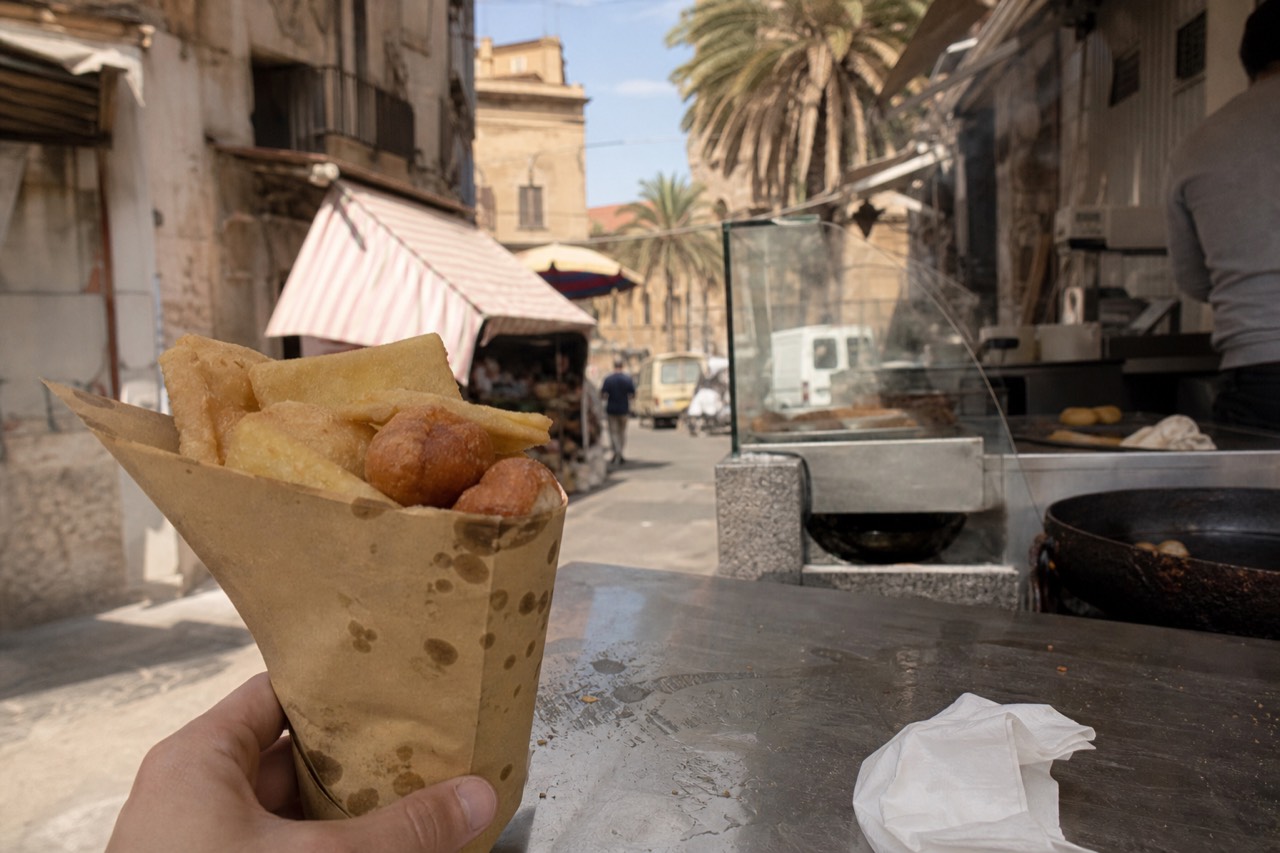
If you eat only five things in Palermo, make them panelle, an arancina, a fresh-filled cannolo, a slice of sfincione and granita con brioche. Panelle is the one dish whose official recognition names Palermo itself as its home, and the rest form the core of the street food sold in the Capo and Ballarò markets.
That is the short answer, and it is built on something firmer than taste. Sicily maintains an official register of traditional foods, the PAT list, which currently counts 293 products island-wide after the national update in March 2025. Most of the famous Palermo dishes sit somewhere on it. But only one of them, panelle, carries the city of Palermo itself as its registered production territory. Everything else belongs to the whole island, or to the Trapani coast, or to the Madonie hills, and a list that admits that honestly is more useful than one that pretends otherwise.
The second thing worth knowing is that Palermo's must-eats are cheap, fried and mostly eaten standing up. This is a city where the mid-morning snack has a stronger claim on your attention than the dinner reservation. The Comune di Palermo's own tourism portal lists the street specialities sold by hawkers in the Capo market as sfincione and sfincionello, pane con la milza, and bread with panelle and potato croquettes. That is the local government describing the canon, not a blog.
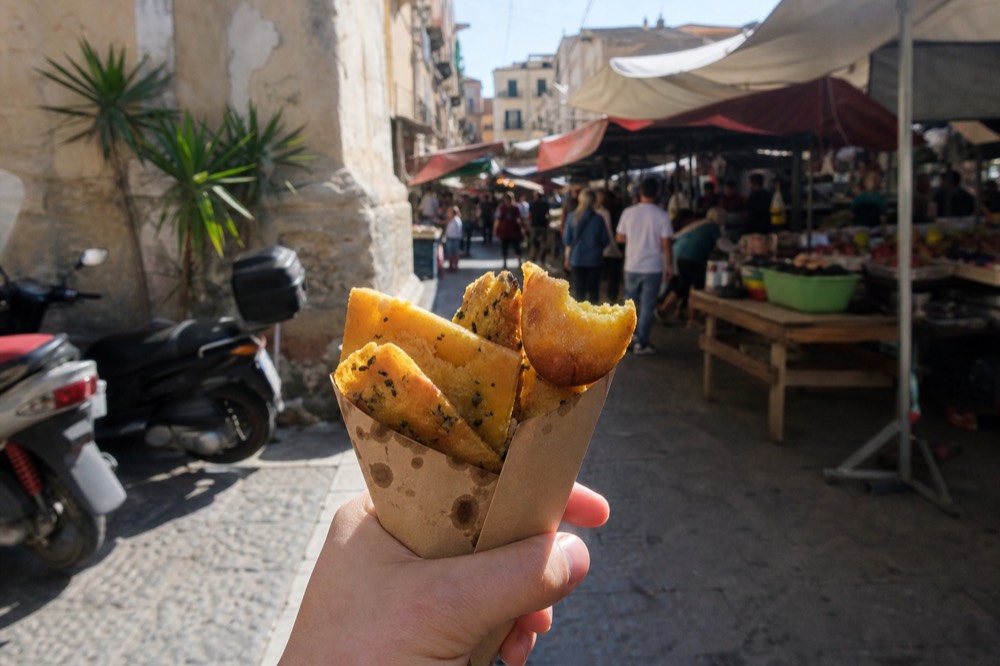
Here is the shortlist in one view, before the page goes into each dish in turn.
| Dish | What it is | Where you will find it |
|---|---|---|
| Panelle | Chickpea-flour fritters, the one canon item whose official territory is Palermo itself | Friggitorie and market stalls across the centro storico |
| Arancina | A fried rice ball, round in the west of Sicily | Bakeries and bars, eaten standing |
| Cannolo | A fried pastry shell filled with sheep's-milk ricotta | Pastry shops that fill it to order |
| Sfincione | Palermo's spongy street pizza, red in the city, white in Bagheria | Bakery windows and market carts |
| Granita con brioche | Iced fruit or almond granita served with a sweet brioche | Bars, in the morning |
One warning before the detail. A visitor to Ballarò in September 2025 reported buying arancini that had been microwaved from pre-made stock, and the local replies were blunt: skip the market stalls that look assembled for tourists and go where the queue is. Names that came up repeatedly from Palermo residents included Passami u Coppu, nni Franco u Vastiddaru, Basile, I Cuochini and Bar Vabres. The lesson is not that the markets are bad, it is that a must-eat list only works if you apply it at the right counter. That judgement call is exactly what a guided walk buys you, and it is why we built Palermo Food Tours around the city's markets rather than its restaurants.
Which Dishes Are Actually From Palermo?
Panelle and iris are the two canon items whose official production territory is the city of Palermo itself. Panelle are chickpea-flour fritters cut half a centimetre thick and fried, and the iris is a round piece of fried sweet dough filled with ricotta cream. Everything else on the must-eat list belongs to a wider Sicily.
The panelle entry in the Regione Siciliana's official technical sheets is unusually specific. The batter is chickpea flour, water, salt and pepper, cooked while stirring until it thickens and comes away from the pan, spread on a board to half a centimetre, cut cold into rectangles and deep-fried in olive oil, then dusted with pepper and served very hot. The sheet notes they are made both in the friggitorie, the fry shops, and at home. You can read the full specification in the official PAT technical sheets published by the Regione Siciliana, which is also where the Palermo territory claim comes from.
The iris is the sweeter sibling. The same official sheets describe it as a typical round piece of Palermo rosticceria, sweet proved dough that is fried and filled through a small hole cut in the base with ricotta cream, dark chocolate and cinnamon. Visitors mostly meet it by accident, ordered instead of a savoury item at a bakery counter, and few regret it.
Why does the territory detail matter for a must-eat list? Because it changes what you are doing when you eat. An arancina in Palermo is eating a Sicilian classic in one of its two capitals. A panelle in Palermo is eating the dish in the only place it is officially from. If your trip is short and your stomach has limits, that distinction is a reasonable tiebreaker, and it is the kind of detail a first page of search results rarely explains.
The practical way to cover all of this in one walk is a guided market tour. The Original Palermo Street Food & Market Tour by Streaty is all-inclusive, runs three hours and holds only 12 spots per departure, so the guide can steer you past the reheated stuff toward the counters that still fry to order.
Arancina Or Arancino: What To Order And Why The Word Matters
In Palermo the word is arancina, feminine and round. The Accademia della Crusca settled the geography: the west of Sicily says arancina, the east says arancino, often conical, and neither form is wrong. What surprises most visitors is that the dish itself is young, with no trace in the written record before the late nineteenth century.
The naming split is the best-documented linguistic fact in Sicilian food, and the Accademia della Crusca's consultation on the question is the authority. Crusca's finding cuts against local pride in an amusing way: Palermo's feminine arancina is the form that follows standard Italian gender rules, while the eastern masculine follows the Sicilian dialect. The campanilismo runs opposite to the grammar.
| Palermo and western Sicily | Catania and eastern Sicily | |
|---|---|---|
| Word | Arancina, feminine | Arancino, masculine |
| Shape | Round | Round or conical |
| Grammar | Follows standard Italian | Follows the Sicilian dialect form |
| Exceptions | Ragusa and Siracusa areas also tend toward arancina |
The deeper surprise is the age of the dish. Crusca states plainly that there are no traces of the preparation in literature, chronicles, diaries, dictionaries, ethnographic texts or recipe books before the second half of the nineteenth century. The first Sicilian dictionary to record the word, Biundi's Sicilian-Italian dictionary of 1857, defines it as a sweet rice dish shaped like a bitter orange. Neither meat nor tomato appears in the early records at all. The much-repeated story that the arancina descends from Arab cuisine is, in Crusca's own conclusion, no longer so certain. The likelier account is a mid-1800s sweet that turned savoury almost immediately.
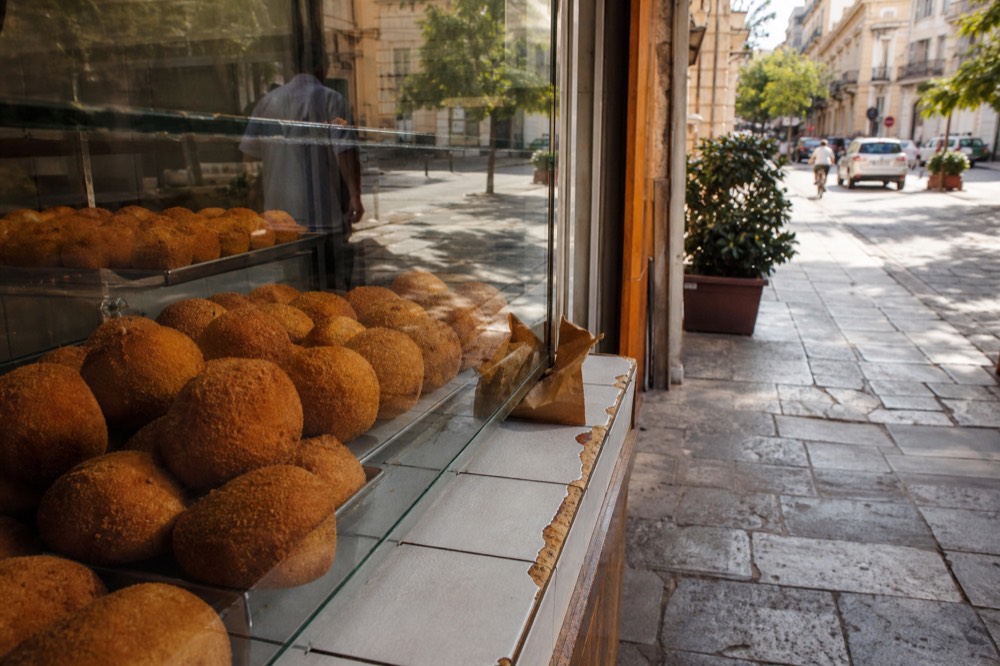
Palermo also gives the dish its own day. The thirteenth of December, the feast of Santa Lucia, is celebrated in the city as Arancina Day, with mass consumption of arancine al burro and alla carne. Bakeries that normally fry a steady morning supply switch to industrial volumes. If your trip touches mid-December, you will eat the best-priced, freshest arancine of the year without trying.
For a single walk that puts arancine in context alongside cannoli and wine, the ten-tastings tour by Secret Food Tours is the format to beat: more than ten tastings over three and a half hours, a perfect 5 rating across 782 reviews, and free cancellation up to 24 hours before, which matters if your December travel plans are still soft.
Where To Eat The Best Cannoli In Palermo
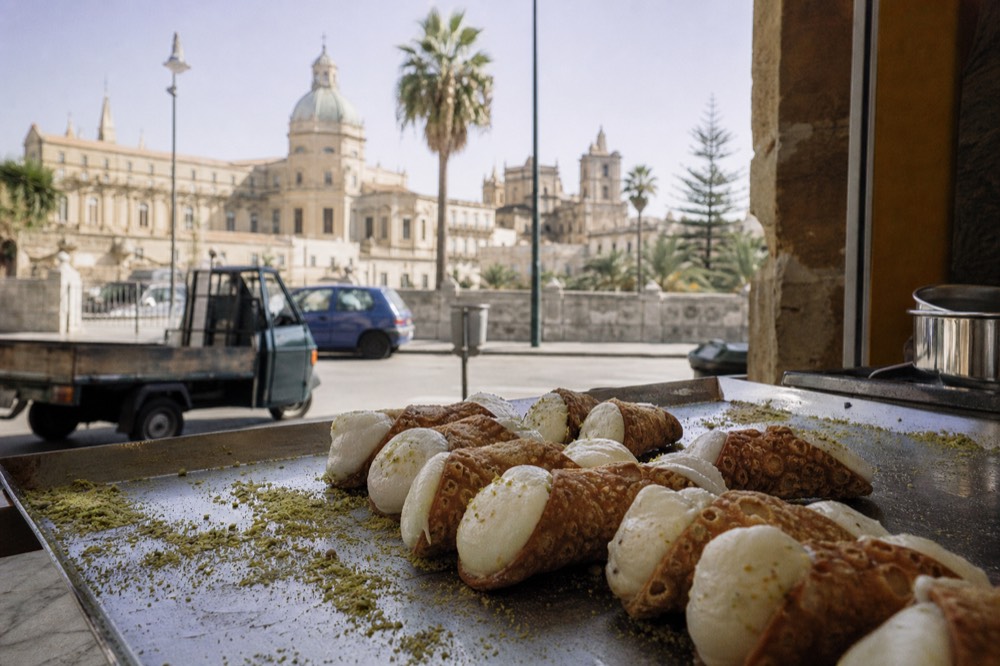
The cannolo you should chase in Palermo is one filled the moment you order it, with sheep's-milk ricotta. Locals consistently point to Piana degli Albanesi as the spiritual home, and to the pastry shops that fill the shell to order rather than hours in advance. The shell takes its name from the cane it was originally rolled around.
Start with the awkward fact. The official PAT technical sheet for the cannolo alla ricotta gives its production territory as Paceco, Erice, Trapani and Valderice, the Trapani coast, not Palermo. The shell's name comes from the cane, Arundo donax, around which the dough was originally rolled before frying. The classic filling is sheep's-milk ricotta with sugar, with candied fruit or chocolate pieces optional. None of that stops Palermo from being an excellent place to eat one. It just means the best cannolo in Palermo is usually the one with the shortest gap between filling and bite.
Recent first-hand advice from residents bears this out. In a Palermo subreddit thread on cannoli, the recommendations converged on a few principles: the best cannoli tradition belongs to Piana degli Albanesi, a town in the hills behind the city; I Segreti del Chiostro, in the Santa Caterina complex, fills to order; and Bosco on Via Amari fills fresh. The same thread carried a useful seasonal caveat, that summer versions often use imported milk ricotta, so the cannolo you eat in August may taste much like the one your neighbour bought in a different shop. Order from a place that fills in front of you and the problem mostly disappears.
If your sweet tooth has room for one more, the cassata sits next to the cannolo in the canon. The official sheet specifies sheep's-milk ricotta, sugar, dark chocolate and cinnamon in the filling, records it as the traditional Easter dolce, and cites a document of the Synod of Mazara of 1575 listing cassata among the sweets indispensable at feast days. Even the name is a live dispute: Treccani derives cassata from the Latin for cheese, while the regional sheet suggests an Arabic origin. Two authoritative Italian sources, two etymologies, and a page that settles nothing is being honest with you.
Sfincione: The Red And White Split
Sfincione is Palermo's own street pizza, and it comes in two colours. The Comune di Bagheria calls the white version its symbol product, while the red one follows the broader Sicilian tradition. Palermo eats red, Bagheria eats white, and the argument between them is old enough to have its own festival.
Sfincione is on the PAT list, which is the strongest official credential a Sicilian street food can carry. What the official record does not give is a full topping formula, and this page will not invent one. What is firmly sourced is the split: the Comune di Bagheria's own announcement for its Sfincione Fest describes the white sfincione as Bagheria's symbol product, alongside the red one made according to Sicilian tradition. The municipal announcement on the Comune di Bagheria site is the primary source for that framing.
In Palermo itself you will eat the red version, sold by the slice from bakery windows and market carts, and it is closer to a soft, oily focaccia than to a Neapolitan pizza. It is a mid-morning or late-afternoon food, cheap by design, and it is one of the items the city's own tourism portal lists among the Capo market's hawker specialities.
Bagheria is a short trip out of the city, and if your dates line up, the Sfincione Fest makes the argument theatrical. The ninth edition runs 20 to 23 November 2026 along Corso Umberto I, with tastings, chefs and concerts. Eating white sfincione inside its home town during its own festival is about as must-eat as the concept gets.
The Offal Question: Pane Con La Milza And Stigghiola
Pane con la milza, an offal sandwich whose name simply means bread with spleen, is the most divisive item on the list, and stigghiola, rolled lamb intestine, is its market-stall companion. Both are old working food, both are sold in the Capo, and neither is for everyone. Trying one of the two is a fair test of the trip.
The Comune di Palermo's tourism portal lists pane con la milza among the street specialities of the Capo market, on the city's official tourism pages. That is the extent of what can be said with official backing, and honestly, it is enough: the sandwich is offal-based, it is cheap, and locals line up for it at lunchtime. If the description appeals, order it. If it does not, the panelle in the same display case come from the same fryer.
Stigghiola has a fuller paper trail. It is on the PAT list, and the official technical sheet is precise: lamb intestine and pork caul fat, with onion, pancetta and primo sale cheese, in two recognised versions, and a shelf life the sheet caps at 72 hours even vacuum-packed and refrigerated. The sheet also floats a hypothesis, in its own hedged voice, that the traditional version is very probably a legacy of past Jewish culinary culture. It is offered as an official-source suggestion, not a settled fact, and it is written that way here.
The Capo rewards a walk even beyond the food. The market sits in the old Seralcadio quarter, entered through Porta Carini, and the Comune attributes the old custom of hanging meat quarters outside the shops to the city's former Jewish presence, for draining the blood. For the full picture of the quarter, including what to pair with the offal, our guide to the Capo market covers it in depth.
A market walk with a guide makes the offal decision easier, because you can ask before you commit. The Original Palermo Street Food & Market Tour by Streaty scores 4.9 across 2308 reviews, runs three hours from $81.64 per person and keeps departures to 12 guests. Note the policy before you book: it is non-refundable, unlike most tours of this type in the city.
Breakfast Of Champions: Granita Con Brioche
Granita con brioche is the breakfast that doubles as dessert, and in Palermo it is eaten sitting down, with the brioche used to scoop the ice. It is a standard Sicilian morning ritual rather than a tourist invention. What has changed lately is the price: a brioche with gelato or granita now commonly costs four to five euros.
Italian food writing treats granita con brioche as a standard Sicilian breakfast, especially in the east of the island around Messina, and the practice is described as longstanding and everyday rather than as a novelty for visitors. The technique is the point: the brioche is not a garnish, it is the utensil. You tear it and scoop. Ordering it standing at a bar in the morning marks you as a tourist only if you eat the brioche first.
The price is the current sore point. Local reporting in the Giornale di Sicilia records that a brioche con gelato or granita now commonly costs four to five euros, with reports of the five-euro mark sparking genuine local backlash as excessive for a traditional item, and cones in the Palermo area noted at three to three and a half euros. A returning visitor on a Sicily forum praised the version at a bar called Brioscia specifically for the warm brioche and its citrus aroma. Warm brioche is a fair quality signal generally: it means the batch is fresh.
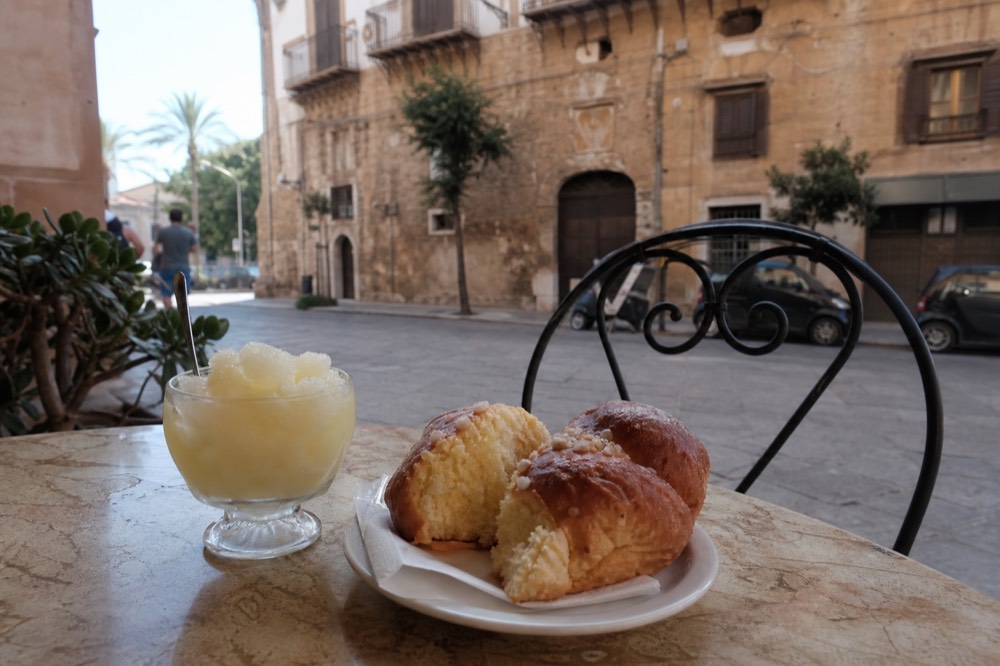
The almond and black-mulberry granite are both on the PAT list in their own right, and the mulberry version in particular is the one Sicilians treat as seasonal and worth planning around. If breakfast is your favourite meal of the day, our piece on what Sicilians eat for breakfast goes deeper on the morning canon.
How Much Does A Must-Eat Day In Palermo Cost?
A full must-eat day in Palermo can cost under twenty euros. An arancina or a panelle sandwich in the centro storico runs three to four and a half euros, granita with brioche four to five, and a pizza with a drink averages 14.56 euros. The famous dishes barely move the total, which is why the city rewards walkers.
The price data comes from local reporting rather than from a menu someone photographed once. Il Sicilia's coverage of centro storico prices records an arancina or a panelle and crocchè panino at three to four and a half euros, roughly double the 2021 level, with tourism-driven demand cited as the driver. The same reporting puts the average pizza and drink at 14.56 euros across a range of nine to 28. Add the granita figure from the section above and the shape of a day is clear.
| Item | Typical price in the centro storico | Note |
|---|---|---|
| Arancina or panelle panino | 3 to 4.50 euros | Roughly double 2021 levels |
| Brioche con gelato or granita | 4 to 5 euros | Cones in the Palermo area from 3 euros |
| Pizza with a drink | 14.56 euros on average | Range runs 9 to 28 euros |
Two practical consequences follow. First, the cheapest eating day and the best eating day in Palermo are the same day, because the canonical items are the cheap ones. Second, the premium spend in this city is not on food at all, it is on guidance: knowing which counter fries to order is worth more than any single dish. Our guide to food tour prices in Palermo breaks down what the guided options cost, and the Palermo street food guide maps the dishes to the stalls.
There is one more way to spend a food afternoon in Palermo that many visitors overlook: making the food. The Palermo pizza and gelato cooking class with dinner and wine runs three hours from $60.95 per person, scores 4.9 across 1208 reviews, includes the meal you cook, and offers free cancellation up to 24 hours before. It often sells out, which tells you how the arithmetic lands for families.
Whichever way you choose to eat your way through the list, the same three tours come up again and again for visitors who want the canon covered in a single afternoon: the all-inclusive market walk, the ten-tastings route for the sweet-toothed, and the hands-on class for travellers who would rather cook the classics than queue for them.
The questions below are the ones readers ask most about eating their way through Palermo, answered with the same sourcing as the rest of this page: official regional food registers, the city's own tourism portal and recent local reporting on prices. Each answer keeps to figures already verified above, so nothing here needs a second guess before you order.
Common Questions About Must-Eat Food In Palermo
What Is A Must Eat In Palermo?
Panelle, an arancina, a cannolo filled to order, a slice of sfincione and granita con brioche. Panelle is the one dish whose official production territory is the city of Palermo itself, and the rest make up the core of the street food sold in the Capo and Ballarò markets.
What is the most popular street food in Palermo?
The arancina is the item most visitors eat first and most often, and the city gives it its own day on 13 December, the feast of Santa Lucia. Panelle are the local equivalent of a daily habit, sold in every friggitoria, and the two are often served together in the same bread roll.
Is pane con la milza worth trying?
It is an offal sandwich, divisive even among locals, and it is sold in the Capo market according to the city's own tourism portal. If you enjoy offal it is one of the most distinctive foods in Italy. If you do not, the same counters sell panelle and crocchè from the same fryer.
Where can I find good cannoli in Palermo?
Order from a shop that fills the shell in front of you. Residents recommend I Segreti del Chiostro in the Santa Caterina complex and Bosco on Via Amari, both of which fill to order, and point to Piana degli Albanesi as the spiritual home of the tradition. In summer, expect imported milk ricotta in many fillings.
How much does street food cost in Palermo?
An arancina or a panelle panino in the centro storico runs three to four and a half euros, and a brioche with gelato or granita four to five. Prices have roughly doubled since 2021, but a full eating day still costs less than a single dinner in most Italian cities.
Is Palermo street food good for vegetarians?
Largely, yes. Panelle and crocchè are potato-and-chickpea based, most pasta dishes are vegetarian by default, and one vegan arancini option is sold at Ke Palle in the city. Vegans should check the panelle, since some versions use broth or cheese in the accompanying items.