What Do Sicilians Eat For Breakfast?
What Sicilians actually eat for breakfast: granita con brioche in the east, fried arancine and panelle in Palermo, what the morning costs, and when to plan around it.
What Do Sicilians Eat For Breakfast?
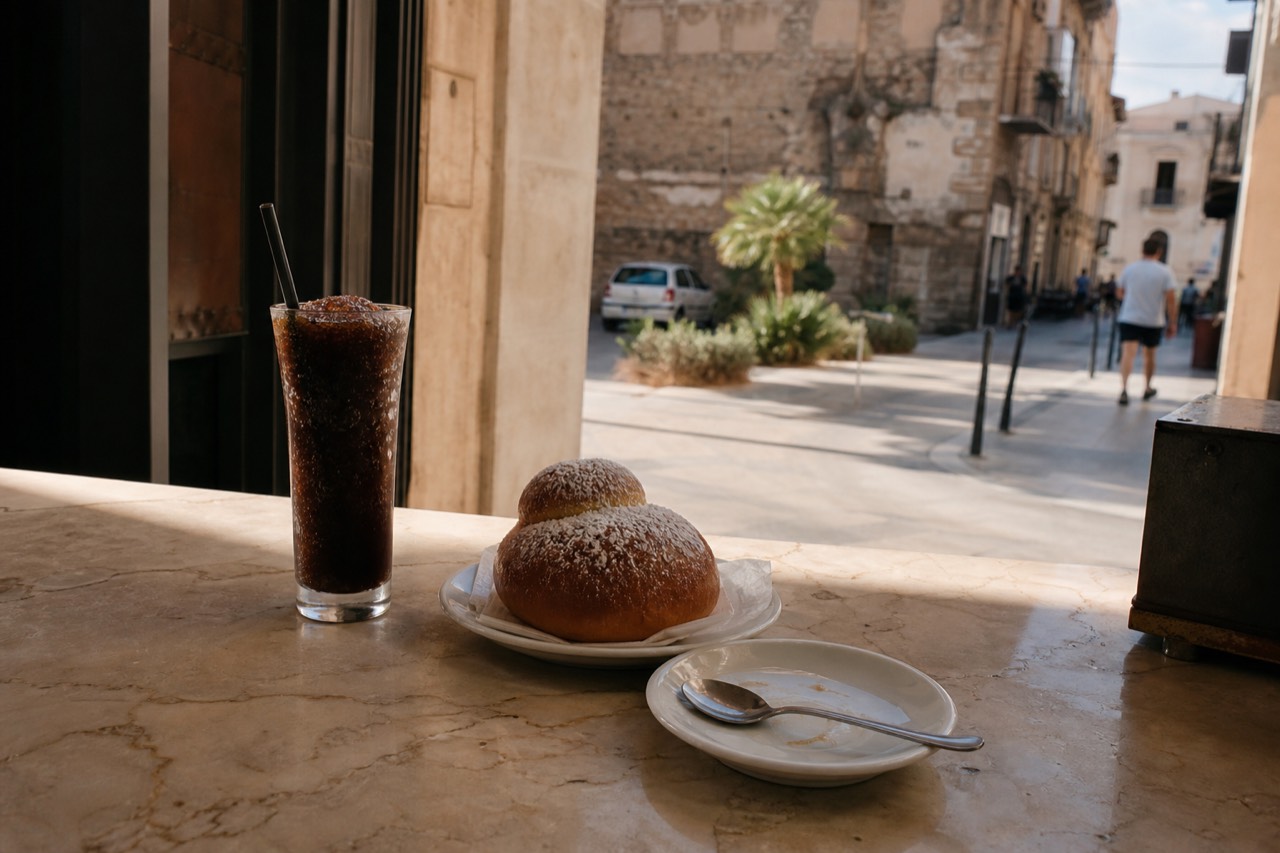
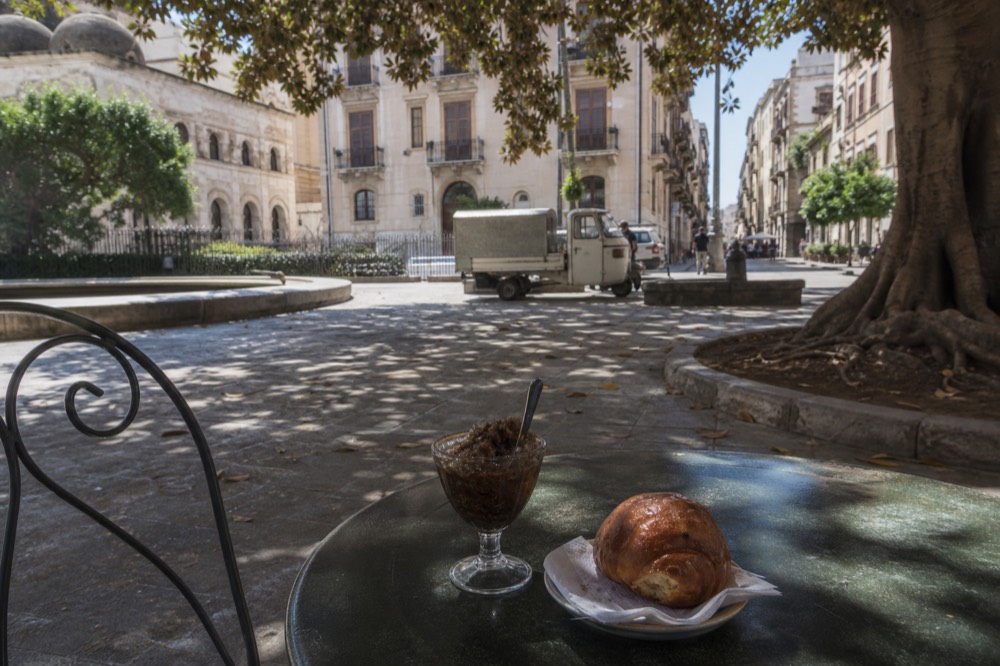
The short answer is granita con brioche: a half-frozen slush of coffee, almond, lemon or black mulberry, served in a glass with a sweet round brioche on the side, and treated as a standard Sicilian breakfast in the warm months, especially in the east around Messina. Palermo complicates the picture: its morning runs savory, on fried arancine, ricotta-filled iris and chickpea-fritter sandwiches.
The question sounds simple, and the island answers it two different ways depending on where you stand. In most of Sicily, and with real conviction along the eastern coast around Messina, breakfast is a seated, cold, unhurried affair. A glass of granita arrives at the table, the brioche sits beside it or is tucked into the glass itself, and the eating happens with the hands as much as with a spoon. This is not a tourist invention or a weekend indulgence. It is how the morning is done.
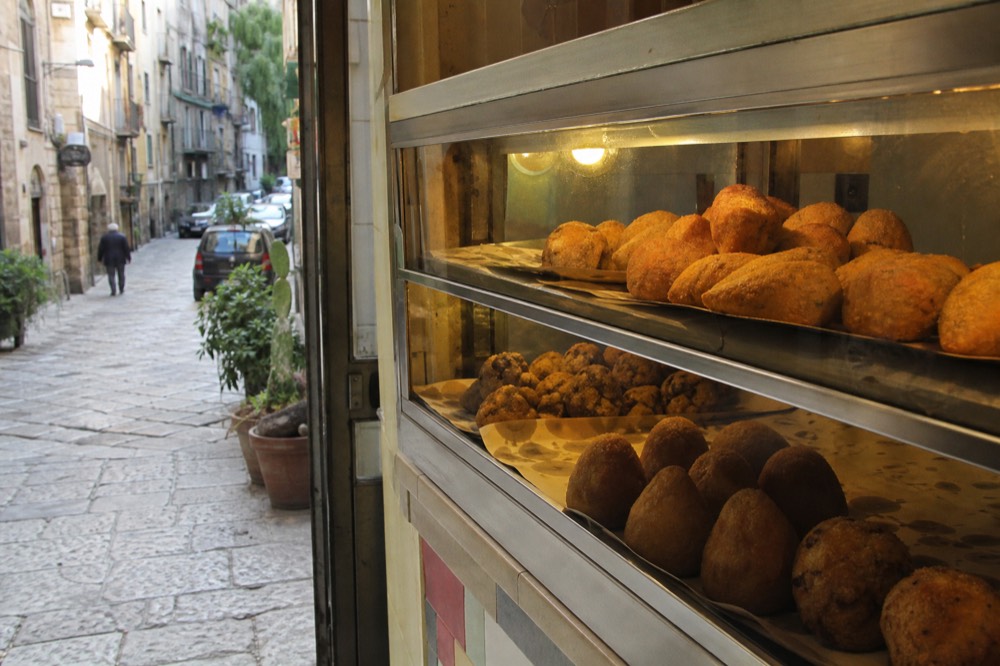
Palermo breaks the pattern. The western capital takes the same frying pans that work the afternoon and points them at breakfast, so the city's traditional morning roster is built on rice balls, chickpea fritters and potato croquettes rather than ice and sugar. A visitor who orders granita in a Palermo bar will not be stared at, but the queue at the friggitoria counter will tell its own story about what the neighborhood actually eats at nine in the morning.
Both halves of the split are documented, which is the point of this page. The granita-and-brioche breakfast is described plainly as a standard Sicilian practice in the Italian press, and the Palermo items all sit on Sicily's official list of traditional products, the PAT, maintained under national rules that require a preparation to have been made consistently for at least 25 years before it can be listed. That is a harder evidentiary bar than most food writing clears, and it is worth knowing which breakfast claims clear it.
If you want to taste your way through the morning rather than research it, a guided walk does the work efficiently. These three are the strongest options for a first visit built around food:
Why Is Granita Con Brioche The Classic Sicilian Breakfast?
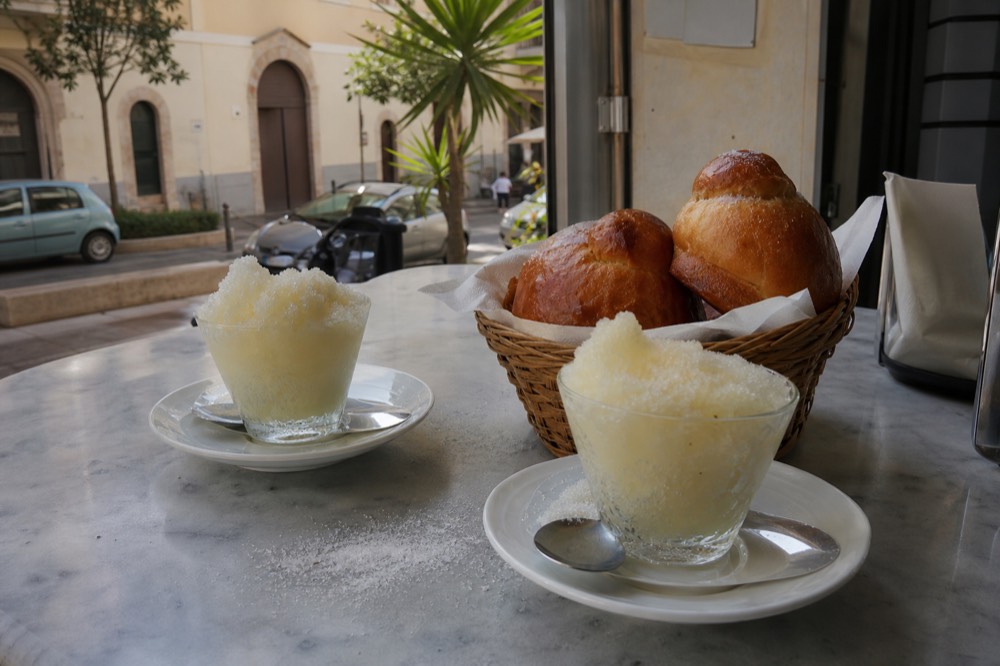
Because it is the one breakfast the island treats as normal rather than as a treat. Corriere, one of Italy's main national newspapers, describes granita con brioche as a standard Sicilian breakfast, strongest in the east around Messina, with the brioche used to scoop the granita from the glass. The flavors are not random either: almond, lemon and black mulberry granitas all appear on Sicily's official list of traditional products.
The mechanics matter more than they sound. Granita is not a slushie and it is not sorbet. The Treccani dictionary defines it as a type of sorbet made from flavored sugar solutions, lemon, coffee or fruit juices, agitated while freezing so the result is a pasty mass of very small ice crystals rather than a solid block. That texture is why the brioche works: the bread is soft enough to be pressed into the ice and used as the eating implement, which is exactly how the practice is described in the eastern part of the island.
The flavor list is also older and more official than most visitors assume. Sicily's PAT list, the regional register of traditional products, carries three granitas by name: granita di gelsi neri, black mulberry; granita di limone, lemon; and granita di mandorla, almond. Coffee granita, the one most visitors order first, is named in Treccani's dictionary definition among the standard flavorings. A breakfast order in Sicily is therefore a choice among items with paperwork behind them, which is a strange and pleasing thing to be able to say about ice.
Ordering is simple even with no Italian. Name the flavor, choose seated or standing, and expect the brioche to arrive whether you asked for it or not, since the pairing is simply assumed by the person behind the counter.
| Flavor | What it is | Standing |
|---|---|---|
| Mandorla (almond) | Granita made from almond milk and sugar | On Sicily's PAT list of traditional products |
| Limone (lemon) | Lemon, sugar and water, stirred as it freezes | On the PAT list |
| Gelsi neri (black mulberry) | Dark mulberry granita | On the PAT list |
| Caffè (coffee) | Coffee granita | Named among the standard flavorings in Treccani's dictionary definition |
There is a regional etiquette worth knowing before you order. The granita breakfast is described as especially entrenched in eastern Sicily and the Messina area, where sitting down for it is the norm rather than the exception. In Palermo it exists, but it competes with the fryer, and the city's own sweet contributions to the morning, the iris above all, are fried rather than frozen. Travelers moving between Catania or Taormina and Palermo often notice the shift within a single day (see Palermo or Taormina). For more on the sweet side of the island's table, see traditional Sicilian dishes beyond breakfast.
Wondering whether a morning food walk is worth booking on a short visit?
What Do People Eat For Breakfast In Palermo?
Palermo eats fried food in the morning. The city's traditional roster includes the arancina, a round rice ball; the iris, a Palermo-territory piece of fried sweet dough filled with ricotta cream; and panelle, chickpea fritters in a roll, the one canon item whose official production territory is the city of Palermo itself. Coffee granita exists here too, but the frying pans lead.
The official descriptions are more specific than most guidebooks manage. The regional technical sheet for panelle, the chickpea fritter, fixes the production territory as the city of Palermo and parts of its province, and even specifies the thickness the batter is spread to before cutting: half a centimetre. The sheet describes a snack of chickpea flour, water, salt and pepper, deep-fried and served very hot. The iris gets its own sheet, defined as a typical round piece of Palermo rosticceria, sweet fried dough filled with ricotta cream, with dark chocolate and cinnamon in the filling. These are not loose street foods with folklore attached. They are catalogued regional products with defined territories.
The city government's own tourism portal lists what the Capo market's hawkers sell: sfincione and sfincionello, pane con la milza, and pane con le panelle e le crocche di patate, bread with chickpea fritters and potato croquettes. That last sandwich is the canonical Palermo breakfast-lunch object, and potato croquettes, crocche di patate, carry their own PAT listing. The arancina completes the set, listed as arancini di riso on the same register despite the Palermitan spelling, typically spherical per the official sheet, with a filling of meat, or alternatively ham and mozzarella, or spinach.
Ask any Palermitan where to get the best version and you will get a different answer each time, usually a bar or friggitoria within walking distance of where they grew up. That loyalty is part of why the morning roster survives at all.
| Item | What it is | Official standing |
|---|---|---|
| Arancina | Typically spherical rice ball, fried, filled with meat, ham and mozzarella, or spinach | Listed as arancini di riso on Sicily's PAT register |
| Iris | Round piece of fried sweet dough filled with ricotta cream, chocolate and cinnamon | PAT sheet, production territory the city of Palermo |
| Panelle | Chickpea-flour fritters, spread half a centimetre thick before frying | PAT sheet, territory Palermo city and province |
| Panino con panelle e crocche | Fritters and potato croquettes in a sesame roll | Named on the Comune di Palermo's Capo market page; crocche di patate is PAT-listed |
Prices have moved, and not quietly. Reporting in the Sicilian press puts an arancina or a panelle-and-crocche sandwich at 3 to 4.50 euros in the historic centre, roughly double the levels of 2021, a rise the same reporting ties to tourism-driven change in the city center. The full picture of what a food-focused trip budgets is covered in the wider Palermo street food canon, and the tour reviews tracked on Palermo Food Tours reflect the same shift through what walkers say they paid.
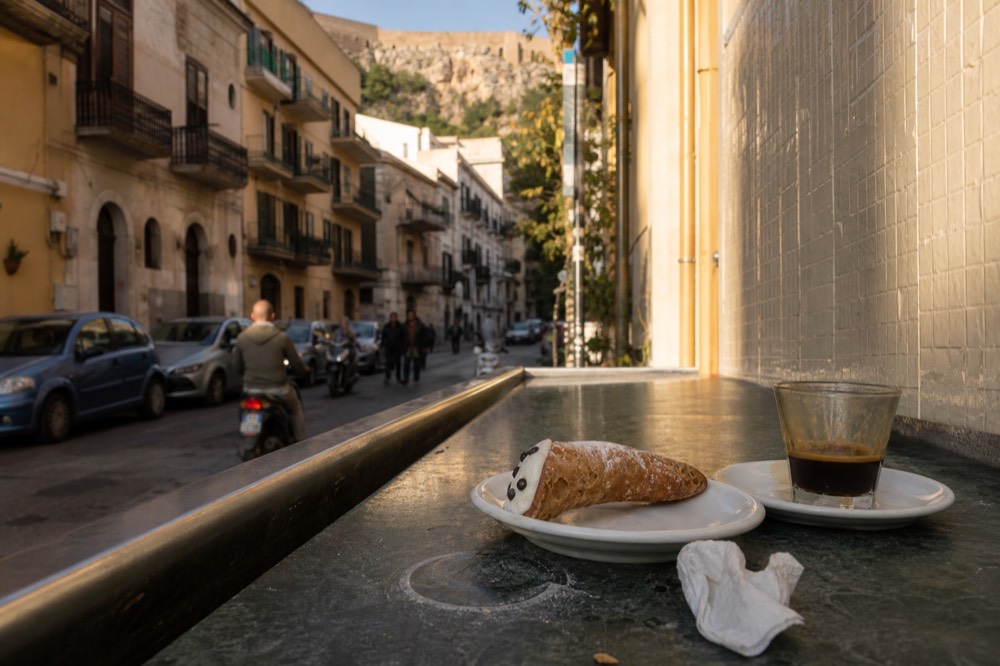
The most direct way into this morning is a guided walk built around it. The Palermo Street Food and History Walking Tour, led by guide Cavallaro Fabrizio, is designed around exactly this roster: a walk through the Capo market with five tastings, a cannolo and a drink, folded into three hours of city history. It is rated 4.9 across 1,672 reviews, costs from $56.91 per person, and carries free cancellation up to 24 hours before departure. It often sells out, which is worth knowing if your dates are fixed.
Is It Arancina Or Arancino At Breakfast?
In Palermo, arancina, feminine and round. The Accademia della Crusca mapped the split: arancina in western Sicily, arancino, round or pointed, in the east, with exceptions around Ragusa and Siracusa. Crusca also found no trace of the dish in literature, chronicles, dictionaries or recipe books before the second half of the 19th century, when the first recorded form was a sweet.
The naming question is the one thing every visitor to Sicily gets quizzed on, and the answer is better documented than most linguistic spats. The Accademia della Crusca, Italy's highest language authority, published a full consultation on the question, and its geography is precise: the feminine arancina, round, in Palermo and the west; the masculine arancino, round or cone-shaped, in the east, with the areas around Ragusa and Siracusa breaking the pattern for dialect reasons. Neither form is wrong. Crusca's finding is that the feminine follows standard Italian grammar, where the fruit is feminine, while the eastern masculine follows the Sicilian dialect word.
The more surprising part of Crusca's consultation is the history. The first Sicilian dictionary to record the word, Biundi's Sicilian-Italian dictionary of 1857, defines it as a sweet rice dish shaped like a bitter orange. Meat and tomato appear nowhere in the 19th-century records at all, and Crusca concludes that the usual Arab-origin story is not supported by the evidence, with the likelier account being a mid-to-late 1800s sweet that turned savory almost immediately. Palermo also gives the dish its own calendar date: 13 December, Santa Lucia, is celebrated in the city as an arancina day of mass consumption, when the fried rice balls are eaten in place of bread by tradition.
If the naming debate interests you, the deeper dive is in how Sicilians argue over the name. If your breakfast curiosity runs past the morning, the same foods come back after dark, and the Vucciria in particular turns into a nighttime eating street. Streaty Food Tours runs a Small-Group Night Street Food Tour of Palermo, all-inclusive, rated 4.9 across 580 reviews, from $69.8 per person for three hours, with only 12 spots per departure. One honest caveat: it is non-refundable, one of only three non-refundable tours in the city's whole roster, so it suits settled plans rather than loose ones.
How Much Does A Sicilian Breakfast Cost?
More than it used to, and Sicilians are saying so out loud. A brioche with granita or gelato now commonly costs 4 to 5 euros, and reports of 4.50 or 5 euro prices have drawn open local backlash as excessive for a traditional item. In Palermo's historic centre an arancina or a panelle sandwich runs 3 to 4.50 euros, roughly double 2021 levels.
The brioche price is the one that stings locally, because the item is a marker of ordinary life rather than a visitor product. Sicilian press coverage has documented the shift, with one Palermo-area report noting cones at 3 to 3.50 euros while seated brioche-with-granita orders reach the 4 to 5 euro band, and the coverage records residents describing the higher prices as a crisis for the tradition itself. The same reporting notes that the price of eating out generally in the historic centre has climbed steeply, with pizza and a drink averaging 14.56 euros across the city in the same survey, against a range of 9 to 28 euros.
| Item | Typical price | Notes |
|---|---|---|
| Brioche con granita or gelato | 4-5 € | Cones reported at 3-3.50 € in the Palermo area; higher prices have drawn local backlash |
| Arancina or panelle sandwich, historic centre | 3-4.50 € | Roughly double 2021 levels |
| Pizza with a drink, city average | 14.56 € | Reference point from the same price survey, range 9-28 € |
None of this makes breakfast a bad deal by the standards of other European food cities, but it does mean the old advice about Sicily being nearly free to eat in has expired. Budgeting 10 to 12 euros per person covers a seated granita breakfast and a fried item from a friggitoria with change, before coffee. The prices also explain why a fixed-price food tour has become a rational choice for many visitors: an all-inclusive ticket locks the morning's cost before the menu board can move.
For a fuller sweep of the city's table beyond the morning, Streaty's Palermo on a Plate tour runs four hours all-inclusive, rated 5.0 across 125 reviews, from $117.13 per person with 12 spots per departure. Like the night tour, it is non-refundable, so it rewards travelers whose plans are already firm.
When Is The Best Time Of Year For A Sicilian Breakfast?
Warm months for granita, winter for citrus. Palermo's climate normals put July at a 29.8 degree average high with just 1.2 rain days, which pushes breakfast early and cold, while May, June and September combine highs in the twenties with few wet days. From January to March the Ciaculli late mandarin, a Slow Food Presidium, is in harvest.
The weather data makes the seasonal logic hard to argue with. The World Meteorological Organization's published normals for Palermo put August as the hottest month by average daily maximum at 30.5 degrees, July a fraction behind at 29.8, and July as the driest month of all, with 6.7 millimetres of rain across 1.2 rain days on average. May, June and September are the walking-tour sweet spots: highs of 23.3, 27.2 and 27.5 degrees respectively, with between roughly two and five rain days each. A cold breakfast is not a gimmick in that climate. It is thermodynamics.
Winter has its own payoff, and it grows on trees. The Ciaculli late mandarin, from the plain on Palermo's southern edge, is a Slow Food Presidium covering around 80 hectares of growers, and it exists because of a spontaneous mutation of the Avana mandarin in the 1940s that produced a late-ripening fruit with very few seeds, thin skin and very sweet, juicy pulp. Its harvest runs January to March. Slow Food's own account notes that the surrounding plain, once described as one big garden, has lost 80 percent of its cultivated land, which makes the winter mandarin one of the last edible traces of the Conca d'Oro within reach of the city.
The practical calendar, then, reads something like this. Book the granita mornings for May through September, when the heat justifies the ice and the rain mostly does not come. Visit a market in the morning rather than the afternoon, since Ballaro's official hours run Monday to Saturday from 07:30 to 20:00 with Sunday mornings only, and the produce is at its best early. If you land in the January-to-March window, trade a little granita for mandarins and fried items, and do not expect the brioche to disappear from the counter. It does not.
By way of a closing comparison, the three walks below cover the morning table between them, and each suits a different kind of traveler:
Sicilians answer the breakfast question two ways: granita con brioche, cold and sweet, across most of the island and with real conviction in the east around Messina, and a fried, savory morning in Palermo built on arancine, iris and panelle sandwiches. The whole meal costs little, the naming of the rice ball has a documented east-west split, and the best season runs May through September.
Common Questions About Sicilian Breakfast
What Do Sicilians Eat For Breakfast?
Granita con brioche in the warm months, especially in eastern Sicily, and a savory fried morning in Palermo: arancine, iris and panelle sandwiches. A brioche with granita or gelato commonly costs 4 to 5 euros, and an arancina or panelle sandwich in Palermo's historic centre runs 3 to 4.50 euros.
Is granita really a breakfast food?
Yes. It is described in the Italian national press as a standard Sicilian breakfast, particularly around Messina in the east, eaten with the brioche used to scoop the ice from the glass. Almond, lemon and black mulberry granitas are all on Sicily's official list of traditional products.
What is an iris?
A round piece of Palermo rosticceria: sweet fried dough filled with ricotta cream, with dark chocolate and cinnamon in the official regional description. Its documented production territory is the city of Palermo itself.
Is it arancina or arancino?
Both are correct, and the Accademia della Crusca says the split is geographic: arancina, feminine and round, in Palermo and western Sicily; arancino, round or cone-shaped, in the east. Neither form is a mistake.
How much does breakfast cost in Palermo?
An arancina or a panelle sandwich in the historic centre runs 3 to 4.50 euros, roughly double 2021 levels. A brioche with granita or gelato commonly costs 4 to 5 euros across Sicily, with cones reported at 3 to 3.50 euros in the Palermo area.