Is Sicilian Pizza A Thing In Sicily?
Sfincione, not the thick rectangular slice sold abroad, is Palermo's answer to Sicilian pizza. Here is what it is, what it costs, and where the white and red traditions split.
Is Sicilian Pizza A Thing In Sicily?
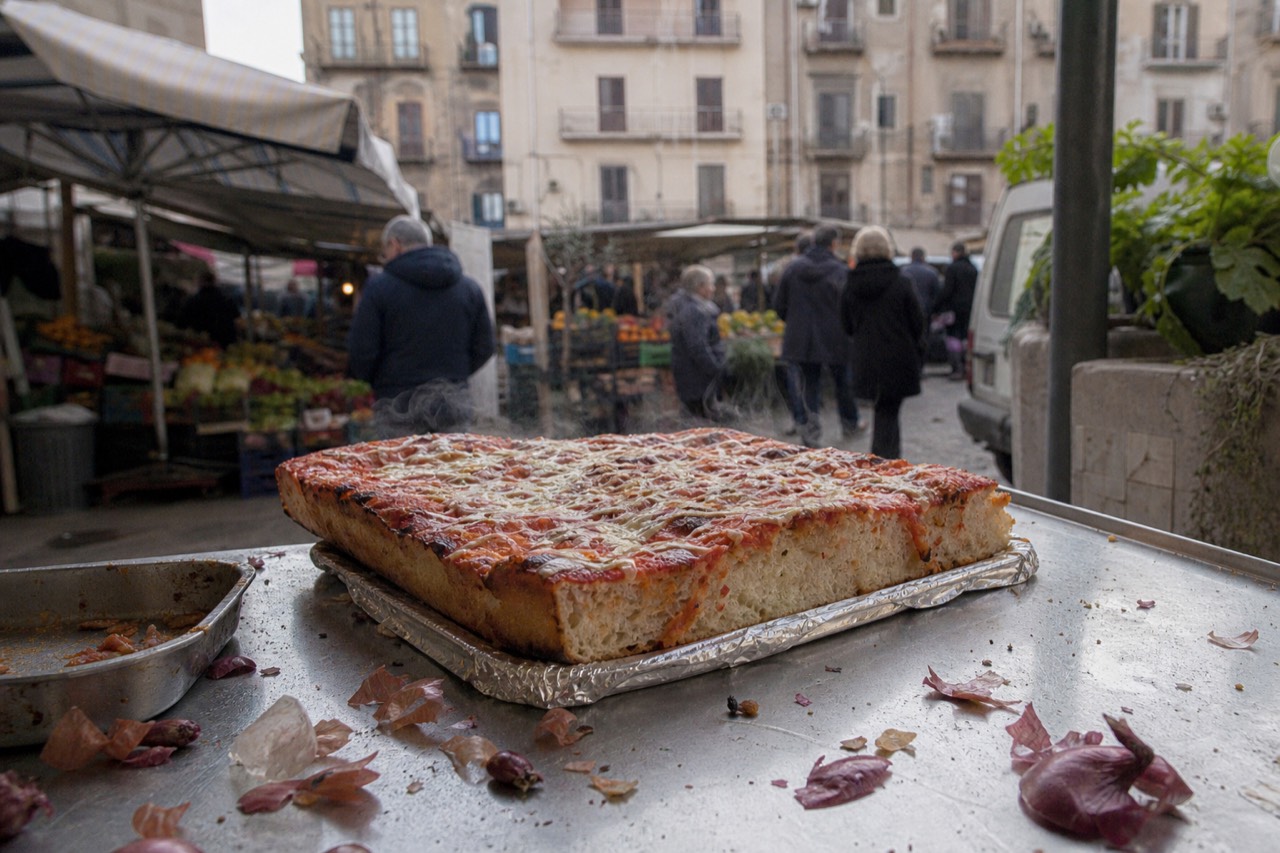
No, not in the form the name suggests. The thick, rectangular "Sicilian slice" familiar from pizzerias abroad is an export style, not something Palermo's bakeries turn out. In Sicily the local equivalent is sfincione, a soft baked street food sold by the slice, while the island's pizzerias mostly serve round pies baked to order.
The Comune di Palermo's own tourism portal answers this question without ever using the phrase. Among the street foods its page for the Capo market lists, sold by hawkers working the stalls, it names sfincione and sfincionello, alongside pane con la milza, panelle and crocche di patate. That is the city government's official inventory of what its most famous market actually sells, and "Sicilian pizza" is not on it. Sfincione is.
The confusion has a long paper trail. A 2012 Forbes article, reporting the results of a reader survey run by the travel site VirtualTourist, placed Palermo fifth among the world's street food cities. The caption the article attached to Palermo praised its fried arancini, its crocche, its panelle, and then added, typo and all, that "they do a mean Sicilan pizza." Fourteen years on, that throwaway line still shapes what visitors expect to find. What they actually find is a city with two separate baked-dough traditions: sfincione at the market counters, and round pizza in the pizzerias, each with its own history and its own price bracket.
If you want to taste your way through both traditions in one afternoon, a guided walk is the efficient route. The three tours above cover the markets where sfincione is made and the streets around them, with cancellation terms that differ from one operator to the next, so it pays to read each listing before committing. The rest of this page explains what sfincione is, how the white and red versions split, what pizza in Palermo costs, and where to point yourself first.
What Is Sfincione, Palermo's Own Take On Sicilian Pizza?
Sfincione is a thick, soft, baked dough sold by the slice, and it is the closest thing Sicily has to a homegrown pizza. It appears on Italy's official register of traditional foods, the Comune di Palermo's tourism portal lists it among the Capo market's street foods, and Italy's reference dictionary carries no entry for it at all.
Start with the official status. Sicily's PAT list, the national register of Prodotti Agroalimentari Tradizionali, includes sfincione among its recognised bakery and confectionery products. To qualify for that list, a preparation must have been made in a consistent, traditional way for at least 25 years, so sfincione's credentials as a genuine Sicilian product are formally documented rather than folklore. Panelle, arancini di riso, cannoli and cassata siciliana sit on the same list. It is a serious inventory, and sfincione is on it.
Then there is the odd part. Treccani, the reference dictionary of the Italian language, has no lemma for sfincione. Look up arancino, cassata, cannolo or granita and you get a careful etymology and definition. Look up sfincione and the dictionary simply has nothing to say. One of the island's signature foods is, lexicographically speaking, undocumented, which is a fair warning about how much confident-sounding description you should trust online. The full traditional topping formula, the origin of the word, and the story that credits a monastery with inventing it are all claims this site has checked and could not source, so we will not repeat them here.
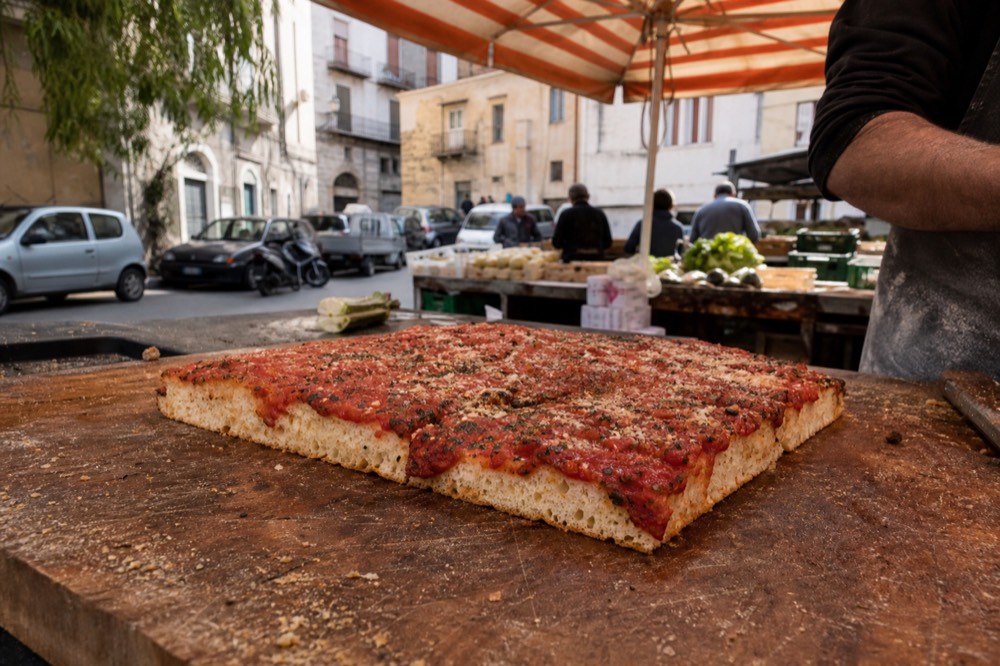
What can be said, and said safely, is practical. Sfincione is baked in trays, cut and sold by the piece, and eaten standing or walking rather than at a table. In Palermo it belongs to the friggitorie and the market stalls rather than to the pizzeria. The Comune's Capo market page, which you can read on the city's official tourism portal, lists it first among the street specialities sold by the market's hawkers. For the wider canon of fried and baked street food, our guide to Palermo street food covers the rest of the list.
A word on the American-style slice, since that is what most people are really asking about. If you learned the phrase "Sicilian pizza" from a pizzeria menu abroad, it probably meant a thick, rectangular, square-cut pie. Nobody in Palermo will know what you are ordering if you ask for it by that name. Ask for sfincione instead, and you will be handed the local version of exactly that idea: a soft, topping-heavy, baked dough meant to be eaten in the street.
| Style | What it is | Where you find it |
|---|---|---|
| The "Sicilian slice" abroad | A thick, rectangular, square-cut slice | Pizzerias outside Italy |
| Sfincione | A thick, soft baked dough sold by the slice | Capo market stalls and friggitorie in Palermo |
| Round pizza | Pies baked to order | Pizzerias across Palermo |
The Palermo: Street Food and History Walking Tour is a good fit for this particular question, because it walks the Capo market ground where sfincione is sold and folds the tastings into the neighbourhood's history. It runs about three hours, from $56.91 per person, holds a 4.9 rating across 1672 reviews, and offers free cancellation up to 24 hours before the start. It also sells out often, which is worth knowing if you are travelling in high season.
White Or Red: Which Sfincione Is The Real One?
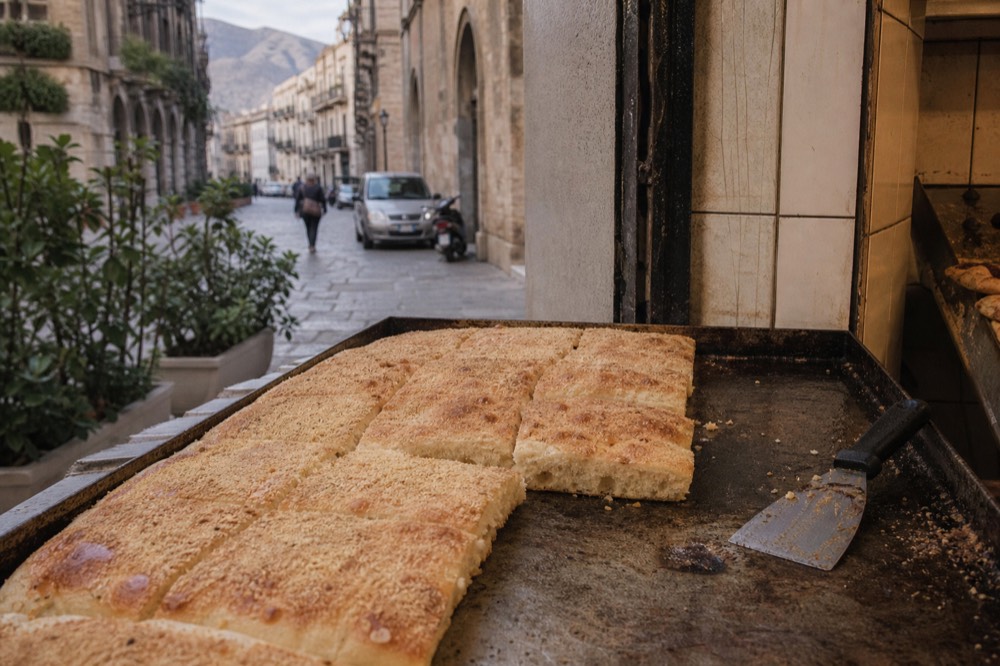
Both are real, and the split is geographic. White sfincione is the symbol product of the town of Bagheria, while the red version follows the broader Sicilian tradition, according to Bagheria's own municipal website. The two camps meet every November at Sfincione Fest, held on Bagheria's Corso Umberto I.
The white-versus-red split is one of those arguments Sicilians genuinely have, and unusually for a food dispute it has an official referee. The Comune di Bagheria, the town just along the coast from Palermo that has its own claim on the dish, states plainly on its own news page that the white sfincione is Bagheria's symbol product, and that the red one follows the Sicilian tradition. That is a municipal government putting its name to a food identity, which is about as settled as this kind of thing gets.
The split matters for visitors because the two versions look and taste different, and because where you are standing when you buy one predicts which you will be handed. In Palermo the red tradition dominates. Head to Bagheria and the white version is the local point of pride. Neither is a tourist invention. Both are old enough, and documented enough, to have a festival dedicated to settling nothing at all.
The festival is real and worth planning around if your dates line up. Sfincione Fest, now in its ninth edition, runs 20 to 23 November on Corso Umberto I in Bagheria, with tastings, chefs and concerts. The event is backed by the municipality itself, and you can read the announcement on the Comune di Bagheria's official page. Going to the fest turns a snack into an event: you taste both traditions side by side, in the town that claims one of them, with locals doing the same thing at the next table.
| Tradition | Home | Official status | Where to try it |
|---|---|---|---|
| White sfincione | Bagheria | Bagheria's symbol product, per the municipal website | Sfincione Fest, Corso Umberto I, 20 to 23 November |
| Red sfincione | Palermo and the wider island | The Sicilian tradition, per the same source | Capo market stalls and friggitorie in Palermo |
Wondering how sfincione fits into a tasting walk through the two traditions?
Most of the food walks on this site can be cancelled free up to 24 hours before they start, so you can lock a date in early and adjust later.
What Kind Of Pizza Do You Actually Eat In Palermo?
Round, baked-to-order pizza, mostly. Palermo's pizzerias serve the round pies now standard across Italy, and the city's pizza-plus-a-drink average sits at 14.56 euros across a 9-to-28-euro range. The island's round-pizza credentials are real: one Sicilian pizzeria, Saccharum, placed 27th nationally in the 50 Top Pizza Italia 2026 ranking.
This is the part of the question people rarely expect. Sicily is not a pizza backwater waiting to be discovered. The 50 Top Pizza Italia 2026 list, the country's most closely watched pizzeria ranking, placed Saccharum in Altavilla Milicia 27th nationally and named it the best pizzeria in Sicily, with a Made in Italy award attached. Archestrato di Gela, also Sicilian, took 50th place. Italian pizza journalism tracks the island seriously, and the island returns the favour.
Palermo's own pizza culture is everyday rather than ceremonial. A recent trip report from a visitor who spent six full days in the city named Funnaco PizzaLab as the best pizza of the stay, alongside market fried food and a swordfish pasta in Monreale. That is the normal shape of a Palermo food week: pizza one night, market snacks the next, a trattoria after that. The round pie is simply one course in a longer menu.
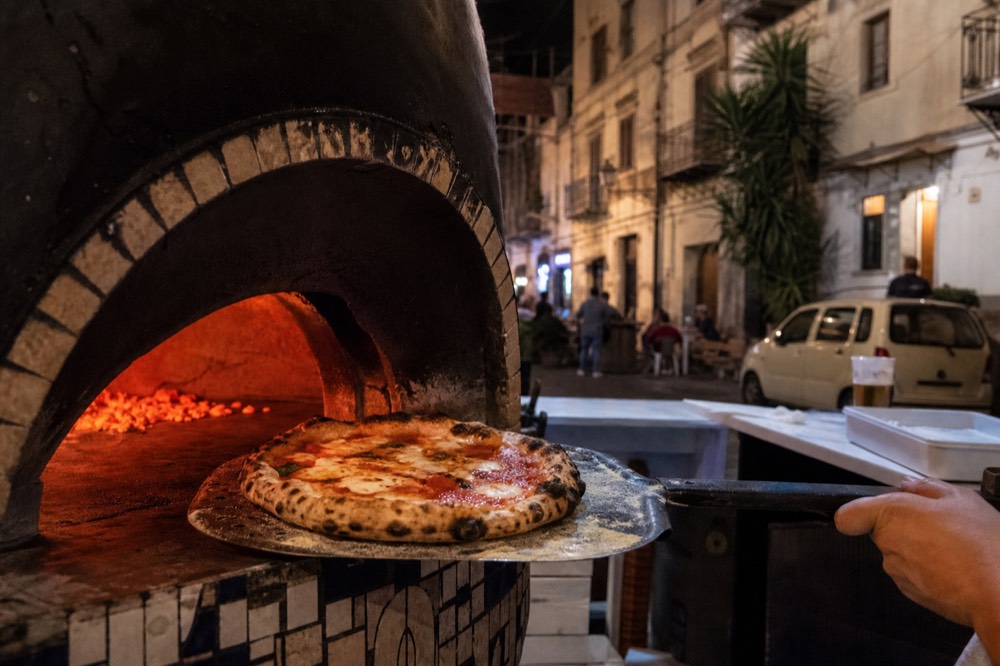
Prices have moved, and fast. Local reporting on the historic centre found that a pizza with a drink now averages 14.56 euros across the city, on a range running from 9 to 28 euros, after a rise of roughly 60 percent over five years, the sharpest increase recorded nationally. You can read the piece on Il Sicilia's site. The practical consequence for a visitor is mild: pizza in Palermo is still fair value by the standards of most European capitals, but it is no longer the near-free meal older guidebooks describe.
How Much Does Pizza And Sfincione Cost In Palermo?
Budget roughly 15 euros for pizza and a drink in Palermo, which is the city's current average, with the spread running from about 9 to 28 euros. Fried street snacks in the historic centre run 3 to 4.50 euros. Sfincione is sold by the slice at market counters, so ask the price at the counter before you commit.
The two food traditions sit in different price brackets, and knowing that shapes a day. A sit-down pizza dinner is a 15-euro-ish proposition at the citywide average, more at the top of the range. The street-food canon, the arancine and panelle sandwiches sold in the historic centre, runs 3 to 4.50 euros a piece, a figure that local reporting notes has roughly doubled since 2021. Sfincione belongs to the second bracket, not the first. It is market food, priced and eaten like market food.
| Item | Typical price | Notes |
|---|---|---|
| Pizza plus a drink | 14.56 euros average, 9 to 28 range | Citywide average |
| Arancina or panelle panino | 3 to 4.50 euros | Historic centre |
| Sfincione slice | Check the counter | Sold by the slice at market stalls |
Two honest caveats. First, the price of a single sfincione slice is not reliably published anywhere this site could verify, so the right move is simply to ask before pointing. Second, the doubling of street-snack prices since 2021 is a tourism-driven shift that local residents feel more sharply than visitors do, and the same reporting that documented it also documented resident frustration. Paying the posted price without haggling is normal; expecting 2021 prices is not realistic.
Where To Try Sfincione In Palermo
The Capo market is the classic address: the Comune di Palermo's tourism portal names sfincione among the street foods its hawkers sell there. Beyond the Capo, friggitorie and market stalls across Ballarò and the historic centre sell it by the slice, and a guided walk is the most reliable way to find the good counters.
The Capo has the official endorsement, but the practical advice is broader. Sfincione travels with the friggitorie, the fried-and-baked snack shops that anchor Palermo's street-food scene, and with the market stalls generally. Ballarò, the largest of the historic markets, carries its own selection, and our Ballarò market guide covers the ground in detail. The honest warning from recent visitor reports is that quality at the big markets varies, with some stalls reheating rather than baking, so a counter with a queue of locals is a better signal than a stall with a menu in four languages.
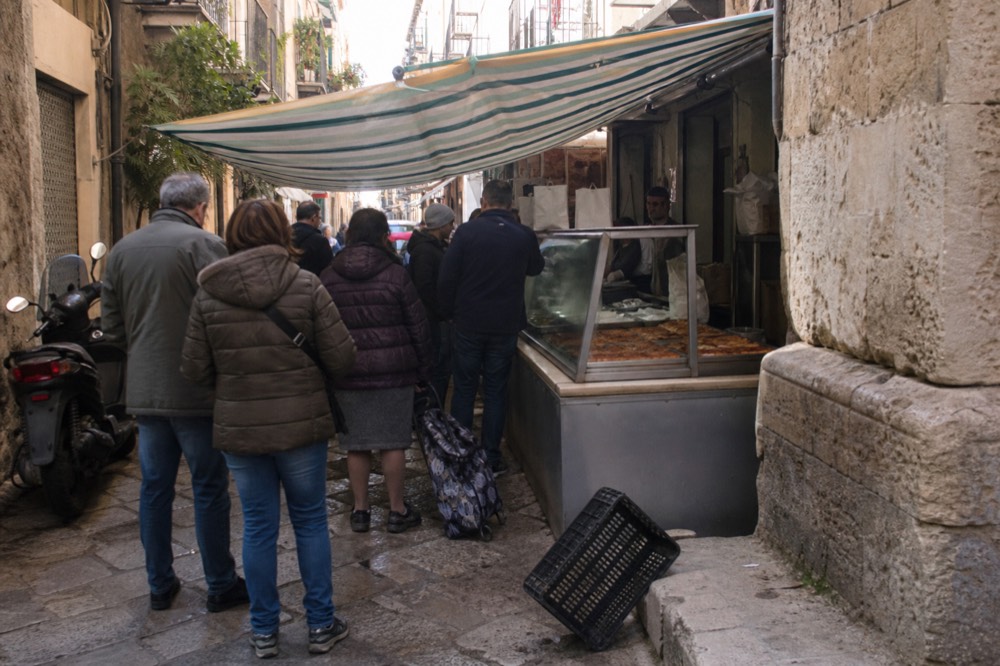
This is where a guide earns their fee. The difference between a reheated slice and a fresh one is the difference between understanding sfincione and wondering what the fuss was about, and no amount of online research reliably tells you which counter does which. The walks on Palermo Food Tours exist partly for this reason: they route you through the stalls that still bake, in the company of someone who knows the difference. For the full sweep of dishes beyond sfincione, our traditional Sicilian food primer is the companion read.
One market walk built around exactly these streets is the Street Food Tour in Ballarò and Vucciria Markets, run by Alessandro Morreale. It runs about three hours, from $92.91 per person, holds a perfect 5 rating across 17 reviews, and can be cancelled free up to 24 hours before. The review count is small, so read the recent feedback yourself, but the itinerary is the deepest market route of the walks listed here.
Is A Food Tour The Best Way To Taste Sfincione?
For most visitors, yes. A food tour puts sfincione in front of you alongside panelle, arancine and the rest of the canon, with a guide who knows which counters reheat and which bake fresh. Palermo's walks run from $39.83 to $92.91 per person, and the cancellation policies differ sharply, so read them before booking.
The cancellation point deserves its own paragraph, because it is the sharpest real difference between the operators. Most of the tours in the city's roster, nineteen of the twenty-two listed on this site, offer free cancellation up to 24 hours before departure. Three do not, and all three of those are Streaty Food Tours products, including the Original Palermo Street Food and Market Tour, which is otherwise one of the best-reviewed walks in the city. That tour runs about three hours from $81.64 per person, holds a 4.9 rating across 2308 reviews, and caps its departures at 12 spots. If your plans are firm, the reviews say it is excellent value. If they are not, book a refundable walk instead.
| Tour | Operator | Price | Rating | Duration | Cancellation |
|---|---|---|---|---|---|
| Palermo: Street Food and History Walking Tour | Cavallaro Fabrizio | from $56.91 | 4.9 across 1672 reviews | 3 hours | Free up to 24 hours |
| The Original Palermo Street Food and Market Tour | Streaty Food Tours | from $81.64 | 4.9 across 2308 reviews | 3 hours | Non-refundable |
| Street Food Tour in Ballarò and Vucciria Markets | Alessandro Morreale | from $92.91 | 5 across 17 reviews | 3 hours | Free up to 24 hours |
The all-inclusive Streaty walk is the one to single out if you want the market canon explained at full length, since the tastings are built into the ticket rather than bought as you go.
Whichever you choose, the underlying logic is the same. Sfincione is a street food with a quality problem, sold from counters you cannot evaluate from a search result, in a city where the famous markets have shifted toward tourists and the best baking has partly moved to specialist shops. A three-hour walk with a local guide solves that problem for roughly the price of a restaurant dinner, and it leaves you with the rest of the afternoon to order a round pizza, compare, and settle the question for yourself.
The short version: Sicilian pizza as sold abroad is not a Sicilian thing, sfincione is, and it costs a fraction of a sit-down pizza. The questions below cover the split between the two traditions, what sfincione bianco is, where to find a fresh slice in Palermo, and what pizza actually costs in the city's pizzerias right now.
Common Questions About Sicilian Pizza In Sicily
Is Sicilian Pizza A Thing In Sicily?
Not as such. The thick rectangular "Sicilian slice" sold abroad is an export style. Sicily's homegrown equivalent is sfincione, a thick, soft baked dough sold by the slice at market stalls and friggitorie, while the island's pizzerias serve round pies baked to order.
Is sfincione the same as pizza?
No. Sfincione is a separate tradition: a thick baked dough sold by the piece as street food, listed on Sicily's official register of traditional foods and sold at market counters rather than pizzerias. It fills the same role pizza fills elsewhere, cheap, filling street food eaten standing, but it is its own dish.
What is sfincione bianco?
The white sfincione, the version without tomato, is the symbol product of Bagheria, the town that celebrates it every November at Sfincione Fest on Corso Umberto I. The red version follows the broader Sicilian tradition and is the one you will mostly meet in Palermo.
Where can I try sfincione in Palermo?
The Capo market is the classic address, and the Comune di Palermo's tourism portal names sfincione among the street foods sold there. Ballarò and the friggitorie of the historic centre carry it too. A guided food walk is the most reliable way to find the counters that bake fresh.
How much does pizza cost in Palermo?
A pizza with a drink averages 14.56 euros across the city, on a range of 9 to 28 euros. Fried street snacks such as an arancina or a panelle panino run 3 to 4.50 euros in the historic centre, and sfincione is priced by the slice at the counter.