What Do Sicilians Call Arancini?
Sicilians do not agree on one word: Palermo says arancina, Catania says arancino, and the Accademia della Crusca has settled why. The full naming story, with tour ideas for tasting both.
What Do Sicilians Call Arancini?
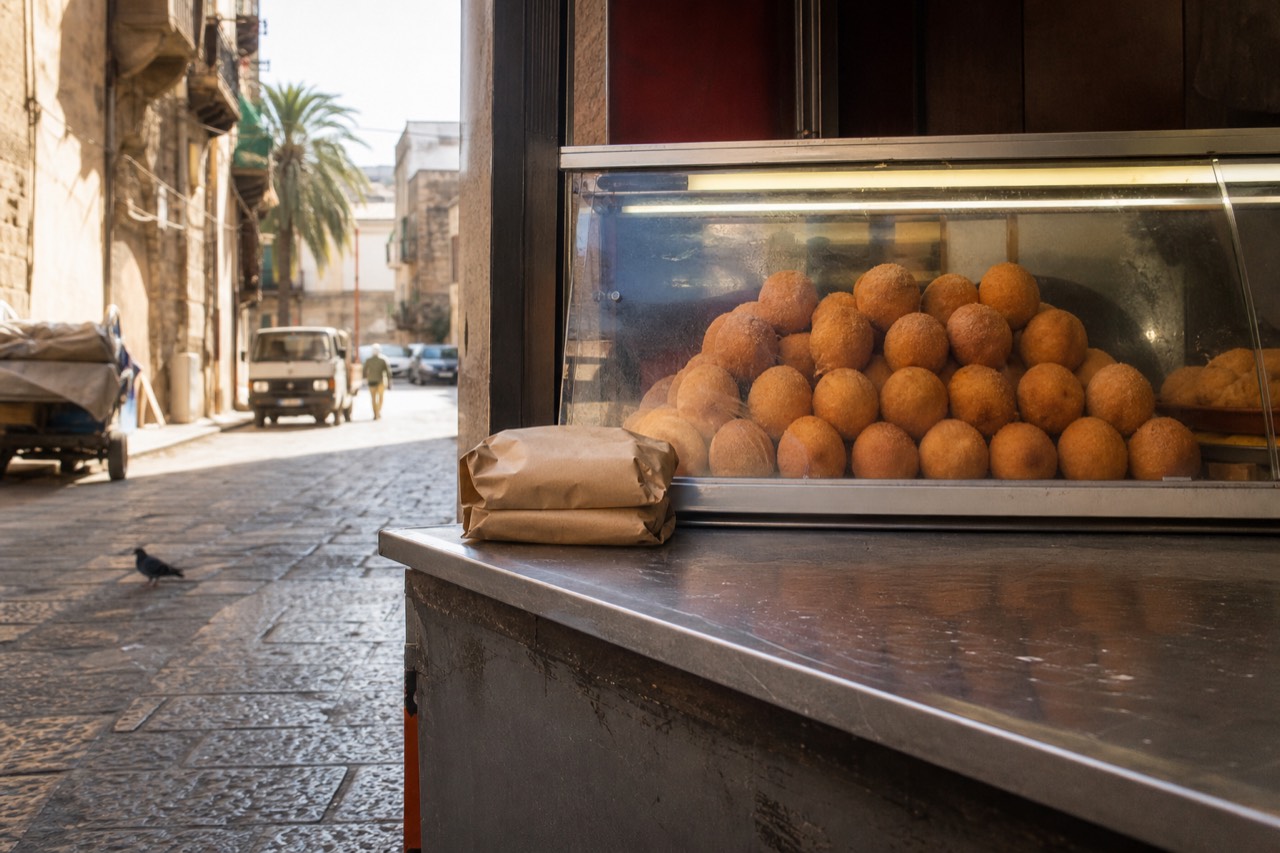
Sicilians use two different names depending on region: in Palermo and western Sicily the rice balls are called arancina, while in Catania and eastern Sicily they are known as arancino. Both terms are correct, and the split reflects the island's linguistic divide rather than any difference in the food itself. The Accademia della Crusca, Italy's highest authority on the language, settled the question in a consultation published in January 2016: the feminine arancina is round and standard in western Sicily, while the masculine arancino is round or cone-shaped in the east. Neither form is a mistake, neither side is going to concede, and the argument has been running in bakeries and bars across the island for generations without any risk of resolution. Visitors who spend more than a day in Sicily will hear it happen live, usually over a plate of the very things being argued about.
That is the short answer, and it is the one you will hear repeated in every bar and friggitoria from Trapani to Taormina. But the longer story is far more interesting than a simple east-versus-west rivalry. The naming split maps onto a genuine grammatical difference between standard Italian and Sicilian dialect, the earliest dictionary records describe a completely different dish from the one fried today, and the beloved story that the rice ball is an Arab inheritance does not survive contact with the written record. There is even a fixed date on the Palermo calendar when the feminine form becomes a collective civic act, which tells you how much identity is folded into a single vowel ending.
The dish itself is officially recognised. The Sicilian Region's agriculture department lists "Arancini di riso" among its traditional agri-food products, in the gastronomy category, despite the masculine form. Sicily carries 293 recognised traditional products in total, according to the regional wine and oil institute's June 2025 edition of its quality-products catalogue, and the rice ball sits in the same family as panelle, crocche di patate and stigghiola, all of them foods of the friggitoria rather than the restaurant. So the island's own government uses the eastern masculine name for a dish that western Sicilians insist on calling feminine, a wrinkle that tells you how contested the word really is, and how comfortable Sicilians are with official and street usage disagreeing in plain sight.
If the naming debate has made you hungry rather than confused, the practical way to settle it is to eat your way across the city. Palermo has a deep bench of guided walks that stop at the friggitorie where the argument happens in real time, and standing at a fry counter with a paper-wrapped arancina is worth more than any amount of reading about one.
Why Does Palermo Say Arancina And Catania Say Arancino?
The difference comes down to grammar rather than rivalry: in Sicilian dialect the word for orange is masculine, giving arancino, while standard Italian treats fruit names as feminine, giving arancina. Catania's arancino reflects the local Sicilian form, while Palermo's arancina actually follows standard Italian grammar, making it the more formally correct version rather than a matter of civic pride. Crusca's finding is that the feminine in the west reproduces the standard Italian model, where the fruit arancia is feminine and the tree arancio is masculine, while the eastern masculine follows the Sicilian dialect form. The campanilismo, the local rivalry, runs in the opposite direction from the grammar, which is the part that makes linguists smile.
This is the detail almost every food blog gets backwards. The usual telling is that Palermo guards its feminine arancina as an act of stubborn local identity against the Italian mainland, a little piece of dialectal resistance kept alive out of pride. When Crusca actually analysed the morphology, the reverse turned out to be true. Palermo's form is the one aligned with the dictionary; Catania's is the one carrying the dialect. A Palermitan saying "arancina" is, grammatically speaking, using better standard Italian than a Catanian saying "arancino", which is precisely why the debate amuses the linguists and exasperates everyone else. Identity and grammar have simply pointed in different directions here, and nobody on either side is troubled by it.
There are exceptions, and they are charming. Crusca notes that parts of the Ragusa and Siracusa areas in the south-east also use the feminine arancina, breaking the tidy east-west line that the map in most people's heads implies. The reason is local and rather lovely: in those districts the commonest dialect word for the fruit was never aranciu at all but partuallu, a different word entirely, so when the Italian word arrived in the area it came in as the standard feminine arancia, and the rice ball went feminine along with it. The border between the two words is not the border of a region but the border of a dialect word for an orange.
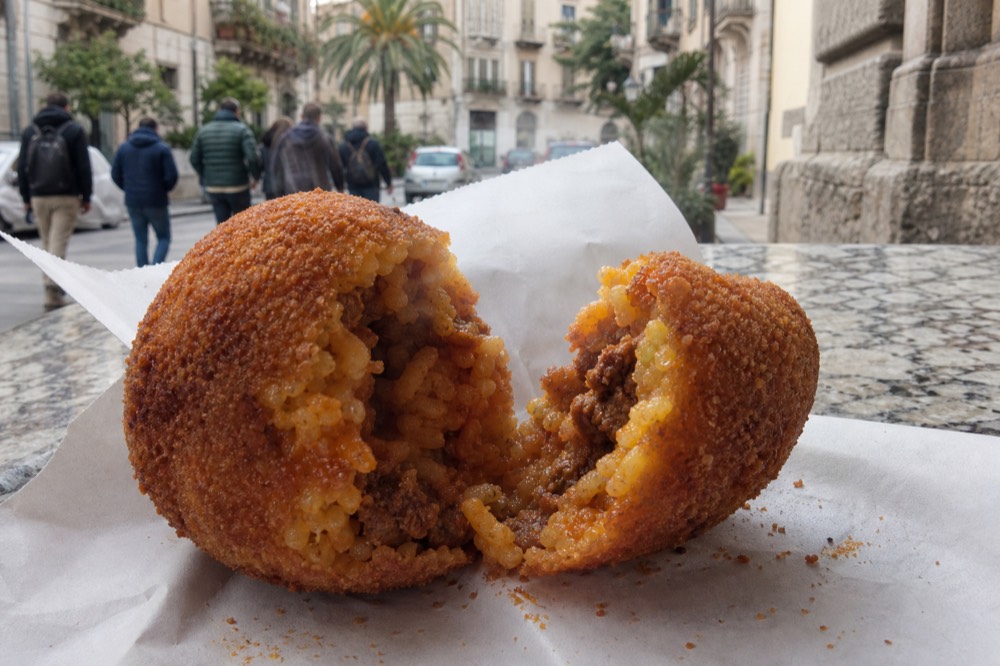
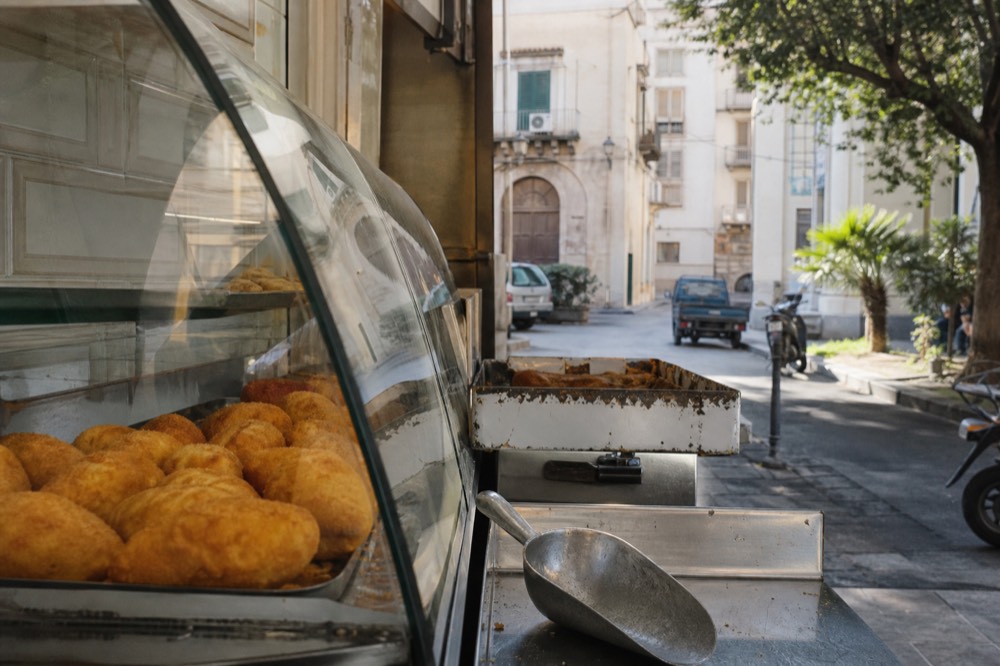
The shape follows the gender more often than not. In Palermo the arancina is round, which the Crusca commentary links to the fruit it resembles, a golden sphere the size of a small orange. In Catania the arancino is frequently conical, a shape some say echoes the profile of Mount Etna looming over the city, though Crusca offers that only as a possibility, with a "potrebbe", never as fact. Visitors usually notice the shape difference before they ever notice the word, because the two objects genuinely look different sitting side by side on a counter, even when the rice and the filling inside are essentially the same.
Wondering where to taste the difference for yourself? A guided walk through the historic centre solves it in one afternoon, and the roster includes tours with free cancellation up to 24 hours, so you can hold a spot without locking anything in.
What Did Arancine Look Like When The Word Was First Written Down?
When Giuseppe Biundi recorded the word arancinu in his 1857 Sicilian-Italian dictionary, he described a sweet rice dish shaped like a bitter orange, containing neither meat nor tomato, so the earliest written form was a dessert-like confection rather than the savory stuffed ball we know today. Antonino Traina's 1868 vocabulary similarly cross-refers it to crucche, little patties made of rice or potato or other things. The savoury fried ball we eat today, golden with ragu and peas sealed inside, is a late transformation of something that started out as a sweet, and the written evidence for that transformation is unusually complete for a street food.
This is the single most surprising fact in the whole naming story, and it comes from the most authoritative source available. The Accademia della Crusca's linguistic consultation, published in January 2016, traced every attestation of the word through Sicilian and Italian dictionaries and found no trace of the preparation, in literature, chronicles, diaries, ethnographic texts or recipe books, before the second half of the 19th century. For a dish that most people assume is ancient, that is a remarkably short paper trail. You can read the full consultation on the Accademia della Crusca's own site, and it rewards the read, because it is one of the few food-linguistics documents written with genuine scholarship rather than enthusiasm.
The paper trail, once it starts, is rich. Federico De Roberto's novel I Vicere, published in 1894, mentions "arancine di riso grosse ciascuna come un mellone", rice arancine each as big as a melon, a size that suggests these were already substantial eating rather than a dainty sweet. Zingarelli's dictionary of 1917 glosses the feminine form as a pasticcio of rice and minced meat in Sicily, showing the savoury version had fully arrived by then. Panzini's Dizionario moderno first recorded the masculine arancino in its 1942 edition, flagged as Sicilian dialect, and it is the masculine that later reference works and the Ministry of Agriculture's own traditional-products list adopted, which is how the masculine ended up on the official paperwork while the feminine kept the streets of Palermo.
Crusca also records a second etymological hypothesis worth knowing. Rather than the shape, the name may come from the colour: Sicilian forms colour adjectives with the suffix -inu, so arancinu would mean simply orange-coloured, in the same pattern as curaddinu, coral-coloured, or frumintinu, wheat-coloured. Under that reading, the name describes the fried golden hue rather than the round form. Two plausible origins, no settled winner, and Crusca declines to pick.
| Source and year | Form recorded | What it describes |
|---|---|---|
| Biundi, Sicilian-Italian dictionary, 1857 | arancinu | A sweet rice dish shaped like a bitter orange |
| Traina, New Sicilian-Italian vocabulary, 1868 | arancinu | Cross-refers to crucche, small patties of rice or potato |
| De Roberto, I Vicere, 1894 | arancine | Rice arancine each as big as a melon |
| Zingarelli dictionary, 1917 | arancina | A pasticcio of rice and minced meat, in Sicily |
| Panzini, Dizionario moderno, 1942 | arancino | First Italian-lexicography attestation, flagged as Sicilian dialect |
Is The Arancina Really An Arab Inheritance?
No, the Arab inheritance is doubtful. Crusca states plainly that the link between the Sicilian rice ball and Arab tradition "no longer seems so certain," and that the likelier account is a mid-to-late 1800s sweet rice dish that turned savoury almost immediately. The tomato, which colours the rice in the classic Palermo version, only began to be cultivated in the south of the peninsula at the start of the 19th century. Neither meat nor tomato appears in any 19th-century attestation of the word, which is a serious problem for any story that places the modern dish centuries earlier.
This matters because the Arab-origin story is repeated everywhere, usually with total confidence and often with invented details. Palermo's Arab period, from the 9th to the 11th century, genuinely transformed Sicilian agriculture and cooking, and rice did arrive on the island in that era, so the story sounds plausible on its face. Saffron, citrus, dried fruits and the sweet-and-savoury palate that defines so much Sicilian cooking all have roots in that period, and archaeologists working at Mazara del Vallo have found aubergine, spinach, watermelon and citrus in Islamic-period deposits. But sounding plausible and being documented are different things, and the Italian language's own referee has looked at the documents and declined to confirm the rice ball's Arab pedigree. The honest position, which almost no food page takes, is that the arancina appears to be a 19th-century invention built from old ingredients, which is a different thing entirely from an old dish.
It is a reminder of how much of what passes for Sicilian food history is really Sicilian food storytelling, polished by repetition until the hedge words fall away. The same caution applies elsewhere on the table. Two authoritative Italian bodies, the Treccani encyclopedia and the Sicilian Region's own technical sheets, flatly disagree about whether the word cassata comes from Latin caseus, cheese, or Arabic quas'at, a bowl. When the institutions cannot agree on etymology, a blog certainly should not, and the same humility belongs in front of the arancina.
For a visitor, none of this diminishes the eating. If anything it sharpens it. Knowing that the arancina is young, contested and grammatically peculiar makes the thing in your hand more interesting, not less, and Palermo is the best place on the island to hold the argument in your hand while you eat it.
Arancina Day: When Palermo Celebrates The Word Itself
Palermo observes 13 December, the feast of Santa Lucia, as a day of mass arancina consumption, with the fried rice balls eaten in the burro or carne versions across the city, and Sicilian press coverage in recent years has branded the date Arancina Day. It is the one date on the calendar when the naming question becomes civic identity: Palermo eats its feminine, round rice balls as a collective act, and the masculine form is nowhere to be heard in the city that day. For a word that is supposedly just a word, that is quite a performance.
The Santa Lucia connection is the traditional custom of avoiding bread and pasta on the saint's day in Palermo, with rice-based and sweet fried foods taking their place at the table. The arancina, round and golden and unmistakably rice at its core, is the poster food of the switch, and the comet-like shape of the ccuccia, the wheat-berry sweet also eaten that day, gets equal billing in the pastry shops. Bakeries and friggitorie queue out of the door from the morning, and the local press runs its annual round of rankings, arguments and earnest investigations about where the best ones are fried that year.
The word has even reached the arts. The masculine form is the title of Andrea Camilleri's 1999 Montalbano story collection "Gli arancini di Montalbano", which Camilleri, an eastern Sicilian from Agrigento province, naturally spelled masculine, and which Crusca cites as an example of the form's literary pedigree. A single island, two genders, and both of them literary, with a fictional detective's name on one of them. That is a rare distinction for any fried food.
For anyone planning a trip around the food calendar, mid-December is a genuinely good moment to be in Palermo: the Christmas season is beginning, the fried-food culture peaks, and the summer tourist crowds have thinned out completely. The trade-off is short daylight, with mid-January offering under ten hours between sunrise and sunset and the light gone before a quarter past five, so plan market mornings accordingly and keep the arancina runs flexible through the afternoon and evening.
How Do You Order One Like A Local?
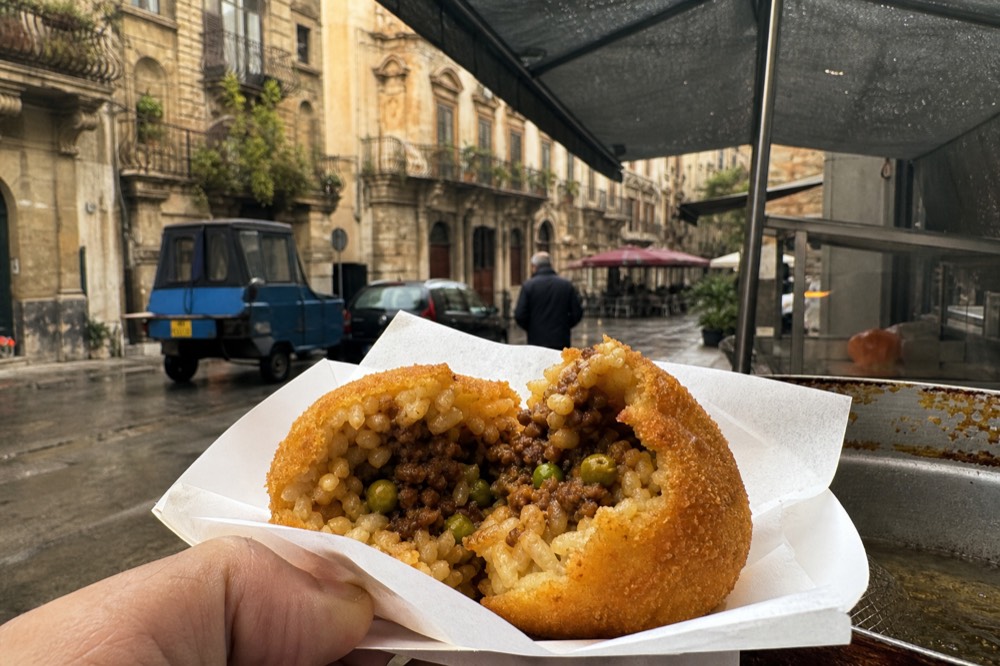
In Palermo, simply ask for "na arancina" and name your filling: al burro for the butter, ham and cheese version, or alla carne for meat ragu with peas. Say it exactly this way and you will be understood anywhere in the city, ordering like a true local. In Catania the same request is "nu arancino", with the masculine article, and the conical shape is often the default on the counter. Nobody will correct a visitor who says the wrong one, though in Palermo a feminine noun said with a masculine article will earn a smile, and possibly a gentle correction delivered with the change.
In the historic centre of Palermo, an arancina or a panelle sandwich runs about 3 to 4.50 euro, according to 2026 reporting in the local press on centro storico prices, roughly double 2021 levels, driven by the shift of the centre's food economy toward tourism. That reporting is worth taking seriously before you budget: prices in the centro storico have risen faster than anywhere else in the city, the increases have been steepest on the items visitors buy most, and the trend is a live local political issue rather than a background grumble. A few streets outside the tourist core, the same snack costs noticeably less.
| Term | Where used | What it means |
|---|---|---|
| Arancina (feminine) | Palermo and western Sicily | The round fried rice ball |
| Arancino (masculine) | Catania and eastern Sicily | The rice ball, often conical |
| Al burro | Everywhere | Filled with butter, ham and cheese |
| Alla carne | Everywhere | Filled with meat ragu and peas |
| Rosticceria | Palermo | The fry-shop category that sells arancine, iris and savoury pastries |
| Iris | Palermo | A round sweet fried dough filled with ricotta cream, its own PAT-listed product |
A note on the plural, which trips up Italian learners constantly: the feminine plural is arancine, the masculine plural is arancini, and the title question of this page is itself the debate in miniature. Sicilians are used to hearing both forms from outsiders, and the argument is affectionate rather than hostile, more banter than grievance. If you want to sound local in Palermo, order in the singular, name the filling without hesitation, and eat it standing up while it is still too hot to hold comfortably, rotating it in the paper like everyone around you.
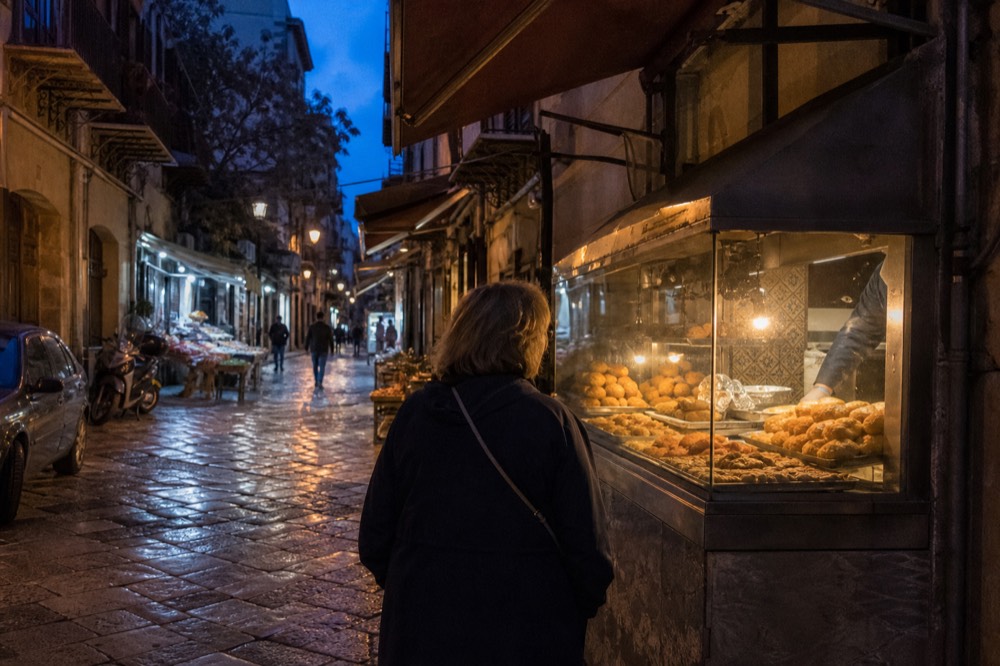
The Best Way To Taste The Difference In Palermo
The naming question is fun, but the food is the point, and Palermo offers several structured ways to eat through the debate: a guided street food walk puts you in front of the right friggitorie with someone who can narrate the arancina-versus-arancino argument while you chew, which beats reading about it later. The walks below are the ones that pair best with this particular mission, covering the fried-food canon, the markets that feed it and the kitchens where the rice gets rolled by hand, so you can compare formats and prices in one place before committing an afternoon.
The Palermo Food Tour by Secret Food Tours is the strongest fit for this particular mission, and it is the tour this site pairs with the story because the tasting list matches the subject exactly. It covers ten or more tastings including arancini, cannoli and wine, runs 3 hours 30 minutes, holds a 5 rating across 782 reviews, and costs from $89.33 per person with free cancellation up to 24 hours. Only 12 spots per departure, so it suits travellers who book ahead rather than those deciding on the morning of. Check availability if the tasting count appeals, and see our Secret Food Tours tasting walkthrough for what the route covers. For everything else the city fries, Palermo Food Tours keeps a full roster across walks, markets and cooking classes.
For a smaller-budget comparison, the Sicilian Street Food Tour by Do Eat Better runs the same 3-hour format from $52.06 per person, rates 4.9 across 1355 reviews, and also caps groups at 12 with free cancellation up to 24 hours. It is a same-family alternative with a lower entry price, useful when the calendar is tight or the budget prefers two tours to one, and the small-group cap means you will actually hear the guide's commentary in a crowded friggitoria rather than reading lips from the back.
And if the naming debate has made you curious about what goes inside the rice, a cooking class settles it in the kitchen. At Casa Di Cilla, a 5-hour class in a real Palermo home kitchen rated 5 across 391 reviews and limited to 10 guests, you learn the rice, the ragu and the frying from someone who has been saying "arancina" since before she could spell it. It runs from $132.51 per person with free cancellation up to 24 hours, and the class covers the full arc from shopping to sitting down at the table.
Our fuller treatment of the city's fried-food canon is in the Palermo street food guide, and the story of where Sicilian food separates from mainland Italian cooking is traced in Sicilian food versus Italian food.
Common Questions About Arancini Names
What Do Sicilians Call Arancini?
Palermo and western Sicily say arancina, feminine and round. Catania and eastern Sicily say arancino, masculine and often cone-shaped. The Accademia della Crusca confirms both are correct: the feminine follows standard Italian grammar, the masculine follows Sicilian dialect.
Is arancina or arancino correct?
Both. Crusca's verdict is that the feminine arancina reproduces the standard Italian model, where the fruit is feminine, while the masculine arancino italianises the Sicilian dialect form aranciu. Regional preference decides which word you will hear, not correctness.
Why is Palermo's round and Catania's pointed?
The Palermo arancina is round, resembling the orange it is named for. The Catanian arancino is frequently conical, a shape some link to the silhouette of Mount Etna, though Crusca offers that only as a possibility, not a fact.
Did the Arabs invent the arancina?
Probably not, according to the Accademia della Crusca. No written trace of the preparation exists before the late 19th century, the earliest dictionary record describes a sweet rice dish, and tomato only entered southern Italian cultivation in the early 1800s. The likelier origin is a 19th-century sweet that turned savoury.
What is Arancina Day?
13 December, the feast of Santa Lucia, when Palermo traditionally avoids bread and pasta in favour of rice-based and fried foods. Arancine al burro and alla carne are eaten citywide, and the local press covers it as Arancina Day.
What fillings should I ask for?
The two classics are al burro, with butter, ham and cheese, and alla carne, with meat ragu and peas. Both are standard in Palermo friggitorie, and naming the filling when you order is the local habit.