What Food Is Palermo Famous For?
Palermo is famous for panelle, arancine, sfincione, cannoli and granita, sold across four historic markets. Here is the canon, where to eat it and what it costs.
What Food Is Palermo Famous For?
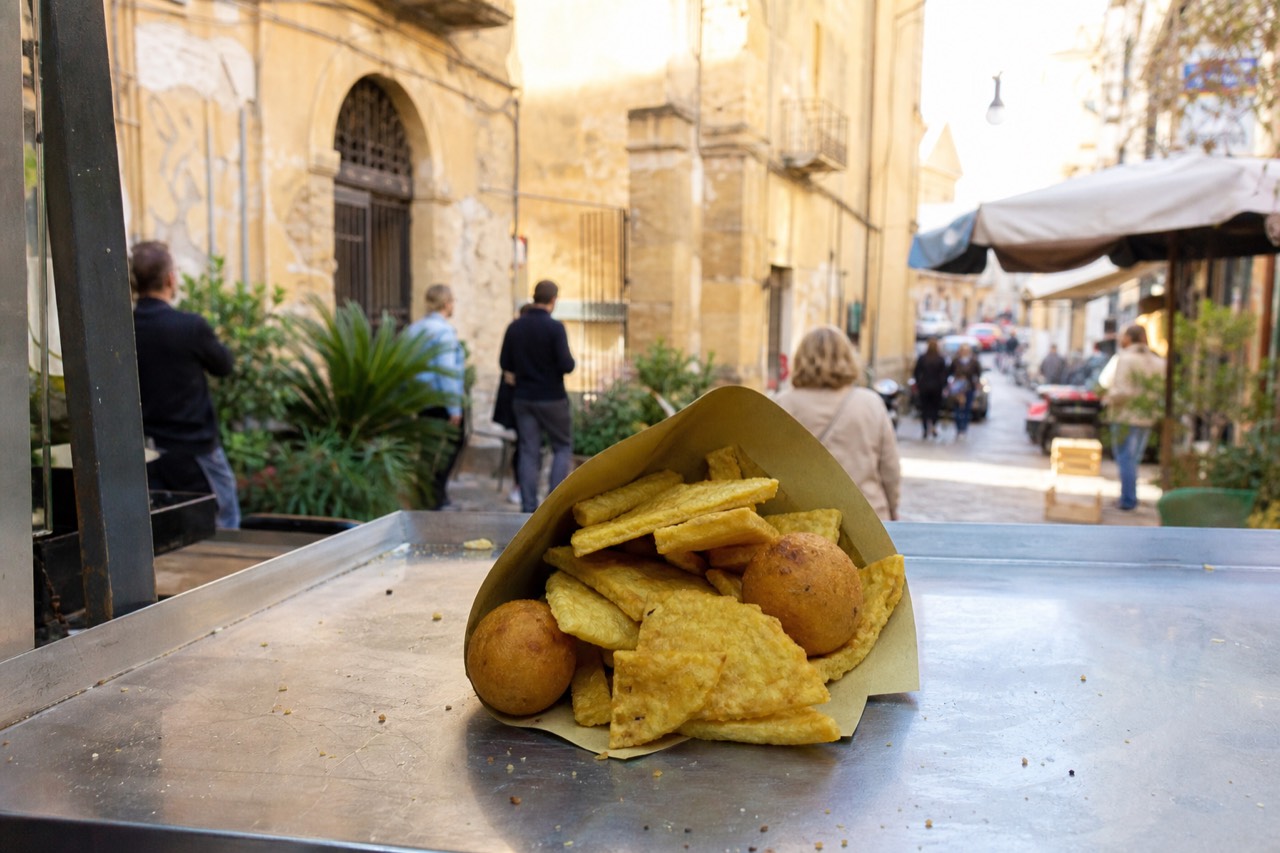
Palermo is famous for fried street food eaten standing up: panelle, arancine, crocché, sfincione and pane con la milza, plus sweets like cannoli, cassata and almond granita with brioche. Most of it is sold in the four historic markets, Ballarò, the Capo, the Vucciria and Borgo Vecchio, where the shouted vendor cry, the abbanniata, is part of the show.
That is the short answer, and it happens to be checkable in a way most food-city claims are not. Italy keeps an official national list of traditional food products, the PAT list, and the Palermo canon is all over it: panelle, crocché, stigghiola, sfincione, iris, caponata, cannoli and cassata are each named there, with government-published technical sheets describing how each one is made. Sicily carries 293 PAT products in total, which is more than most visitors would guess, and the fried snacks Palermo is famous for sit inside a documented national scheme rather than a marketing line.
The fame is also older and more specific than the current wave of food travel writing suggests. Palermo has been trading on a 2012 Forbes street food ranking for well over a decade, a ranking that turns out, on inspection, to be a reader poll run by a travel website that no longer exists. The city's food reputation deserves better sourcing than that. Every claim below comes from an official Italian body, the city's own tourism portal, or dated local reporting, and where the sources disagree, the disagreement is shown rather than smoothed over.
What follows is the canon in full. The fried savouries come first, then the sweets, then the naming argument every visitor stumbles into within their first hour, then the markets where the food actually lives, and finally what everything costs now that prices have moved.
Which Palermo Foods Are On Italy's Official Traditional List?
Nine Palermo staples sit on Italy's official PAT list of traditional food products: arancini di riso, panelle, crocché di patate, stigghiola, iris, sfincione, caponata di melanzane, cannoli and cassata. Sicily carries 293 PAT products in total, and panelle is the one item whose official production territory is the city of Palermo itself.
The PAT scheme, Prodotti Agroalimentari Tradizionali, was created by Italian legislation in 1998. To qualify, a product's preparation, conservation and ageing methods must have been practised in a consistent, traditional way for not less than 25 years. The national list is revised annually, and Sicily's count stands at 293 products as of the twenty-fifth revision, issued in March 2025. This is the machinery behind the word "traditional" on a Palermo menu, and it is worth knowing which foods actually carry the designation.
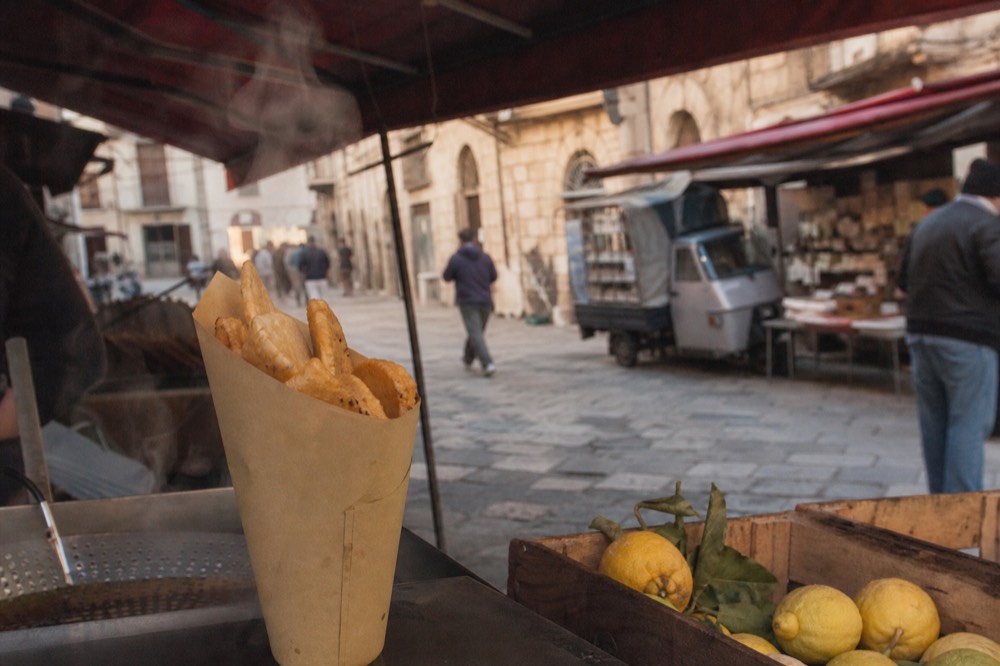
For Palermo the list matters because it separates documented tradition from folklore. Panelle is the standout. Its official production territory is the city of Palermo and parts of its province, the only canon item whose territory is the city itself, and the technical sheet is precise to the point of fixing the batter at half a centimetre thick before it is cut cold into rectangles, deep-fried and served very hot. The other items are listed with their own territories and descriptions:
| Food | Official PAT status | What the official sheet says |
|---|---|---|
| Panelle | Listed; territory is the city of Palermo and parts of its province | A chickpea-flour batter with water, salt and pepper, deep-fried and served hot |
| Arancini di riso | Listed; production territory is the whole island | Typically spherical, filled with meat, or ham and mozzarella, or spinach |
| Crocché di patate | Listed | Potato croquettes, a friggitoria staple |
| Stigghiola | Listed | Lamb intestine with caul fat, onion and pancetta; the sheet sets a 72-hour shelf life |
| Iris | Listed; territory of Palermo | Round sweet fried dough filled with ricotta cream |
| Sfincione | Listed | A Palermo street bake; the white version is Bagheria's symbol product per the town's own site |
| Caponata di melanzane | Listed; territory is western Sicily | Fried aubergine with celery, olives, tomato, onion, capers, sugar and vinegar |
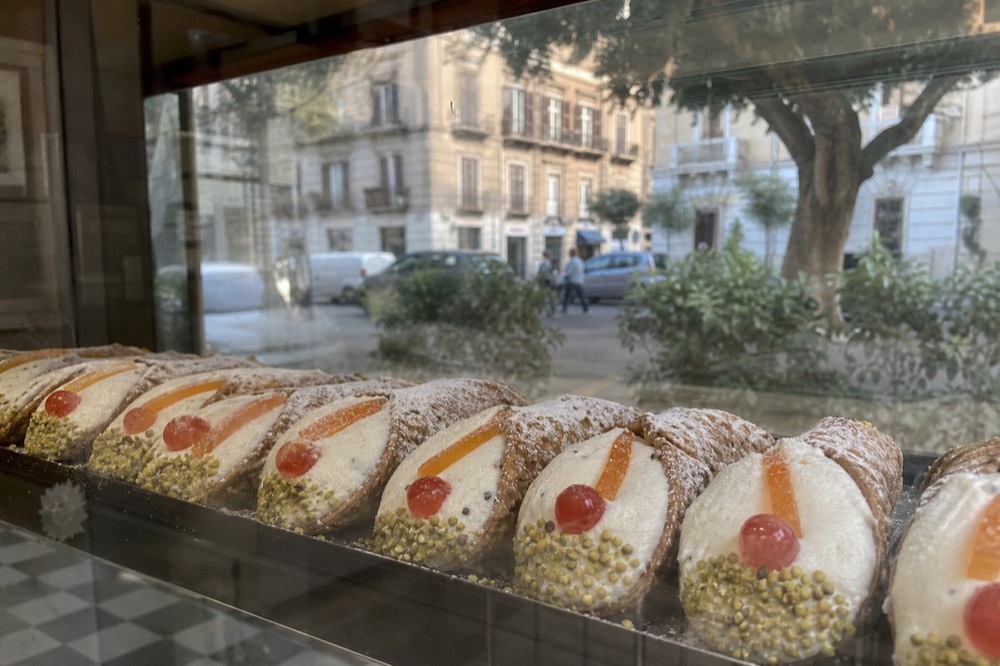
| Cannolo | Listed; territory is the Trapani area, not Palermo | A fried shell filled with sheep's-milk ricotta |
The negative list is just as useful, and almost nobody publishes it. Pani ca meusa, frittola and babbaluci are not on the Sicilian PAT list, despite being among the foods most associated with the city. The Comune di Palermo's tourism portal does list pane con la milza among the street foods sold at the Capo market, so its presence there is real and official. What is missing is any authoritative source for the sandwich's much-repeated origin stories and definitions, and this site declines to repeat them. The same caution applies to the often-claimed Slow Food recognition for Palermo street foods: direct searches of the Slow Food Foundation's own site return nothing for panelle, arancine or sfincione. Snails do appear on the PAT list under the name Vaccareddi, though the popular Palermo word for them does not.
For dish-by-dish detail, the Regione Siciliana's official PAT technical sheets publish the full descriptions, and our guide to Palermo street food covers where to find each item on the ground.
What Sweets Is Palermo Famous For?
Cannoli, cassata siciliana and granita with a brioche are the three sweets Palermo is most famous for. All three are PAT-listed, and all three carry surprises: the official cannolo territory is the Trapani area rather than Palermo, cassata has a paper trail to 1575, and two authoritative Italian sources disagree about where the word cassata even comes from.
Start with the cannolo, because the territory detail genuinely surprises people. The official technical sheet's production territory for the cannolo alla ricotta is Paceco, Erice, Trapani and Valderice, the Trapani area, not Palermo. The name comes from the cane, Arundo donax, around which the shell was originally rolled before frying. The filling specified is sheep's-milk ricotta with sugar, optionally candied fruit or chocolate. Palermo has its own cannolo culture regardless, and the town most cited by Sicilians for the definitive version is Piana degli Albanesi, in the Palermo hills, which now runs an annual Cannolo Fest; the second edition was held on 16 and 17 May 2026 with pastry shops from across the island.
Cassata is the older sweet, on paper at least. The PAT sheet specifies a sponge cake soaked in fortified wine, filled with ricotta cream enriched with chocolate, covered in sugar glaze and candied fruit, and records it as the traditional Easter dolce. Its documentation reaches back to a Synod of Mazara text of 1575 that lists cassata among the sweets indispensable at feast days. The etymology is genuinely contested: the Treccani encyclopedia derives cassata from the Latin caseus, cheese, while the Regione Siciliana's own sheet says it appears to come from the Arabic quas'at. Two official Italian bodies, two different answers. Present both, settle neither.
Granita rounds out the trio, and it is the breakfast. Treccani defines it as a type of sorbet of sugar solutions flavoured with lemon, coffee or fruit juice, agitated during freezing so it forms tiny ice crystals, and the PAT list carries granita di limone, granita di mandorla and granita di gelsi neri. The brioche used to scoop it is part of the ritual. Local press reported in 2026 that a brioche with gelato or granita now commonly costs 4 to 5 euros in Palermo, and that prices of 4.50 or 5 euros were provoking genuine local backlash as excessive for a traditional item. The iris, a round piece of Palermo rosticceria made of sweet fried dough filled with ricotta cream, deserves a mention too: its official territory is Palermo, making it the sweet sibling of panelle in that respect.
One practical note for anyone with allergies: European food information rules in force since December 2014 make allergen information mandatory for non-prepacked foods, including restaurants and market stalls, so a friggitoria is legally obliged to be able to tell you what is in the fryer.
Is It Arancina Or Arancino In Palermo?
In Palermo the rice ball is arancina, feminine and round; in Catania it is arancino, masculine and round or cone-shaped. The Accademia della Crusca settled the grammar in 2016: both are correct, and the split is purely geographic, with Palermo's feminine form actually following standard Italian while the east follows Sicilian dialect.
The Accademia della Crusca, Italy's foremost language academy, published a full consultation on the question in January 2016, and it is the single best-sourced linguistic fact on this entire subject. The geography is exact: arancina, round, in the western half of the island including Palermo; arancino, round or pointed, in the east including Catania, with pockets of the Ragusa and Siracusa areas breaking the pattern. The cone shape sometimes linked to the silhouette of Mount Etna is offered by Crusca as a possibility, not a fact.
The genuinely surprising part is the history. Crusca found no trace of the preparation in literature, chronicles, dictionaries, ethnographic texts or recipe books before the second half of the nineteenth century. The first Sicilian dictionary to record the word, Biundi's Sicilian-Italian dictionary of 1857, defines arancinu as a sweet rice dish shaped like a bitter orange. Neither meat nor tomato appears in the early records at all, and tomato cultivation in the south of the peninsula only began at the start of the nineteenth century. Crusca's conclusion is blunt: the link between the Sicilian rice ball and Arab tradition no longer looks certain, and the likelier account is a mid-to-late 1800s sweet that turned savoury almost immediately. Federico De Roberto's 1894 novel I Vicere already describes arancine di riso each the size of a small melon, so the savoury version arrived fast.
The grammar verdict is the fun part. Palermo's feminine arancina is the form that follows standard Italian, where the fruit is feminine and the tree is masculine. The eastern masculine follows the Sicilian dialect word aranciu. In other words, the campanilismo runs opposite to the grammar: Palermo's proud local form is the standard one. If you visit on 13 December, Santa Lucia, you will find the city celebrating its de facto Arancina Day with mass consumption of the things. The full detail is in the Accademia della Crusca's language consultation, which is worth reading in full before you argue with a local.
Which Palermo Markets Should You Eat In?
Ballarò, the Capo, the Vucciria and Borgo Vecchio are Palermo's four historic markets, all described on the city's own tourism portal. Ballarò trades Monday to Saturday from 07:30 to 20:00 and Sunday mornings mostly; Borgo Vecchio is a morning market; and the Vucciria's daytime food trade has largely given way to nightlife.
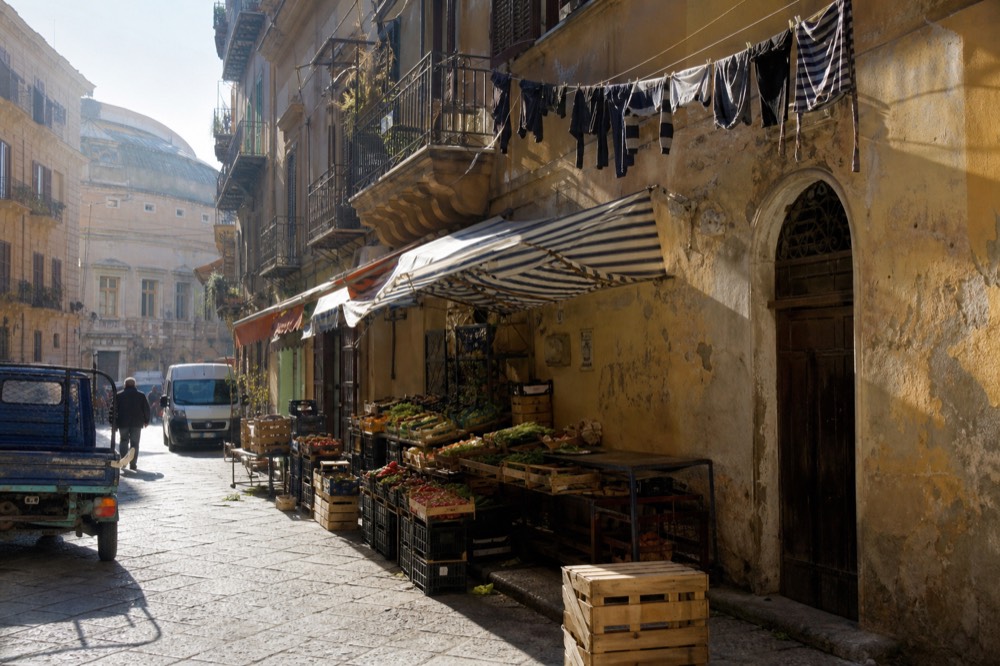
Ballarò is the one the city's own tourism portal calls the oldest and largest market in Palermo, a characterisation worth repeating with that attribution because there is no scholarly date behind it. It stretches from piazza Casa Professa to the bastions of corso Tukory, in the Albergheria quarter, and it is the only one of the four for which the Comune publishes exact hours: Monday to Saturday 07:30 to 20:00, Sunday predominantly mornings only. A guide of 1800 already described the piazza as a "piazza di grascia", grascia meaning foodstuffs, marking the traders' specialisation. Even the name is disputed: the Comune offers three competing hypotheses, from a village near Monreale, from a title of the sovereigns of the Sind region, or from a word meaning fair or market.
The Capo sits in the ancient Seralcadio quarter, entered principally through Porta Carini. It was historically the meat market; the Comune notes the dialect word for its butchers' shops is carnezzerie, a Spanish-era borrowing, and records the striking custom of quarters of meat hung outside the shops, attributed to the city's former Jewish presence, for draining the blood. The same official page lists the street foods sold here: sfincione, pane con la milza, and pane con le panelle e le crocché di patate. Our Ballarò market guide covers the other side of the city's market map in detail.
The Vucciria is the complicated one. It was anciently the Bucceria grande, the word coming from the French boucherie, and it was the most important food piazza of old Palermo until the viceroy Caracciolo gave it an orderly arrangement in 1783. Its most famous image is Renato Guttuso's painting La Vucciria, a three-by-three-metre canvas painted between 1 October and 6 November 1974, with the produce flown up from Palermo to the painter's studio; the painter himself chose that it hang at the University of Palermo's Steri, a short walk from the market. Today the daytime food trade has largely given way to nightlife: PalermoToday reported in March 2025 that the Vucciria has all but disappeared as a daily market, with traders quoted saying they have lost around 80 percent of their traditional customers. The area is now a formally regulated pedestrian zone, with the current ordinance in force to 31 December 2026. Against that decline, Food & Wine's Global Tastemakers awards named it the best market in the world for food enthusiasts in 2025, which tells you something about how differently visitors and residents see the place.
Borgo Vecchio is the quiet one, and the only one with a hard founding date: 1556, after the construction of the new port, settled by fishermen and sailors moving out of the Kalsa. It is a morning market behind the Politeama, and the Comune itself notes the quarter has undergone urban gentrification, with a growing young and tourist presence at night.
| Market | Quarter | Official hours | Character |
|---|---|---|---|
| Ballarò | Albergheria | Mon-Sat 07:30-20:00; Sun mostly mornings | The largest; produce, fish and street food |
| Capo | Seralcadio | Every day, morning and afternoon | Historic meat market; friggitorie and bakeries |
| Vucciria | Around piazza Caracciolo | Officially daily, but daytime trade has shifted to nightlife | Bars and evening food; Guttuso's subject |
| Borgo Vecchio | Behind the Politeama | Mornings | Founded 1556; locals' market, gentrifying at night |
The evening is now half the story, and it is the half most visitors miss. A guided night walk is one way to handle the Vucciria after dark, when the pedestrian area fills and the food stalls that remain light up. The Small-Group Night Street Food Tour of Palermo, run by Streaty Food Tours, runs 3 hours from $69.8 per person, holds a 4.9 rating across 580 reviews, and caps departures at 12 spots. It is all-inclusive, and it is non-refundable, one of only three non-refundable products on this site's 22-tour roster, all of them from the same operator.
The official descriptions of all four markets, including the Ballarò hours above, come from the Comune di Palermo's own tourism portal, which is the source of record for what each market is and was.
Where Does Palermo's Street Food Reputation Come From?
The line comes from a Forbes article published on 19 September 2012, which reported a reader survey run by VirtualTourist, a travel site that has since closed. Palermo placed fifth. It was a member poll, not editorial research, and it is now fourteen years old, so treat it as history rather than a live credential.
Almost every English-language page about Palermo food repeats some version of "fifth best street food city in the world". The claim has a real original, and tracing it is worth the effort. The publisher was Forbes, the author Andrew Bender, the date 19 September 2012, and the methodology, in the article's own words, was a survey of members of VirtualTourist.com about their favourite street food experiences. VirtualTourist has since closed. The archived Forbes article survives, and its Palermo slide praises the surprise of finding street food in a slow-food country, naming arancini, crocché, panelle and cardoons.
So the famous ranking is a fourteen-year-old reader poll on a defunct website. That does not make the food worse, but it does mean the credential deserves an expiry date, and almost no page that repeats it supplies one. What current recognition exists is thinner than the repetition implies. The Michelin Guide Italia 2026 gives Palermo city a single one-star restaurant, Mec, with Buatta Cucina Popolana retaining a Bib Gourmand. Food & Wine's Global Tastemakers award for the Vucciria in 2025 is real and recent. TasteAtlas's user-rating rankings place Palermo only in the broader top 100 food cities, well behind Naples at number one. The honest summary: the eating is excellent, the paper trail behind the superlatives is mostly a decade old, and being the page that says so is worth more than being the hundred-and-first page that repeats the poll.
What Does Food Cost In Palermo?
Street food is still the cheap end: an arancina or a panino with panelle and crocché in the historic centre runs roughly €3 to €4.50. Sit-down eating costs more than it did, with pizza and a drink averaging €14.56, and a coperto charge is legal if it is printed on the menu.
Prices have moved, and local press has documented exactly how much. Il Sicilia reported in May 2026 that an arancina or a panelle sandwich in the centro storico now costs 3 to 4.50 euros, roughly double the 2021 level, and that pizza with a drink averages 14.56 euros across the city, a rise of about 60 percent in five years, the sharpest increase recorded in Italy (see Cooking Class Costs). The brioche con granita backlash noted above is part of the same story: a traditional breakfast item crossing the 5-euro line is now a local controversy, not a rounding error.
The coperto is the charge that catches visitors out. The Italian consumer organisation Altroconsumo sets out the rule plainly: there is no national law banning or capping the cover charge, but it must be clearly stated in writing on the menu or before you order, an obligation that traces back to a 1940 royal decree requiring displayed price lists. If it was clearly signalled, ordering means accepting it. If it was not, you can contest it. Sicily has no regional ban on the charge; Lazio does, which is why advice carried over from Rome is wrong here.
Quality at the markets is the other live question, and the honest answer is that it varies by stall. A September 2025 traveller's report from Ballarò described pre-made arancini reheated in a microwave, with local replies steering the visitor toward established friggitorie away from the market stalls, names like Passami u Coppu, I Cuochini and Basile. The pattern in those first-hand reports is consistent: the markets are for atmosphere and produce, and the best fried food often sits just outside them. Our where locals eat in Palermo guide collects the venues that keep coming up in local recommendations.
What Is The Best Way To Taste All Of It In One Trip?
A guided walk is the most efficient way to cover the canon, and the choice in Palermo is wide. On this site's roster, prices run from $39.83 for a 2.5-hour tasting walk to $150 for a five-hour markets-and-beyond itinerary, with most three-hour small-group walks landing between $52.06 and $89.33 per person.
Palermo is a walking city by design, not by accident. The historic centre sits inside a limited traffic zone that operates during the day on weekdays and at night at weekends, which is why essentially every food tour here is a walking tour and why a hire car is a liability in the centre rather than an asset. Given a short trip and a long canon, a guided walk buys you three things: a route through the markets that skips the microwave stalls, a guide who can explain the arancina's actual history, and portion control across a dozen fried things you would otherwise order one at a time.
| Tour | Operator | From | Duration | Cancellation |
|---|---|---|---|---|
| Palermo: Street Food Walking Tour with Local Guide & Tasting | Hili srl | $39.83 | 2.5 hours | Free, up to 24h |
| Palermo Sicilian Street Food Tour: Small Group | Do Eat Better Experience | $52.06 | 3 hours | Free, up to 24h |
| Palermo: Street Food and History Walking Tour | Cavallaro Fabrizio | $56.91 | 3 hours | Free, up to 24h |
| The Original Palermo Street Food & Market Tour | Streaty Food Tours | $81.64 | 3 hours | Non-refundable |
| Palermo Food Tour: 10+ Tastings | Secret Food Tours | $89.33 | 3 hours 30 minutes | Free, up to 24h |
| Savoring Palermo: In The Markets and Beyond | Culinary Backstreets Walks | $150 | 5 hours | Free, up to 24h |
The tasting-count route suits visitors who want the canon in one pass. Secret Food Tours' Palermo Food Tour promises more than ten tastings, arancini, cannoli and wine among them, runs 3 hours 30 minutes from $89.33 per person, and holds a perfect 5.0 rating across 782 reviews. It caps departures at 12 spots and offers free cancellation up to 24 hours before, which matters if your itinerary is still moving.
The cancellation policy is the sharpest decision axis on the whole roster, and it deserves more attention than it usually gets. Nineteen of the 22 tours on Palermo Food Tours offer free cancellation up to 24 hours; the three that do not are all Streaty products, including the night walk above. Group sizes run small across the board, from 7 spots on the Culinary Backstreets deep dive to 12 on most walks, so popular departures genuinely sell out, and several listings say they often do.
Timing matters almost as much as the ticket. World Meteorological Organization climatological normals for Palermo make May, June and September the walking-tour sweet spots: May averages a 23.3-degree high with 4.1 rain days, June 27.2 degrees with 1.9, September 27.5 with 5.4. July is the driest month at 6.7 millimetres of rain, but it is also the month the city hands its centre to the Festino di Santa Rosalia, with processions on 14 and 15 July running straight through the ground a market walk covers. August is the hottest month by mean daily maximum. Go in late spring or early autumn, book the small-group formats early, and check the cancellation terms before you commit.
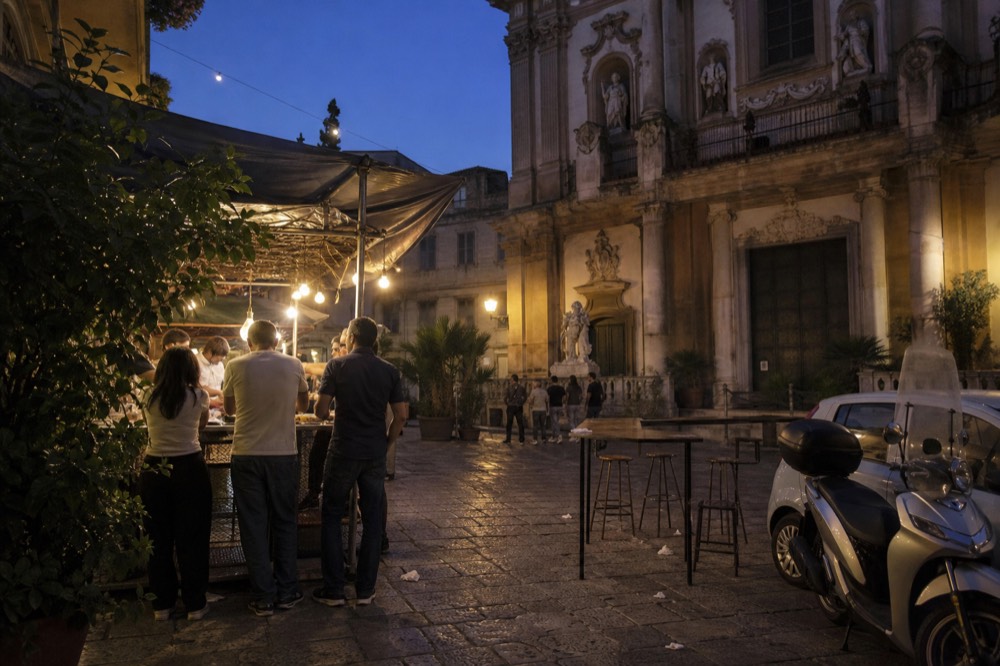
Palermo is famous above all for its fried street food, panelle, arancine, crocché and sfincione, followed by cannoli, cassata and granita with brioche, sold across four historic markets. The canon is documented on Italy's official PAT list of traditional products, prices run from a few euros at a friggitoria to a sit-down meal, and the best way to taste it all is a small-group walking tour.
Common Questions About Palermo's Famous Food
What Food Is Palermo Famous For?
Fried street food eaten standing up: panelle, arancine, crocché, sfincione and pane con la milza, sold across the four historic markets, followed by cannoli, cassata and granita with brioche. Most of the savoury canon and all three sweets are on Italy's official PAT list of traditional products, so the fame is documented, not just repeated.
What is the most Palermo food of all?
Panelle. It is the only item in the street food canon whose official PAT production territory is the city of Palermo itself, and the government technical sheet even fixes the batter at half a centimetre thick. The iris, a sweet fried dough filled with ricotta cream, is the other item whose official territory is Palermo.
Is Palermo famous for pizza?
Not primarily. The local bake is sfincione, which is PAT-listed and comes in a red Palermo version and a white Bagheria version that the town of Bagheria calls its symbol product. Palermo's pizza scene exists and is improving, with Saccharum in nearby Altavilla Milicia placing 27th nationally in the 50 Top Pizza Italia 2026 ranking, but sfincione is the answer a Palermitan gives first.
Can you eat well in Palermo without a tour?
Yes. The markets are free to enter, Ballarò trades Monday to Saturday from 07:30 to 20:00, and the historic centre is compact and walkable. A tour adds context, a vetted route past the reheated-arancini stalls, and small-group access to friggitorie you might not find alone, which is why many visitors take one walk and then explore solo.
What food is Palermo famous for that you cannot get elsewhere?
Panelle and iris are the two with Palermo as their official production territory. The cannolo, by contrast, has its official territory in the Trapani area, and the arancina is made across the whole island, so the truly Palermo-specific items are the humble fried ones, not the famous sweets.