What Is The Most Popular Street Food In Sicily?
The arancina is Sicily's most popular street food by reach, panelle is the most Palermo-specific, and the cannolo is the most famous sweet. Here is what the official records, the current prices and the tour roster actually say.
What Is The Most Popular Street Food In Sicily?
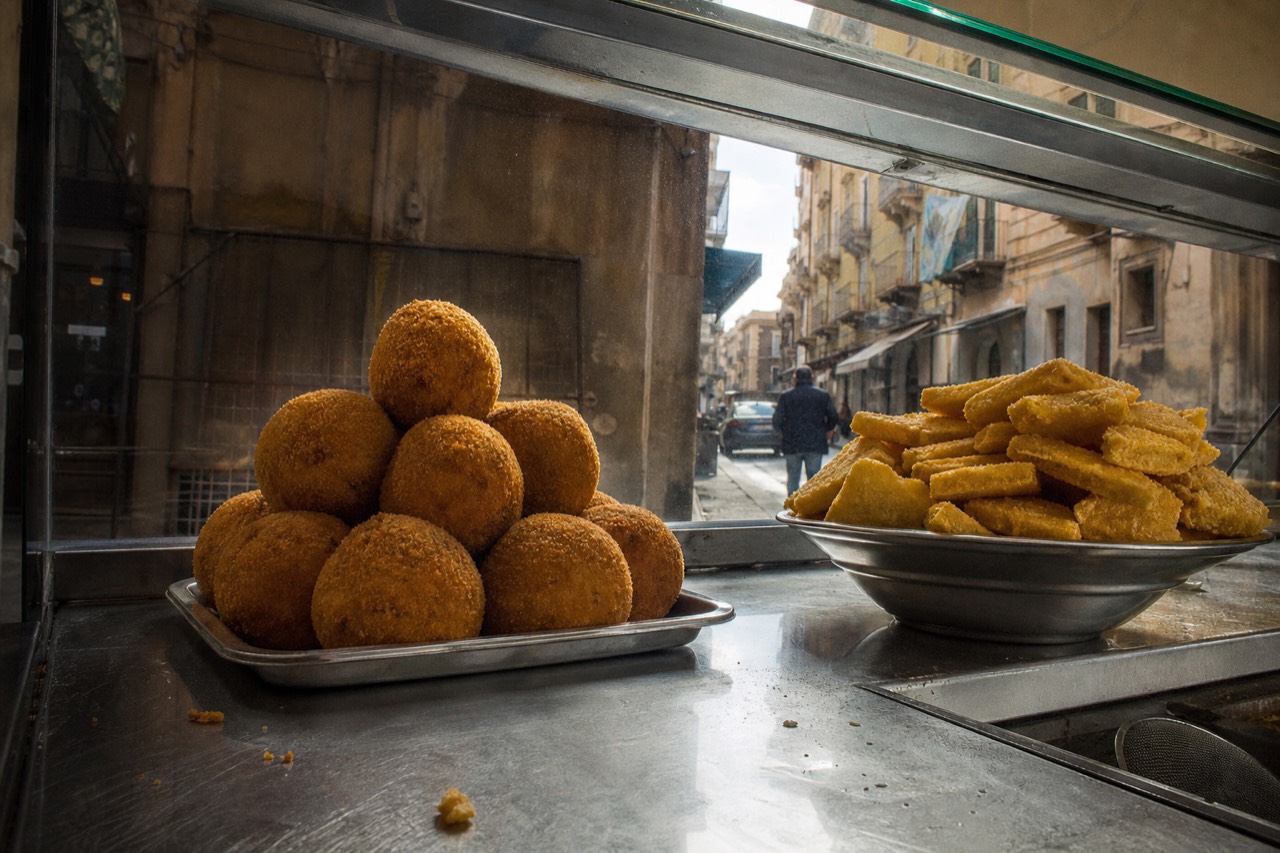
The arancina, or arancino as it is called in eastern Sicily, is the most popular street food on the island: a fried rice ball that appears in every town, in every friggitoria, and at every festival. Panelle, the chickpea fritter, is the most popular in Palermo specifically, and the cannolo is the most famous sweet sold on the street.
Popularity is easiest to measure by reach. The Regione Siciliana's official sheet for arancini di riso, the entry on Italy's national list of traditional foods, records the production territory as the whole island, which no other classic Sicilian street snack can claim. Wherever you are in Sicily, from Trapani to Syracuse, someone within walking distance is frying rice balls. That ubiquity, more than any poll or prize, is what settles the question.
Palermo narrows it. The panelle, a chickpea-flour fritter, is the one item on the traditional list whose official production territory is the city of Palermo itself and parts of its province, which makes it the most Palermitan thing you can eat standing up. The city's own tourism portal, describing the Capo market, lists the hawkers' wares as sfincione and sfincionello, pane con la milza, pane con le panelle and crocche di patate. Fried savouries are the local street food category, and the rice ball sits at the top of it. Our Palermo street food guide unpacks the full canon dish by dish.
One piece of context is worth knowing, because you will meet it everywhere. The often repeated claim that Palermo ranks fifth in the world for street food traces back to a 2012 Forbes article, which was itself reporting a reader survey run by a travel site called VirtualTourist that has since closed. It is a real piece of history rather than a live credential, and no newer verified global ranking has replaced it. The food does not need the list anyway.
If you would rather have a local walk you through all of this on the ground, these are the three formats worth comparing first.
Why Does Sicily Argue About Arancina Versus Arancino?
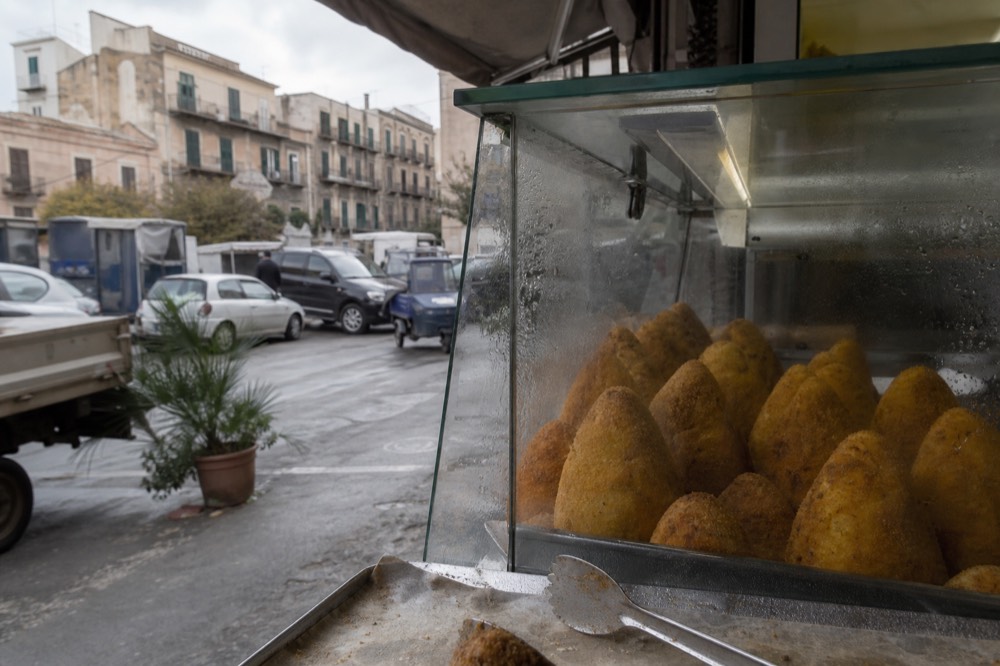
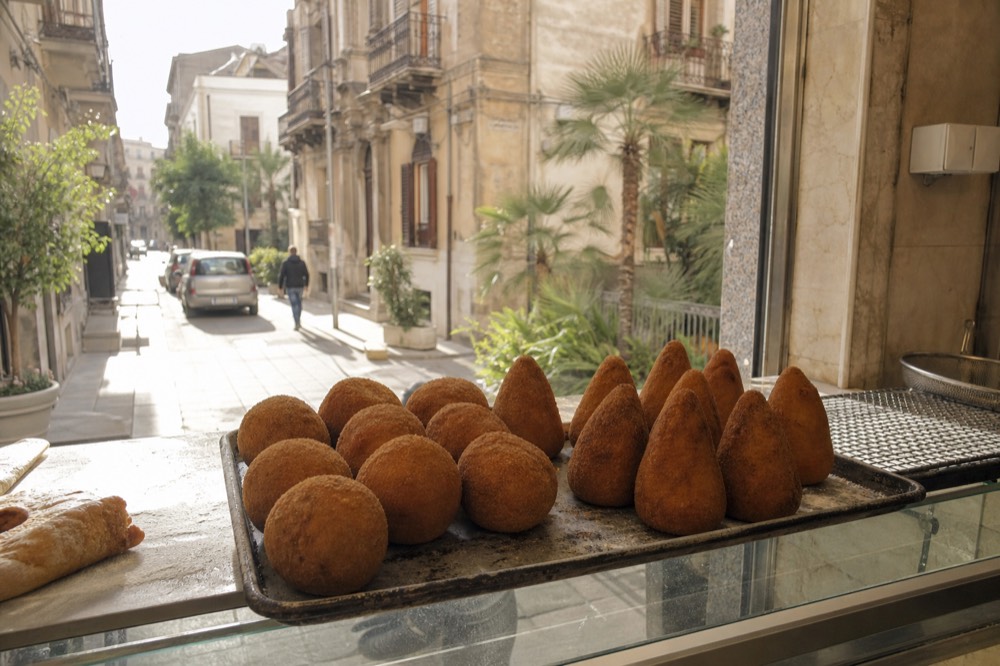
The Accademia della Crusca, Italy's foremost language academy, has settled the question: both forms are correct, and the split is geographic. Palermo and western Sicily say arancina, a round rice ball; Catania and the east say arancino, often cone shaped. The feminine west follows standard Italian grammar, while the masculine east follows the Sicilian dialect word for the fruit.
The academy's consultation on the question is worth reading in full, because it dismantles the origin story most pages repeat. The first Sicilian dictionary to record the word, Biundi's 1857 volume, defines arancinu as a sweet rice dish shaped like a bitter orange. Crusca's researchers found no trace of the preparation in literature, chronicles, diaries, dictionaries, ethnographic texts or recipe books before the second half of the 19th century, and neither meat nor tomato appears in the early records at all. On the Arab-origin story, the academy's conclusion is blunt: the link between the rice ball and Arab tradition "does not seem so certain", and the likelier account is a mid-1800s sweet that turned savoury almost immediately.
The grammar is the genuinely surprising part. Standard Italian pairs a masculine tree with a feminine fruit, so Palermo's arancina is the form that conforms to the national language, while the eastern arancino follows the Sicilian dialect word aranciu. The campanilismo runs exactly opposite to the grammar: the city that insists hardest on its own word is the one using the standard Italian form.
There is a calendar attached, too. The 13th of December, the feast of Santa Lucia, is marked in Palermo as Arancina Day, with the city consuming arancine al burro and alla carne in industrial quantities. We unpack the vocabulary fight in more detail in why Sicilians cannot agree on the name.
Which Sicilian Street Foods Are Officially Recognised As Traditional?
Italy keeps a national list of traditional foods, the PAT, and Sicily carries 293 entries on it as of the 2025 update. The street food canon on that list includes arancini di riso, panelle, crocche di patate, stigghiola, iris, sfincione and cannoli. To qualify, a preparation must have been made in a consistent traditional way for at least 25 years, which makes the list a useful filter against invented traditions.
The scheme was created under a 1998 legislative decree and is updated annually; the twenty-fifth national revision was issued in March 2025. Sicily's count of 293 products comes from the regional wine and oil institute's June 2025 edition of its quality-products survey. The bar is a real one: 25 years of documented, consistent production before anything earns a place.
The list is just as interesting for what it leaves off. Pani ca meusa, frittola, babbaluci, rascatura and sfincionello are all absent, even though the city's tourism portal lists pane con la milza among the Capo market's wares. Absence does not mean a food is not traditional; it means nobody has documented a quarter century of consistent production for the national register, or that the item sits outside the categories the register uses. Snails, for instance, do appear, listed as vaccareddi rather than the colloquial babbaluci.
Here is what the official sheets actually record for the core street items:
| Street food | What the official sheet records | Production territory |
|---|---|---|
| Arancini di riso | A rice product, typically spherical, filled with meat, or alternatively ham and mozzarella or spinach | The whole island |
| Panelle | A snack of varying shape made from chickpea flour, water, salt and pepper, spread half a centimetre thick before frying | The city of Palermo and parts of its province |
| Crocche di patate | Potato croquettes, listed in the gastronomy category | Not specified in the retrieved sheets |
| Stigghiola | Lamb intestine and caul fat with onion, pancetta and primo sale cheese; not to be consumed more than 72 hours after production | Not specified in the retrieved sheets |
| Iris | A round piece of Palermo rosticceria, sweet fried dough filled with ricotta cream | The territory of Palermo |
| Sfincione | Listed in the bakery, pastry and confectionery category | Not captured in the retrieved sheets |
| Cannolo | Ricotta inserted into a cylindrical fried shell, originally rolled around a piece of cane | Paceco, Erice, Trapani and Valderice |
The source for all of this is the regional government's own technical sheets, which are drier and more precise than any food blog. The stigghiola entry is a good example of their tone: the sheet offers, in its own hedged words, that the traditional version is very probably a legacy of past Jewish culinary culture. That is an official source hypothesising, not a fact, and it should be read as such.
Reading the canon is one thing; eating your way through it in a single afternoon is another, and that is exactly what a guided walk is for. A guide who knows which friggitoria fries to order and which has slipped into reheating can save you both money and disappointment, and most of the walks on the current roster allow free cancellation up to 24 hours before departure, so the commitment is small.
How Much Does Street Food Cost In Sicily?
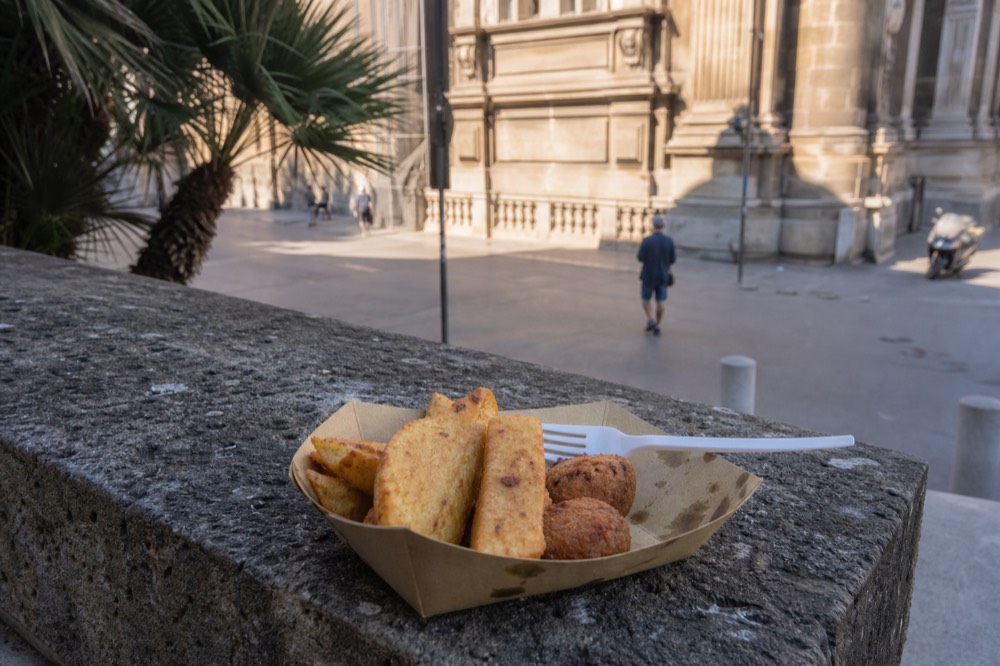
In Palermo's historic centre an arancina, or a panino with panelle and crocche, now runs 3 to 4.50 euros, and local press reporting notes that is roughly double the 2021 level. A brioche with gelato or granita commonly costs 4 to 5 euros. Outside the centro storico prices soften, and the markets remain the cheapest place to eat standing up.
The sharpest local reporting on this comes from the Sicilian press, which has been documenting the price squeeze in the centre. One analysis put pizza and a drink at an average of 14.56 euros in Palermo, in a range running from 9 to 28 euros, after a rise of about 60 per cent in five years, the sharpest increase recorded in any Italian city. The same reporting found the fried snacks at double their 2021 price, a shift it attributed to tourism.
The brioche has become a local controversy in its own right. When a brioche with gelato hit 5 euros in the Palermo area, local newspapers covered the backlash, with cones reported at 3 euros in one area. Sicilians read that as a traditional item pricing itself out of its own tradition. Visitors should read it as a ceiling rather than a norm.
Here is what the sourced figures add up to:
| Item | Reported figure | Where it comes from |
|---|---|---|
| Arancina, or panino with panelle and crocche | 3 to 4.50 euros in the centro storico | Local press reporting on Palermo prices, roughly double the 2021 level |
| Brioche with gelato or granita | 4 to 5 euros, with cones reported at 3 euros in one area | Local coverage of price complaints in the Palermo area |
| Pizza and a drink | 14.56 euros on average, range 9 to 28 | Local press analysis of centro storico menus |
| Cannolo | No reliably sourced citywide figure | The price is on the counter; treat any number you read online as a lead, not a fact |
A walking lunch of one arancina and one cannolo, eaten standing at a market counter, remains one of the cheaper meals in southern Europe even after the increases. If you would rather fold the cost of the tastings into a single booking, the cheapest guided option on the roster is the Palermo Street Food Walking Tour with Local Guide & Tasting by Hili srl: from $39.83 per person, 2.5 hours, rated 4.8 across 933 reviews, free cancellation up to 24 hours, and it often sells out.
Where Should You Actually Eat Street Food In Palermo?
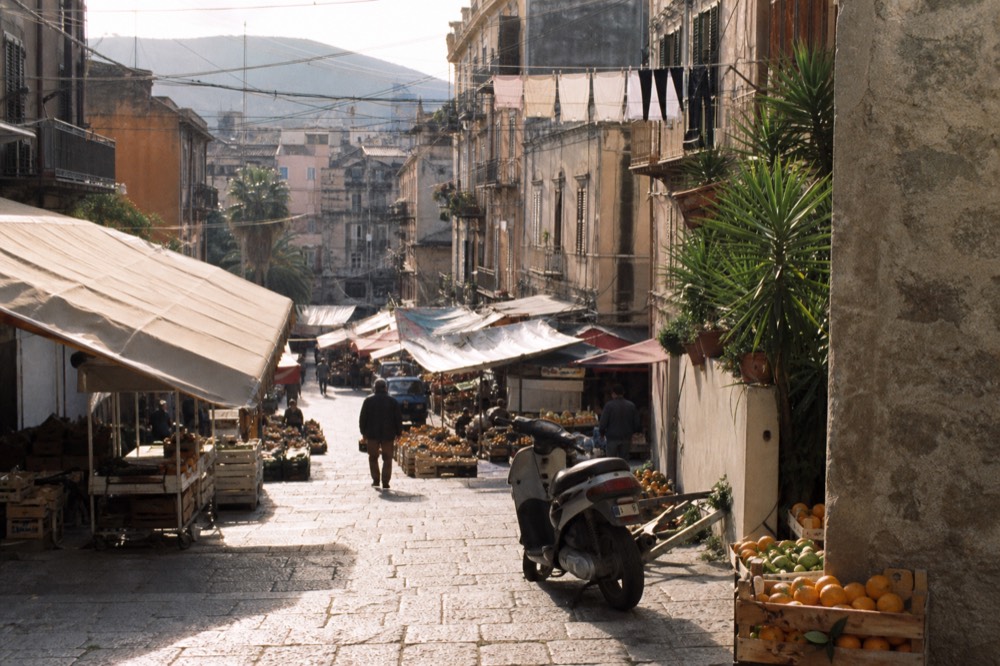
The city's own tourism portal names four historic markets, Ballaro, il Capo, la Vucciria and Borgo Vecchio, and the Capo is where it lists the classic fried street foods being sold by hawkers. Ballaro trades Monday to Saturday from 07:30 to 20:00, and mostly mornings only on Sunday. Recent visitor reports warn that some market stalls now reheat pre-made arancine, so the fryer matters more than the address.
The markets are the theatre as much as the kitchen. The shouted sales cry of the hawkers has its own Palermitan word, abbanniata, and the city's tourism portal calls listening to it part of the show. Ballaro, which the portal describes as the city's oldest and largest market, stretches from piazza Casa Professa to the bastions of corso Tukory, and its official hours are the most useful practical fact in the whole canon: 07:30 to 20:00, Monday to Saturday. Our guide to Palermo's markets covers all four in detail.
The picture is not static, and honest pages should say so. PalermoToday reported in March 2025 that the Vucciria has all but disappeared as a daytime food market, the Capo is slowly emptying and Ballaro is transforming, with traders quoted saying they have lost around 80 per cent of their custom, a figure that belongs to the traders rather than to any measurement. The same reporting described tourist street food replacing traditional stalls across the centre.
That shift has a practical consequence for visitors. One traveller's report from September 2025 described buying arancini at Ballaro and finding them microwaved and pre-made, with several stalls much the same; locals in the replies steered the visitor away from the market fryers and toward named friggitorie instead, with Passami u Coppu, nni Franco u Vastiddaru, Basile, I Cuochini and Bar Vabres recurring in local recommendations. The lesson is not that the markets are bad. It is that fried food is only as good as the fryer it comes out of, and a reheated arancina is a waste of both euros and appetite.
This is the gap a good guide closes, and it is the reason this site exists. The rest of Palermo Food Tours is built on exactly this problem: separating the fryers worth queueing at from the stalls reheating yesterday's batch. The most tasting-heavy option is the Secret Food Tours walk, with 10 or more tastings including arancini, cannoli and wine, from $89.33 per person over 3 hours 30 minutes, rated 5 across 782 reviews, and capped at 12 spots per departure.
Is A Guided Street Food Tour In Sicily Worth Booking?
A guided street food walk in Palermo costs between $39.83 and $89.33 per person across the group tours on the current roster, runs from 2.5 hours to 3 hours 30 minutes, and the best rated hold scores of 4.9 or 5 across hundreds to thousands of reviews. All but three of the tours on the wider roster allow free cancellation up to 24 hours, so the booking risk is low.
What a guide actually adds is a filter and a pace. The filter is the one described above: which counter, which fryer, which hour. The pace matters more than visitors expect, because Palermo's street food is dense and fried, and five stops in three hours is a different experience from eight stops attempted alone with no idea what to order next. Some walks are all-inclusive, with every tasting in the ticket price, while others mix paid tastings along the way; check which format you are booking before comparing prices.
Here is how the main options stack up:
| Tour | Operator | Rating | From per person | Duration | Cancellation |
|---|---|---|---|---|---|
| Palermo: Street Food Walking Tour with Local Guide & Tasting | Hili srl | 4.8 across 933 reviews | $39.83 | 2.5 hours | Free up to 24 hours |
| Palermo Sicilian Street Food Tour: Small Group | Do Eat Better Experience | 4.9 across 1355 reviews | $52.06 | 3 hours | Free up to 24 hours |
| Palermo: Street Food and History Walking Tour | Cavallaro Fabrizio | 4.9 across 1672 reviews | $56.91 | 3 hours | Free up to 24 hours |
| Palermo Food Tour: 10+ Tastings of Arancini, Cannoli, Wine & More | Secret Food Tours | 5 across 782 reviews | $89.33 | 3 hours 30 minutes | Free up to 24 hours |
| Palermo: Half-Day Cooking Class & Market Tour | Siciliandays | 4.8 across 63 reviews | $209.04 | 4 hours | Free up to 24 hours |
The Do Eat Better small-group tour is the middle path through that table: from $52.06 per person over 3 hours, rated 4.9 across 1355 reviews, capped at 12 guests per departure, with free cancellation up to 24 hours. It suits visitors who want the tasting density of the big walks without the top-end price.
For visitors who would rather make the food than walk between fryers, the Siciliandays half-day cooking class and market tour is the format shift: from $209.04 per person over 4 hours, rated 4.8 across 63 reviews, it pairs a market visit with a hands-on session. It is the most expensive card in the set, and it buys a different thing entirely.
Which Sicilian Sweets Count As Street Food?
The cannolo is the most famous, but its official PAT territory is the Trapani area, not Palermo: Paceco, Erice, Trapani and Valderice. The iris, by contrast, is listed with the territory of Palermo itself, a round piece of fried rosticceria filled with ricotta cream. Sfincione, sold by the slice, exists in a red Palermo tradition and a white version that Bagheria calls its symbol product.
The cannolo's name is literal: it comes from the cane, Arundo donax, around which the shell was originally rolled before frying. The official sheet specifies sheep's-milk ricotta for the filling, and the practical advice from recent first-hand reports is unanimous: the best cannoli are filled to order, not sitting pre-filled in a case. Local recommendations keep pointing to Piana degli Albanesi, in the hills behind Palermo, as the place with the strongest cannolo reputation, a view that recurs across traveller threads year after year.
Sfincione is where the official record is thinnest and the local pride loudest. The Comune di Bagheria's own festival page describes the white sfincione as the town's symbol product, alongside the red version of the Sicilian tradition. Beyond that framing, no authoritative topping list exists for either version, so treat any ingredient list you read online as one bakery's recipe rather than the recipe. Bagheria backs its claim with an annual festival in November.
The iris deserves more attention than it gets from English-language pages, because it is the one sweet on the traditional list whose territory is Palermo itself: a round piece of fried rosticceria, proved, rested, then filled with ricotta cream through a cut in the base. Granita, finally, is the breakfast item; the dictionary name records the granular look of the ice, and the brioche-and-granita pairing is described in Italian food writing as a standard Sicilian breakfast, especially in the east of the island.
None of this requires much of a plan beyond comfortable shoes and an appetite that peaks early, because the markets trade hardest in the morning and the best fryers sell out by early afternoon. Decide whether you want to navigate alone or hand the filtering to a local, book accordingly, and leave room for one more cannolo than seems sensible.
The short answers: the arancina is Sicily's most popular street food, panelle is the most Palermo-specific, and the cannolo is the most famous sweet. The naming split is geographic and both forms are correct, prices in the historic centre run 3 to 4.50 euros for fried savouries, and a guided walk is optional but cheap and easy to cancel. The questions below cover the details visitors ask most often.
Common Questions About Sicilian Street Food
What Is The Most Popular Street Food In Sicily?
The arancina in the west and the arancino in the east: the fried rice ball whose official production territory covers the whole island. In Palermo specifically, panelle run it close, and the cannolo is the most famous sweet.
Is it arancina or arancino?
Both are correct. The Accademia della Crusca's position is that the split is geographic: arancina, round, in Palermo and the west; arancino, often cone shaped, in Catania and the east.
What are panelle made of?
Chickpea flour, water, salt and pepper, per the official regional sheet, spread half a centimetre thick, cut cold into rectangles and deep fried.
What is the difference between red and white sfincione?
The Comune di Bagheria describes the white version as its symbol product and the red as the Sicilian tradition. Beyond that framing, no authoritative topping list exists, so treat any ingredient list you read as one bakery's recipe.
How much does street food cost in Palermo?
Roughly 3 to 4.50 euros for an arancina or a panelle panino in the historic centre, about double the 2021 level. A brioche with granita runs 4 to 5 euros.
Do I need to book a food tour?
No, but the walks start from $39.83 per person, the best rated often sell out, and most allow free cancellation up to 24 hours, so there is little cost to reserving a spot early.